Tú me regresas el aliento.
Eddie
Tú me regresas el aliento.
Eddie
Ha sido un día largo…
Eddie
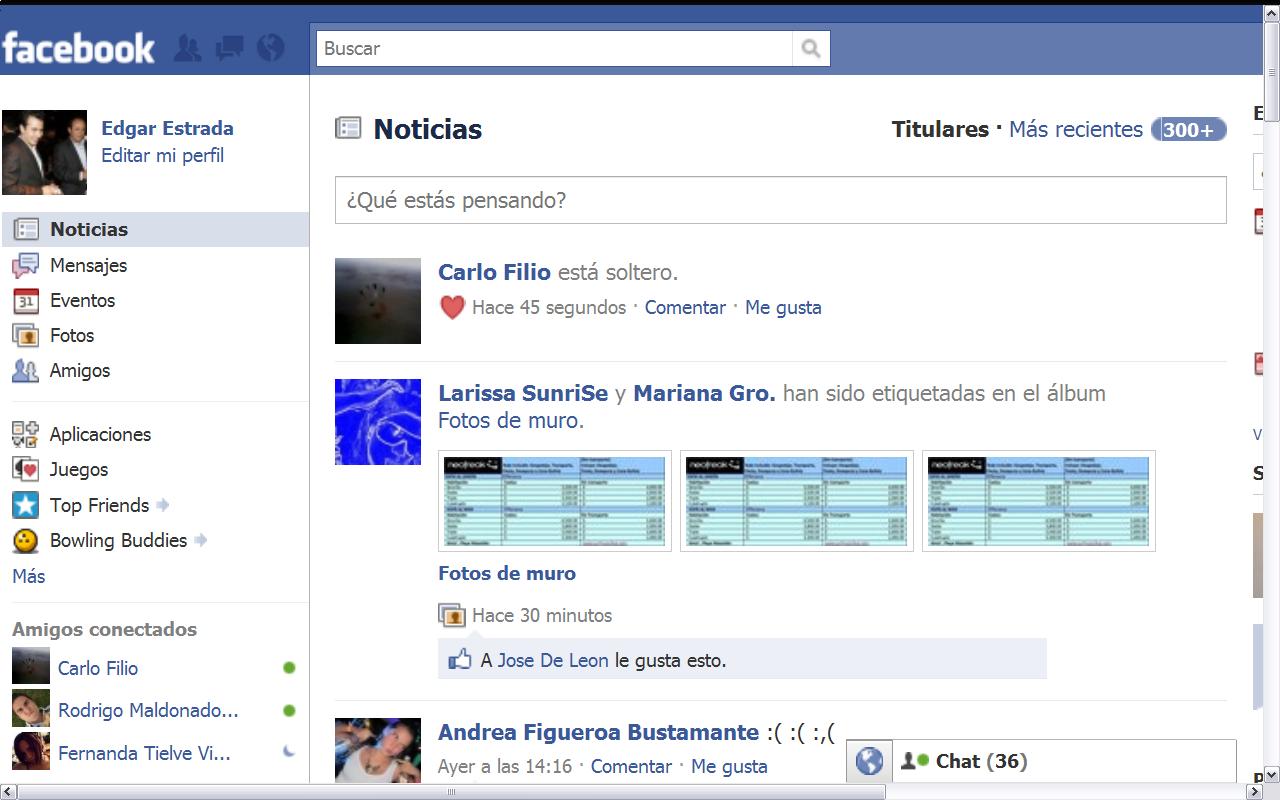
Continuando con esta observación podemos ver que sólo unas horas después incluso unos minutos después la gente no pudo evitar comentar al rededor del tema, y lo curioso es que algunas personas comentaron que les parecía buena esta separación.
Sin saber que es simplemente una charada, será de alguna manera una manera de ofrecer apoyo a un amigo, o simplemente un mensaje sutil de «aqui estoy» en fin. Creo que este tipo de información es algo que debería formar de las relaciones interpersonales de cada quien. Algunas situaciones no deberían ser objeto de opinión de todas las personas a nuestro al rededor.

Si decides comprometerte con una mujer, ¡hazlo! de lo contrario es mejor aguardar con calma en soltería.
No solo es importante cumplir los compromisos porque de esta manera la gente dará crédito a nuestras palabras, si no que solo de esa manera seremos capaces de demostrarnos a nosotros mismos, que existimos, pero además que otros seres, no necesariamente humanos, pueden considerarnos dignos de compartir el tiempo y el espacio presente sin temernos y sin atacarnos.
El romper una promesa o faltar a un compromiso conlleva consecuencias irreparables, la decepción y la desconfianza son manchas, como lunares que se tatúan en la piel de quién miente o falla. Y no solo la persona a quien se ha traicionado sale lastimada sino que el concepto que la gente que sabe tiene de aquel que ha fallado también provoca el mismo terror que a quien se lastima.
Es por esto que quiero aclarar que nada de malo tiene actuar conforme a los deseos personales y sueños, sin embargo en el momento que alguien cede parte de su independencia como carta de crédito a una sarta de nuevos beneficios, entonces deberá actuar de acuerdo al compromiso previamente estipulado.
Un compromiso es la única manera que tenemos los seres humanos de los demás animales de la naturaleza, romperla nos hace no solo animales sino peores, pues se puede inferir, de manera correcta o no, que se actuó con malicia y dolo.
Es decisión personal llevar una consciencia que comulgue con los deseos y los sueños personales, que den lo que esperan a recibir, o vivir una doble vida como parece exigir la sociedad seguir alimentando nuestro ego, robando la inocencia y aprovechándose de su buena voluntad.
Yo decido comprometerme, primero conmigo. Ya es tiempo.
Video marketing has become one of the best promotional tools on the web. Well-executed videos can grab attention faster than any other advertising medium as videos continue to draw internet users in droves. Research by eMarketer shows 66.7 percent of the 147.5 million U.S. internet users watch video online monthly. By 2014, eMarketer estimates that number will rise to 77 percent of internet users (193.1 million people). 
Online video has surged in popularity due to the rapid proliferation of broadband and video technology advances. This has resulted in the production of cost-effective, premium videos, a dramatic increase in traffic to video-sharing sites, and online video’s acceptance into the mainstream.
Consumers are receptive to video on websites, landing pages, search results pages, emails, and video-sharing sites because it is so engaging and self-explanatory. Video conveys information quickly and accurately, making it an excellent tool for marketers because consumers want to know more about the companies they deal with and the products/services they buy. Video is a very memorable medium. A study by The Wharton School of Business revealed that video improves comprehension and retention by 50 percent over a live presentation. Other studies have indicated that video speeds up buying decisions by 72 percent when compared to print. Therefore, company and product information communicated in videos can generate more leads and ecommerce sales.
The effectiveness of video advertising
It’s well-known that video ads increase traffic and conversions. This has been documented by both online research firms as well as video solution providers. Here are a few key findings from some studies:
.Fox Networks and comScore (January 2010)
In March of this year, comScore found video generates higher lift than display ads in a study directly comparing the effectiveness of video and display. 
When comparing the ad effectiveness of video vs. Flash companion banners, Dynamic Logic (2010) found that video is more effective than display when measuring brand lift.
Dynamic Logic (2004), in a classic brand awareness study based on more than 1,500 online ad campaigns from more than 1.7 million respondents, found that online video ads achieved greater branding with fewer impressions than all types of banner ads .
. 
Time and again, studies indicate video is an effective marketing tool that can be shared easier than any type of media. It’s no wonder online video advertising has experienced robust growth since 2006.
Growth of video ad dollars
The 2009 IAB Internet Advertising Revenue Report (PDF) indicated digital video ad spending increased 39 percent to $1 billion in Q4 2009. In 2007, Forrester predicted U.S. online video advertising spending would reach $7.1 billion in 2012, with the retail/wholesale and travel/hospitality industries spending the most on video advertising.
The 2010 eMarketer study mentioned earlier states that spending on online video advertising will increase from $1.4 billion to $5.2 billion between 2008 and 2014. While video advertising is still a fraction of the total internet advertising spend (4 percent in 2009), video is on the rise as a web marketing medium.
Video marketing on the web
Online video has come a long way since the user-generated videos on YouTube. Video is being used in many new and different ways, such as professional video resumes and personal videos for dating. The use of marketing videos online is on the rise due to the interactive, mnemonic, and storytelling features of video. Let’s review a sampling of the marketing uses of video.
Short corporate videos are a hot new format that can be used to promote your business with a little online branding. Research shows that people prefer to watch a video rather than read about your company online. This type of video is displayed on your site to capture the essence of your business, and it gives connecting with your customers, prospects, and stakeholders a personal touch.
These short videos are easy and economical to create and can increase your website response as much as four-fold. One source of excellent online video production is CorpShorts, which produces customized corporate videos. Another source is Spotzer, which offers affordable videos that can be tagged with a business name.
Video interactive banner ads can be used to extend TV campaigns onto the web. Television advertisers can transform their commercials into interactive ads through video advertising technologies like Veeple, Innovid iRolls, or Mixpo.
Veeple makes anything in a video clickable by adding clickable elements to static videos through overlays that make the ads interactive. Innovid iRolls add post-production interactive objects to pre-roll video ads, providing rollover functionality for special offers and sales info. Mixpo transforms a TV spot into an interactive «Xspot» ad by adding overlays that make the video interactive with clickable objects, a call-to-action, or links to the end of the conversion funnel.
Video hot spots allow consumers to scroll over a product in the video to view an ad, click a link with product detail information, or purchase the product directly. A caption with details about the item appears over the product when the user scrolls over the hot spot. This is an unobtrusive way for marketers to reach consumers watching videos of their own choosing. However, this requires product placement efforts.
Videos with buy buttons can be created with Adobe’s new Creative Suite 5, which provides a user-friendly way to build these Flash-enabled applications and deploy them across multiple ecommerce and m-commerce platforms without having to work with software code. This product builds on the omnipresence of Flash across the web.
Read more at: http://www.imediaconnection.com/content/26656.asp


Desde hace ya algunos meses he venido discutiendo con un gran número de personas el imapcto de las interacciones sociales virtuales por medio de facebook especificamente. El día de hoy se pone a prueba uno de estos paradigmas en los que una persona que sostiene una relación de pareja, cambiará su estado a «soltero» sólo para conocer las posibles reacciones que esto generará en su red social y en su pareja.
En el Blog de Eddie daremos seguimiento a estas interacciones e iremos comentando lo que sucede.
Eddie

Como todas las semanas, FIFA.com abre el espacio para la expresión de sus lectores. Sin embargo, en esta oportunidad, queremos consultarte sobre un tópico distinto y particular: el Álbum Virtual de cromos de la Copa Mundial de la FIFA Sudáfrica 2010. ¿Ya lo estás coleccionando? ¿Cuál es la pegatina más complicada de conseguir?
Hicieron falta apenas un par de días para que el Álbum Virtual de Cromos de la Copa Mundial de la FIFA se convirtiera en una verdadera obsesión. La novedad, esperada por los fanáticos de todo el mundo, corrió como el agua y ya es todo un éxito entre nuestros usuarios. Ahora ha llegado el tiempo de tu opinión: ¿cuál es la pegatina más deseada? Esa que, en cuanto llegue, te hará más feliz que el resto… No seas tímido y comparte tu deseo, ¡otro podría leerlo aquí y ofrecerte un intercambio! ¿Se trata de tu jugador favorito? ¿Tal vez te emocione el logo de tu selección? ¿Te obsesiona el Trofeo de la Copa Mundial de la FIFA?
El espacio, como de costumbre, está abierto para que los internautas intercambien impresiones. Ya sabes lo que tienes que hacer: ¡haz clic en “Añade tu comentario” y cuéntanos cuál es la pegatina que no puedes sacar de tu cabeza!
Si todavía no estás coleccionando el Álbum de cromos Virtual de la Copa Mundial de la FIFA, todavía estás a tiempo. ¡Haz clic en el enlace de la derecha y comienza a abrir paquetes!
lee más en: http://es.fifa.com/worldcup/news/newsid=1204494/index.html#el+cromo+suenos
Did man really walk on the Moon or was it the ultimate camera trick, asks David Milne? The greater lunar lie. feetIn the early hours of May 16, 1990, after a week spent watching old video footage of man on the Moon, a thought was turning into an obsession in the mind of Ralph Rene.

“How can the flag be fluttering,” the 47 year old American kept asking himself, “when there’s no wind on the atmosphere free Moon?” That moment was to be the beginning of an incredible Space odyssey for the self-taught engineer from New Jersey. He started investigating the Apollo Moon landings, scouring every NASA film, photo and report with a growing sense of wonder, until finally reaching an awesome conclusion: America had never put a man on the Moon. The giant leap for mankind was fake.
It is of course the conspiracy theory to end all conspiracy theories. But Rene has now put all his findings into a startling book entitled NASA Mooned America. Published by himself, it’s being sold by mail order – and is a compelling read.
The story lifts off in 1961 with Russia firing Yuri Gagarin into space, leaving a panicked America trailing in the space race.
At an emergency meeting of Congress, President Kennedy proposed the ultimate face saver, put a man on the Moon. With an impassioned speech he secured the plan an unbelievable 40 billion dollars. And so, says Rene (and a growing number of astro-physicists are beginning to agree with him), the great Moon hoax was born.
Between 1969 and 1972, seven Apollo ships headed to the Moon. Six claim to have made it, with the ill fated Apollo 13–whose oxygen tanks apparently exploded halfway–being the only casualties.
But with the exception of the known rocks, which could have been easily mocked up in a lab, the photographs and film footage are the only proof that the Eagle ever landed. And Rene believes they’re fake. For a start, he says, the TV footage was hopeless. The world tuned in to watch what looked like two blurred white ghosts gambol threw rocks and dust. Part of the reason for the low quality was that, strangely, NASA provided no direct link up. So networks actually had to film “man’s greatest achievement” from a TV screen in Houston–a deliberate ploy, says Rene, so that nobody could properly examine it.
By contrast, the still photos were stunning. Yet that’s just the problem. The astronauts took thousands of pictures, each one perfectly exposed and sharply focused. Not one was badly composed or even blurred. As Rene points out, that’s not all:
Award winning British photographer David Persey is convinced the pictures are fake. His astonishing findings are explained alongside the pictures on these pages, but the basic points are as follows:
David Persey believes the mistakes were deliberate, left there by “whistle blowers”, who were keen for the truth to one day get out. If Persey is right and the pictures are fake, then we’ve only NASA’s word that man ever went to the Moon. And, asks Rene, why would anyone fake pictures of an event that actually happened?
The questions don’t stop there. Outer space is awash with deadly radiation that emanates from solar flares firing out from the sun. Standard astronauts orbiting earth in near space, like those who recently fixed the Hubble telescope, are protected by the earth’s Van Allen belt. But the Moon is 240,000 miles distant, way outside this safe band. And, during the Apollo flights, astronomical data shows there were no less than 1,485 such flares.
John Mauldin, a physicist who works for NASA, once said shielding at least two meters thick would be needed. Yet the walls of the Lunar Landers which took astronauts from the spaceship to the moons surface were, said NASA, “about the thickness of heavy duty aluminum foil”. How could that stop this deadly radiation? And if the astronauts were protected by their space suits, why didn’t rescue workers use such protective gear at the Chernobyl meltdown, which released only a fraction of the dose astronauts would encounter? Not one Apollo astronaut ever contracted cancer–not even the Apollo 16 crew who were on their way to the Moon when a big flare started.
“They should have been fried,” says Rene. Furthermore, every Apollo mission before number 11 (the first to the Moon) was plagued with around 20,000 defects a-piece. Yet, with the exception of Apollo 13, NASA claims there wasn’t one major technical problem on any of their Moon missions. Just one defect could have blown the whole thing. “The odds against this are so unlikely that God must have been the co-pilot,” says Rene.
Several years after NASA claimed its first Moon landing, Buzz Aldrin “the second man on the Moon”–was asked at a banquet what it felt like to step on to the lunar surface.
Aldrin staggered to his feet and left the room crying uncontrollably. It would not be the last time he did this. “It strikes me he’s suffering from trying to live out a very big lie,” says Rene. Aldrin may also fear for his life. Virgil Grissom, a NASA astronaut, was due to pilot Apollo 1. In January 1967, he baited the Apollo program by hanging a lemon on his Apollo capsule (in the US, unroadworthy cars are called lemons) and told his wife Betty: “if there is ever a serious accident in the space program, it’s likely to be me.”
Nobody knows what fuelled his fears, but by the end of the month he and his two co-pilots were dead, burnt to death during a test run when their capsule, pumped full of high pressure pure oxygen, exploded. Scientists couldn’t believe NASA’s carelessness–even a chemistry student in high school knows high pressure oxygen is extremely explosive. In fact, before the first manned Apollo fight even cleared the launch pad, a total of 11 would be astronauts were dead. Apart from the three who were incinerated, seven died in plane crashes and one in a car smash. Now this is a spectacular accident rate.
“One wonders if these ‘accidents’ weren’t NASA’s way of correcting mistakes,” says Rene. “Of saying that some of these men didn’t have the sort of ‘right stuff’ they were looking for.”
NASA won’t respond to any of these claims, their press office will only say that the Moon landings happened and the pictures are real. But a NASA public affairs officer called Julian Scheer once delighted 200 guests at a private party with footage of astronauts apparently on a lunar landscape. It had been made on a mission film set and was identical to what NASA claimed was they real lunar landscape.
“The purpose of this film,” Scheer told the enthralled group, “is to indicate that you really can fake things on the ground, almost to the point of deception.” He then invited his audience to “come to your own decision about whether or not man actually did walk on the Moon”. A sudden attack of honesty? You bet, says Rene, who claims the only real thing about the Apollo missions were the lift offs. The astronauts simply have to be on board, he says, in case the rocket exploded. “It was the easiest way to ensure NASA wasn’t left with three astronauts who ought to be dead,” he claims, adding that they came down a day or so later, out of the public eye (global surveillance wasn’t what it is now) and into the safe hands of NASA officials, who whisked them off to prepare for the big day a week later.
And now NASA is planning another giant step–project Outreach, a one trillion dollar manned mission to Mars. “Think what they’ll be able to mock up with today’s computer graphics,” says Rene chillingly. “Special effects was in its infancy in the 60’s. This time round will have no way of determining the truth.”
Space oddities:

X-rays above my head,
imagined better,
more than one second,
earned by the years,
nothing else matters,
and thats all I want.
 EDI TIMES