Balcones cerrados

Se escuchan los gritos, el llanto y los sollozos. Se ven unas manos agitandose con fuerza en la sombra que dibujan sobre la pared del comedor. En la barra de la cocina la gran ensaladera luce color ceniza frente la apasionada discusión que sostienen.

Sé que están ahí pero no los miro, los oigo pero trato de no escuchar, como me gustaría estar en otro lado. Como en la playa de Veracruz con mi tía Magnolia, mi madre con esa hermosa falda de colores y los cabellos sueltos y alborotados, mi padre con el tío Gastón bebiendo cerveza y revolviendome los cabellos mientras juego con mis primos, todo bajo un calido Sol que da la sensación de que nada puede salir mal.

Mi madre se sienta sola sobre el sillón que esta frente a mí y enciende un cigarro, sabe que estoy frente a ella pero trata de no mirarme, sus labios tiemblan de coraje y sus ojos estan a punto de romperse en lagrimas. Ya no escucho a mi padre, ya no se mueve la sombra de sus manos contra la pared del comedor.

Mi madre mira hacia la inmesidad como escapando de si misma, no sé si es porque lucha y si es porque ha dejado de luchar. Las espriales del humo del cigarro dibujan en el aire enrarecido de la sala unas formas tristes, crean formas curvas que desdibujan los recuerdos de mi corta niñez y de una pareja de novios. Unos novios que se arrebataron a la vida y nadaron contra corriente, que fueron fugacez y hermosos, arrogantes como arrogantes son los jovenes e intempestivos como las almas viejas o muy jovenes. Y que el tiempo y la realidad les fueron moldeando sus alas en piernas y su fuego en forma de civilidad, se volvieron buenos ciudadanos y piezas del grenaje social.

Así, hoy que llueve suave y silencioso dentro de la gran ciudad, las ventanas se ven mojadas, salpicadas como si alguien les estuviera mojando, los balcones permanecen cerrados y la voluntad esta callada observando.

Mi madre se levanta del sillón, ni me mira y se dirije a su habitación, mi padre no está para contarme cuentos esta noche, se oscurece en la sala de estar, tomo una fruta de la barra de la cocina, siento una extraña sensación en mi pecho, pero no se que es, no se siente como los raspones en las rodillas, ni los gritos de las misses, esto es algo que no había sentido jamas.

Es hora de ir a la cama, a oscuras me dirijo a mi cama y tengo mucho miedo, al fin, sólo tengo 7 años.

¡A generar tráfico como locos!


La verdad no soy un blogero profesional ni ningún ingeniero en sistemas y programación avanzada. Pero gracias al acercamiento que he tenido en los últimos meses al marketing digital, la publicidad en línea, las redes sociales (social media) he podido desarrollar sencillas herramientas que generan ingresos.

Todo Publisher, Blogger, Artista o cualquier persona con algo de tiempo libre para generar un sitio en internet, ya sea de manera profesional o como aficionado, tienen algo en comun: Generar visitas.

Que la gente vea nuestro contenido, lo disfrute, y si se puede que compre el servicio que ofrecemos, que haga click en los anuncios que colocamos, o que le diga a sus amigos de nuestro sitio. Esto no es poca cosa, yo misma vivo gracias a trabajar en una pàgina de internet, (no está en efecto) y por lo tanto sé de los alcances que tiene la web 2.0.

Lo más sorprendente es que cualquier persona con un equipo medianamente funcional con funciones de red y una conexión promedio a internet, puede generar contenidos, vertir opiniones, anunciar su trabajo, promocionar productos y generar ingresos. Así es dinero desde internet.

Existen numerosas herramientas para lograrlo, desde codigos que implementados en tu sitio generan anuncios, hasta codigos que metes en tu página y cuentan las visitas, las gestiona y te genera datos bastante relevantes.

Para los asiduos interneters, lo que estoy diciendo parece algo lógico y que todo el mundo sabe, pero la realidad es que, por lo menos en México la gente aún no tienen idea del potencial que tiene la red de redes sobre todo en el ámbito económico y social. En unos pocos años, estoy seguro que los que hoy entienden lo que digo, sabrán que tienen sus ventajas ser uno de los primeros en saberlo.

Proximamente estaré compartiendo mis experiencias y algunos consejos para los que crean que es hora de volverse virtuales y omnipresentes.

Denial of Service Attack Knocks Twitter Offline (Updated)

(By: Wired.com)
By Eliot Van Buskirk
August 6, 2009
10:06 am
Categories: Social Media

Twitter was shut down for hours Thursday morning by what it described as an “ongoing” denial-of-service attack, silencing millions of Tweeters. It’s the first major outage the service has suffered in months and possibly the first ever due to sabotage. The outage appeared to begin mid-morning, EST, and affected users around the world.

The first official word about the outage came in a terse statement on Twitter’s status blog: “Site is down — We are determining the cause and will provide an update shortly.” That was followed by a more relaxed post on the main Twitter blog by co-founder Biz Stone, which nevertheless gave no indication of how the defense was going — or how long the service might be down.

“On this otherwise happy Thursday morning, Twitter is the target of a denial of service attack,” wrote Stone. “Attacks such as this are malicious efforts orchestrated to disrupt and make unavailable services such as online banks, credit card payment gateways, and in this case, Twitter for intended customers or users. We are defending against this attack now and will continue to update our status blog as we continue to defend and later investigate.”

A spokeswoman for Spark Capital, a major investor in Twitter, wouldn’t offer an official statement but implied that the company isn’t overly concerned about the outage and expects the site to come back online soon.

In a denial-of-service attack, a malicious party barrages a server with so many requests that it can’t keep up, or causes it to reset. As a result, legitimate users can only access the server very slowly — or not at all, as appears to be the case here.

Not only was the site down, but client applications that depend on the Twitter API could also not connect to the service, creating a complete Twitter blackout. According to June ComScore numbers Twitter has more than 44 million registered users and its user base has been growing rapidly for months as it becomes better known in the mainstream.

In the early minutes of the outage, we confirmed it in two New York boroughs and received word that it was down in Brazil as well. At that point, Twitter apparently didn’t know what had hit it. Subsequently readers saying they were in Russia, Denmark, Chile, the UK, Hong Kong, France and the Netherlands all weighed in below. Some were taking it in stride — “Too many toilets flushing tweets!” wrote one, in reference to a Wired.com story. Others urged the rest of us to “get a life.”

The world won’t come to a complete standstill as a result of the Twitter outage, of course, but its impact will be felt far and wide. The popular short messaging service has become an integral part of the communications ecosystem — our first question was, how do you confirm Twitter is down without Twitter? — and from its millions of inveterate users, we expect an outpouring of pent-up Tweeting when this gets sorted out.

An extended outage could have an impact on the spread of information — videos, music, and articles like this one — to say nothing of a growing number of businesses which depend on the service. The resiliency of the service as it begins to fashion a business plan and cater to enterprise customers would also be a concern to Twitter, which, in the glamorous tradition of Silicon Valley startups, makes no money but has big ambitions.

Twitter hasn’t had a significant outage since May 8, and has shown improved reliability since last year, when such outages were a regular occurrence. The last scheduled maintenance we know about was on June 16 — delayed by a day at the urging of the US State Department. This was during the height of the anti-government protests in Iran, much information was being disseminated to the world via Twitter, and the maintenance window, in the middle of the night in California, would have been prime daylight hours in Tehran.

We experienced a seemingly unrelated problem when accessing the Twitter blog through Google. The page greeted one Wired.com employee with an error message beginning “We’re sorry… but your query looks similar to automated requests from a computer virus or spyware application. To protect our users, we can’t process your request right now.” Another Wired.com employee was able to access the page as usual, with no virus warning. But with other users encountering the same error message, we wondered whether today’s Twitter outage was somehow related to Google’s virus warning. Judging from Twitter’s admission that it is under a denial-of-service attack, that appears to have been the case.

Why Is Obama’s Top Antitrust Cop Gunning for Google?

(By: Wired.com)


Christine Varney’s blunt assessment sent a buzz through the audience at the National Press Club in Washington, DC. Varney, a partner at Hogan & Hartson and one of the country’s foremost experts in online law, was speaking at the ninth annual conference of the American Antitrust Institute, a gathering of top monopoly attorneys and economists. Most of the day was filled with dry presentations like «Verticality Regains Relevance» and «The Future of Private Enforcement.» But Varney, tall and professorial, did not hide her message behind legalese or euphemism. The technology industry, she said, was coming under the sway of a dominant behemoth, one that had the potential to stifle innovation and squash its competitors. The last time the government saw a threat like this—Microsoft in the 1990s—it launched an aggressive antitrust case. But by the time of this conference, mid-June 2008, a new offender had emerged. «For me, Microsoft is so last century,» Varney said. «They are not the problem. I think we are going to continually see a problem, potentially, with Google.»

Coming from Varney, it was a particularly damning comparison. As an attorney who represented Netscape in the late 1990s, she was instrumental in painting Bill Gates and company as overeager bullies. Now, Varney was suggesting that Google was repeating Microsoft’s expansionist behavior. Instead of dominating the desktop, Varney said, Google was starting to colonize the emerging cloud-computing industry, amassing «enormous market power» and potentially creating an ecosystem that customers would be powerless to escape. She acknowledged that her remarks might ruffle some feathers at Google headquarters in Mountain View, California. «If any of my colleagues or friends from Google are here,» she said, «I invite you to jump up and scream and yell at me.»

Nobody took her up on that offer. But it is safe to assume that plenty of Googlers were jumping and screaming six months later when President Obama appointed Varney head of the Justice Department’s antitrust division, making her the government’s most powerful antimonopoly prosecutor. On May 11, during her first public speech on the job, Varney made it clear that her stance had not changed much since her presentation at the conference: She planned to take a forceful approach to applying the nation’s antitrust laws. «In the past, the antitrust division was a leader in its enforcement efforts in technology industries, and I believe we will take this mantle again,» she said. She did not mention Google by name, but there was little doubt to whom she was referring.

Ever since its founding 11 years ago, Google has seen itself as one of the Good Guys. Founders Larry Page and Sergey Brin conceived their company as a kind of public trust. «We believe a well-functioning society should have abundant, free, and unbiased access to high-quality information,» they wrote in the run-up to Google’s IPO five years ago, a goal that requires «a company that is trustworthy and interested in the public good.» They created a touchy-feely work environment with perks like onsite laundry facilities and free food. Prospective hires were grilled on not just their technical expertise but also their ethics—whether they were «Googley.» Google’s self-image was pithily summed up in its famous founding credo: «Don’t be evil.»

For most of its history, investors, users, and tech gurus shared Google’s view of itself. After all, the company’s rise to prominence—on the back of search algorithms so powerful and elegant they changed the Internet forever—is a case study in heroic entrepreneurialism. Its long-tail business model gives even the smallest Web sites a chance to make money. It routinely creates and distributes great products for free, even when there is no obvious benefit to the company. Its spirit of openness and collaboration laid the groundwork for the mash-upable, user-generated modern Web.
But recently, Google’s size and ambitions have begun to obscure its halo. Advertisers have watched nervously as the company’s share of the search-advertising market has jumped to 75 percent from 50 percent over the past three years. In 2007, Google attracted a yearlong antitrust review from US and European regulators after it announced plans to acquire online ad firm DoubleClick. In 2008, the DOJ swatted down a search-ad deal Google had made with Yahoo, arguing that it «would have furthered [Google’s] monopoly.» The company is currently under investigation by the DOJ for its ambitious book-scanning project, which aims to make every book ever published searchable on Google. And the Federal Trade Commission is looking into whether the Apple board seats held by Google CEO Eric Schmidt and board member Arthur Levinson violate federal antitrust law.

For much of its history, Google has responded to most criticism with two words: Trust us. The company has repeatedly persuaded skeptics that its immensity is a mere byproduct of its altruistic mission and that the algorithms it uses to organize the Internet, while proprietary, are objective and benevolent. But in an economy destroyed by bad faith, secretive formulas, and complicated mathematics, trust is in short supply, and Google’s assurances are losing their persuasive power. More than 15 years ago, federal regulators began making Microsoft the symbol of anticompetitive behavior in the tech industry. Now, a newly activist DOJ may try to do the same thing to Google.

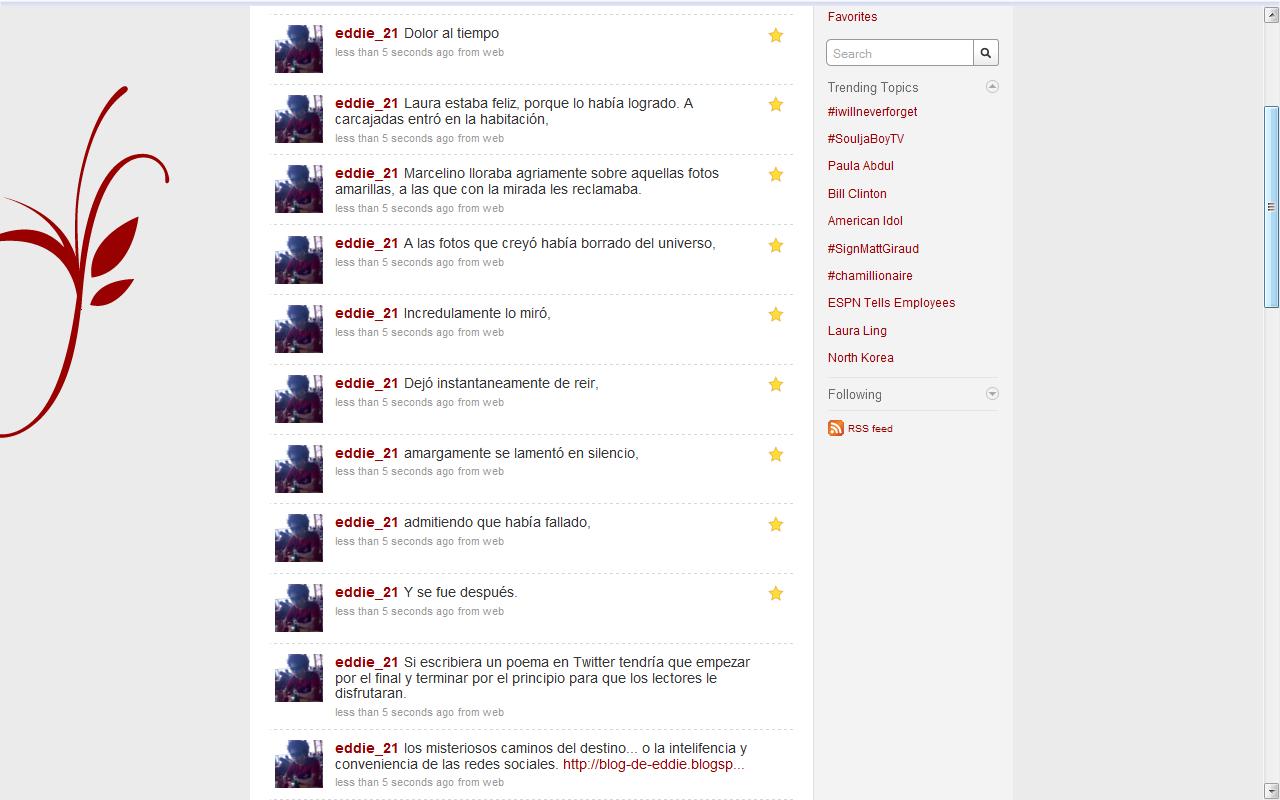
Twetting poetry (reedited) "Dolor al tiempo"

Home

* Inbox
* Sent

0 more result since you started searching. Refresh to see them.

1.
Edgar Estrada
eddie_21:Dolor al tiempo
less than 5 seconds ago from web

2.
Edgar Estrada
eddie_21:Laura estaba feliz, porque lo había logrado. A carcajadas entró en la habitación,
less than 5 seconds ago from web

3.
Edgar Estrada
eddie_21:Marcelino lloraba agriamente sobre aquellas fotos amarillas, a las que con la mirada les reclamaba.
less than 5 seconds ago from web

4.
Edgar Estrada
eddie_21: A las fotos que ELLA creyó había borrado del universo,
less than 5 seconds ago from web

5.
Edgar Estrada
eddie_21:Incredulamente lo miró,
less than 5 seconds ago from web

6.
Edgar Estrada
eddie_21:Dejó instantaneamente de reir,
less than 5 seconds ago from web

7.
Edgar Estrada
eddie_21:amargamente se lamentó en silencio,
less than 5 seconds ago from web

8.
Edgar Estrada
eddie_21:admitiendo que había fallado,
less than 5 seconds ago from web

9.
Edgar Estrada
eddie_21:(Y) SIMPLEMENTE se fue (después).
less than 5 seconds ago from web

La pesadez, Hoy podría morir

Escribo sólo por la gula de escribir. Un poco por la atención ajena y mucho más por la atención propia, que me obliga a admirarme cada día más. Desde las sabanas de una tibia y dura cama, con los ojos diminutos entrecerrados, y los pies cansados de dar pasos motorizados, me obligo a derramarme un poco en lineas arrogantes.

Pero basicamente escribo porque estoy cansado. Porque tuve un largo día y recorrí muchas vidas, porque hoy lo tuve todo y hoy podría morir.

No hubo fuegos artificiales, y si hubo ni los ví. Hubo mucho trabajo, reconocimiento, errores, desengaños, celos, placeres, delicias a mi paladar y a mi cuerpo. Hubo llanto añejo y sorpresas nuevas, besos apasionados y otros arrepentidos.

Hubo consejos de mis padres y abrazos, largos viajes y tediosos regresos. Placeres personales y lujos compartidos. Caridad, ayuda, favores personales y ajenos. Sonreí y camine en nubes. Grite de manera viseral y también fui magnánimo, y por todo eso estoy muy cansado.

Finalmente doy asilo a mi amiga canina en el suelo de mi habitación. Hoy viví cosas únicas y también hice lo de siempre. Por eso cobijado en mis líneas escribo con la misma pesadez que placer, por eso me quejo y me quejo como todos los débiles y miedosos, pero no dejo de vivir así.

Porque soy imperfecto, y humano, demasiado humano. Porque soy grande, tan grande como mi sueño. Porque soy práctico y fácil de complacer; Como la vida que vivo, la vivo a mi vivir, al ritmo de la vida que es vida, y no sólo vivir.

Porque si todo se detiene aquí, doy gracias por poderlo escribir.

Consciencia de la libertad

De los colores oscuros…
de las noches tibias…
de la ciudad que vibra con las luces, los olores…
y la gente;

De los eternos suspiros del hombre con miedo,
Con una extraña y paranóica compañía canina,
Y la tranquilidad de saber que puede ser.

Tantos anhelos que se suman a los deseos de conocer,
Con los brazos llenos de besos, ternura y fuego.
Un mundo de ideas ilusorias y sueños abandonados por otros.

Mientras por muchos días mis ojos permanecieron cerrados…
hoy me niego a no notar la plenitud y la luz de la noche,
Y en sus ojos recordarte y verme a mi junto a ti…
Tranquilo.

La sensación irónica de un cigarro sin tener que fumarlo,
El deseo animal de dominio saciado por la idea de poder,
La grandeza y la gloria desde los comodos zapatos de la humildad…
Pensando.

Dejan mis manos atrás las viejas riendas,
Doy pues mis primeros pasos descalzos sobre mis nuevas reglas,
Disfruto de mi amada soledad en tu compañía,
Siento el placer de tenerlo todo…
En un largo camino, hacia un simple paso más.