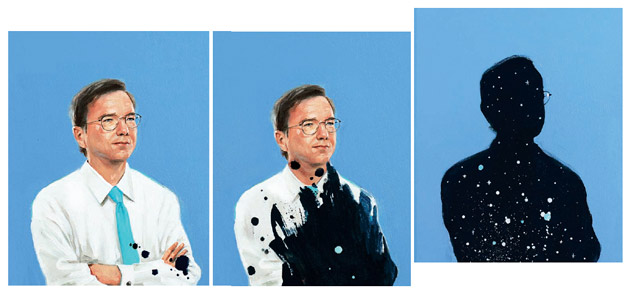
Why Is Obama’s Top Antitrust Cop Gunning for Google?

(By: Wired.com)


Christine Varney’s blunt assessment sent a buzz through the audience at the National Press Club in Washington, DC. Varney, a partner at Hogan & Hartson and one of the country’s foremost experts in online law, was speaking at the ninth annual conference of the American Antitrust Institute, a gathering of top monopoly attorneys and economists. Most of the day was filled with dry presentations like «Verticality Regains Relevance» and «The Future of Private Enforcement.» But Varney, tall and professorial, did not hide her message behind legalese or euphemism. The technology industry, she said, was coming under the sway of a dominant behemoth, one that had the potential to stifle innovation and squash its competitors. The last time the government saw a threat like this—Microsoft in the 1990s—it launched an aggressive antitrust case. But by the time of this conference, mid-June 2008, a new offender had emerged. «For me, Microsoft is so last century,» Varney said. «They are not the problem. I think we are going to continually see a problem, potentially, with Google.»

Coming from Varney, it was a particularly damning comparison. As an attorney who represented Netscape in the late 1990s, she was instrumental in painting Bill Gates and company as overeager bullies. Now, Varney was suggesting that Google was repeating Microsoft’s expansionist behavior. Instead of dominating the desktop, Varney said, Google was starting to colonize the emerging cloud-computing industry, amassing «enormous market power» and potentially creating an ecosystem that customers would be powerless to escape. She acknowledged that her remarks might ruffle some feathers at Google headquarters in Mountain View, California. «If any of my colleagues or friends from Google are here,» she said, «I invite you to jump up and scream and yell at me.»

Nobody took her up on that offer. But it is safe to assume that plenty of Googlers were jumping and screaming six months later when President Obama appointed Varney head of the Justice Department’s antitrust division, making her the government’s most powerful antimonopoly prosecutor. On May 11, during her first public speech on the job, Varney made it clear that her stance had not changed much since her presentation at the conference: She planned to take a forceful approach to applying the nation’s antitrust laws. «In the past, the antitrust division was a leader in its enforcement efforts in technology industries, and I believe we will take this mantle again,» she said. She did not mention Google by name, but there was little doubt to whom she was referring.

Ever since its founding 11 years ago, Google has seen itself as one of the Good Guys. Founders Larry Page and Sergey Brin conceived their company as a kind of public trust. «We believe a well-functioning society should have abundant, free, and unbiased access to high-quality information,» they wrote in the run-up to Google’s IPO five years ago, a goal that requires «a company that is trustworthy and interested in the public good.» They created a touchy-feely work environment with perks like onsite laundry facilities and free food. Prospective hires were grilled on not just their technical expertise but also their ethics—whether they were «Googley.» Google’s self-image was pithily summed up in its famous founding credo: «Don’t be evil.»

For most of its history, investors, users, and tech gurus shared Google’s view of itself. After all, the company’s rise to prominence—on the back of search algorithms so powerful and elegant they changed the Internet forever—is a case study in heroic entrepreneurialism. Its long-tail business model gives even the smallest Web sites a chance to make money. It routinely creates and distributes great products for free, even when there is no obvious benefit to the company. Its spirit of openness and collaboration laid the groundwork for the mash-upable, user-generated modern Web.
But recently, Google’s size and ambitions have begun to obscure its halo. Advertisers have watched nervously as the company’s share of the search-advertising market has jumped to 75 percent from 50 percent over the past three years. In 2007, Google attracted a yearlong antitrust review from US and European regulators after it announced plans to acquire online ad firm DoubleClick. In 2008, the DOJ swatted down a search-ad deal Google had made with Yahoo, arguing that it «would have furthered [Google’s] monopoly.» The company is currently under investigation by the DOJ for its ambitious book-scanning project, which aims to make every book ever published searchable on Google. And the Federal Trade Commission is looking into whether the Apple board seats held by Google CEO Eric Schmidt and board member Arthur Levinson violate federal antitrust law.

For much of its history, Google has responded to most criticism with two words: Trust us. The company has repeatedly persuaded skeptics that its immensity is a mere byproduct of its altruistic mission and that the algorithms it uses to organize the Internet, while proprietary, are objective and benevolent. But in an economy destroyed by bad faith, secretive formulas, and complicated mathematics, trust is in short supply, and Google’s assurances are losing their persuasive power. More than 15 years ago, federal regulators began making Microsoft the symbol of anticompetitive behavior in the tech industry. Now, a newly activist DOJ may try to do the same thing to Google.
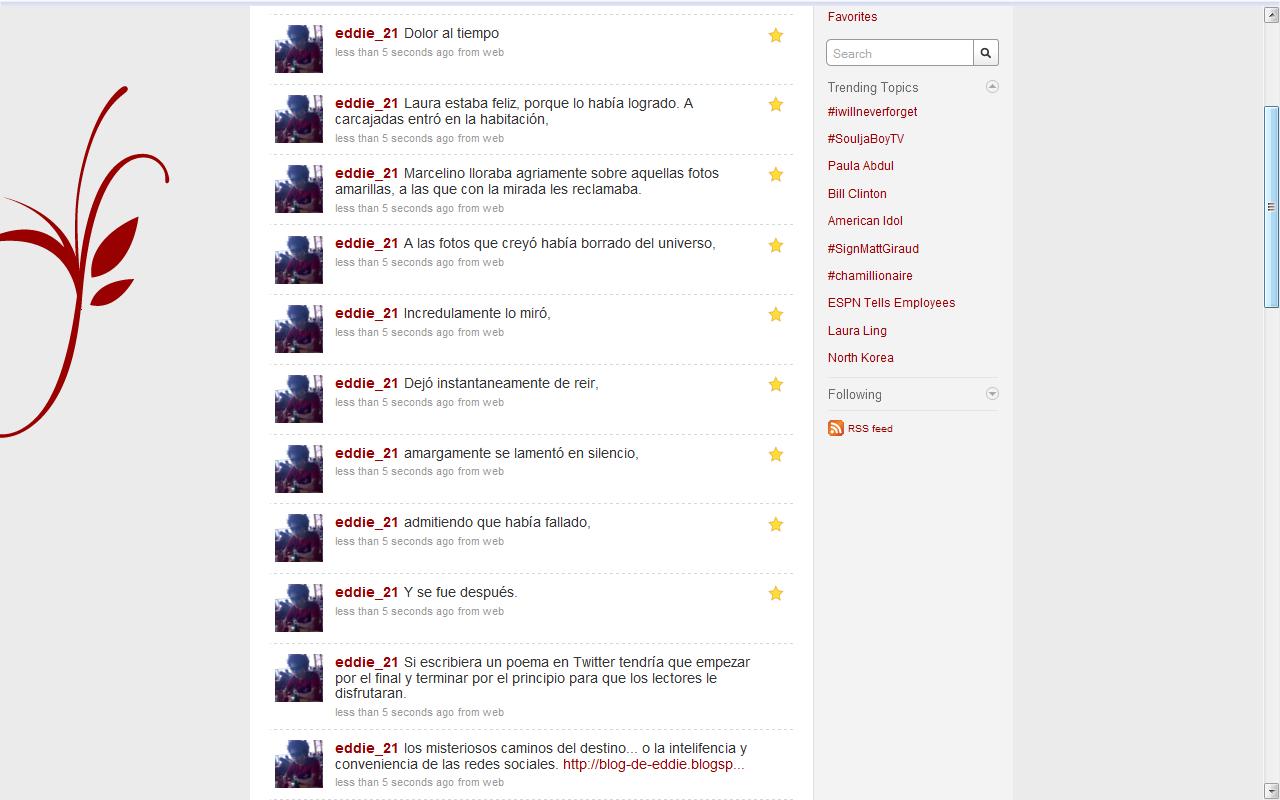
Twetting poetry (reedited) "Dolor al tiempo"

Home

* Inbox
* Sent

0 more result since you started searching. Refresh to see them.

1.
Edgar Estrada
eddie_21:Dolor al tiempo
less than 5 seconds ago from web

2.
Edgar Estrada
eddie_21:Laura estaba feliz, porque lo había logrado. A carcajadas entró en la habitación,
less than 5 seconds ago from web

3.
Edgar Estrada
eddie_21:Marcelino lloraba agriamente sobre aquellas fotos amarillas, a las que con la mirada les reclamaba.
less than 5 seconds ago from web

4.
Edgar Estrada
eddie_21: A las fotos que ELLA creyó había borrado del universo,
less than 5 seconds ago from web

5.
Edgar Estrada
eddie_21:Incredulamente lo miró,
less than 5 seconds ago from web

6.
Edgar Estrada
eddie_21:Dejó instantaneamente de reir,
less than 5 seconds ago from web

7.
Edgar Estrada
eddie_21:amargamente se lamentó en silencio,
less than 5 seconds ago from web

8.
Edgar Estrada
eddie_21:admitiendo que había fallado,
less than 5 seconds ago from web

9.
Edgar Estrada
eddie_21:(Y) SIMPLEMENTE se fue (después).
less than 5 seconds ago from web

La pesadez, Hoy podría morir

Escribo sólo por la gula de escribir. Un poco por la atención ajena y mucho más por la atención propia, que me obliga a admirarme cada día más. Desde las sabanas de una tibia y dura cama, con los ojos diminutos entrecerrados, y los pies cansados de dar pasos motorizados, me obligo a derramarme un poco en lineas arrogantes.

Pero basicamente escribo porque estoy cansado. Porque tuve un largo día y recorrí muchas vidas, porque hoy lo tuve todo y hoy podría morir.

No hubo fuegos artificiales, y si hubo ni los ví. Hubo mucho trabajo, reconocimiento, errores, desengaños, celos, placeres, delicias a mi paladar y a mi cuerpo. Hubo llanto añejo y sorpresas nuevas, besos apasionados y otros arrepentidos.

Hubo consejos de mis padres y abrazos, largos viajes y tediosos regresos. Placeres personales y lujos compartidos. Caridad, ayuda, favores personales y ajenos. Sonreí y camine en nubes. Grite de manera viseral y también fui magnánimo, y por todo eso estoy muy cansado.

Finalmente doy asilo a mi amiga canina en el suelo de mi habitación. Hoy viví cosas únicas y también hice lo de siempre. Por eso cobijado en mis líneas escribo con la misma pesadez que placer, por eso me quejo y me quejo como todos los débiles y miedosos, pero no dejo de vivir así.

Porque soy imperfecto, y humano, demasiado humano. Porque soy grande, tan grande como mi sueño. Porque soy práctico y fácil de complacer; Como la vida que vivo, la vivo a mi vivir, al ritmo de la vida que es vida, y no sólo vivir.

Porque si todo se detiene aquí, doy gracias por poderlo escribir.

Consciencia de la libertad

De los colores oscuros…
de las noches tibias…
de la ciudad que vibra con las luces, los olores…
y la gente;

De los eternos suspiros del hombre con miedo,
Con una extraña y paranóica compañía canina,
Y la tranquilidad de saber que puede ser.

Tantos anhelos que se suman a los deseos de conocer,
Con los brazos llenos de besos, ternura y fuego.
Un mundo de ideas ilusorias y sueños abandonados por otros.

Mientras por muchos días mis ojos permanecieron cerrados…
hoy me niego a no notar la plenitud y la luz de la noche,
Y en sus ojos recordarte y verme a mi junto a ti…
Tranquilo.

La sensación irónica de un cigarro sin tener que fumarlo,
El deseo animal de dominio saciado por la idea de poder,
La grandeza y la gloria desde los comodos zapatos de la humildad…
Pensando.

Dejan mis manos atrás las viejas riendas,
Doy pues mis primeros pasos descalzos sobre mis nuevas reglas,
Disfruto de mi amada soledad en tu compañía,
Siento el placer de tenerlo todo…
En un largo camino, hacia un simple paso más.

Algo real

Es la violenta historia de nuestras vidas.
Escritas en rocas filosas cubiertas de arena, de sal y de almas pasajeras.
Sólo entonces nos volvemos Nosotros.
Sin tanto decoro y con pocas razones razonables.
Más bien siguiendo nuestro instinto lógico, poco común.
Así nuestros besos saben más dulces que los demás amores terrenales.
Cuando las aves emprenden vuelo nosotros volamos más alto.
Se han golpeado fuerte los humanos contra si mismos y sus espíritus estan sangrando.
Los mortales piensan que es malo sangrar.
Entre espadas, rufianes, engaños y balas nos amamos.
En medio de una tormenta, en el vórtice asesino nos damos un beso.
Nadando en el ataque visual de la gran manzana nos juramos amor.
Y con espadas, alaridos, dolor, pasión, miedo e ilusión.
Secamos nuestras lagrimas y decidimos amarnos.

Marines Ban Twitter, MySpace, Facebook


(By: Wired.com)

By Noah Shachtman August 3, 2009 | 11:20 pm | Categories: Army and Marines, Info War

The U.S. Marine Corps has banned Twitter, Facebook, MySpace and other social media sites from its networks, effective immediately.

“These internet sites in general are a proven haven for malicious actors and content and are particularly high risk due to information exposure, user generated content and targeting by adversaries,” reads a Marine Corps order, issued Monday. “The very nature of SNS [social network sites] creates a larger attack and exploitation window, exposes unnecessary information to adversaries and provides an easy conduit for information leakage that puts OPSEC [operational security], COMSEC [communications security], [and] personnel… at an elevated risk of compromise.”

The Marines’ ban will last a year. It was drawn up in response to a late July warning from U.S. Strategic Command, which told the rest of the military it was considering a Defense Department-wide ban on the Web 2.0 sites, due to network security concerns. Scams, worms, and Trojans often spread unchecked throughout social media sites, passed along from one online friend to the next. “The mechanisms for social networking were never designed for security and filtering. They make it way too easy for people with bad intentions to push malicious code to unsuspecting users,” a Stratcom source told Danger Room.

Yet many within the Pentagon’s highest ranks find value in the Web 2.0 tools. The Chairman of the Joint Chiefs of Staff has 4,000 followers on Twitter. The Department of Defense is getting ready to unveil a new home page, packed with social media tools. The Army recently ordered all U.S. bases to provide access to Facebook. Top generals now blog from the battlefield.

“OPSEC is paramount. We will have procedures in place to deal with that,” Price Floyd, the Pentagon’s newly-appointed social media czar, told Danger Room. “What we can’t do is let security concerns trump doing business. We have to do business… We need to be everywhere men and women in uniform are and the public is. If that’s MySpace and YouTube, that’s where we need to be, too.”

The Marines say they will issue waivers to the Web 2.0 blockade, if a “mission critical need” can be proven. And they will continue to allow access to the military’s internal “SNS-like services.” But for most members of the Corps, access to the real, public social networks is now shut off for the next year.

Envuelto en las llamas

Cubierto de las particulas más ardientes que existen, un grito desde mi garganta atraviesa tu cuerpo, tu alma y tu cerebro. En el instante en que tus timpanos siguen vibrando, nuestros labios se funden violentamente en un salvaje acto de amor.

Mis pupilas se dilatan y mis manos tiemblan, tus ojos se rompen un lagrimas que queman el suelo y engrandecen tu espiritu. Es tal la unión entre los dos que no cabe un segundo entre nosotros. Sólo con palabras no vamos a entender lo que hicimos con acciones. Sólo con acciones vamos a tener palabras que den sentido a nuestras acciones.

Entonces en medio de un mar picado y agresivo, entre las nubes de la tormenta y la negritud absoluta del cielo marino. Me encuentro envuelto entre las llamas, tus cabellos rubios y tus brazos de seda, que escriben con hierros incandecentes sobre mi piel por siempre tu nombre.

Inconsolable

Y ahí me quedé inconsolable mirando al suelo, con la rodillas enterradas en el cesped artificial y deseando que la gloria no nos hubiera sido arrebatada.

Después de dejarlo todo en la cancha, y de sufrir por las carencias propias de la falta de ritmo, el equipo se desmebro lentamente en la cancha, mientras la furia y la fuerza de los que quedabamos seguiamos luchando por el triunfo.

La tensión estaba al borde, los nervios se anidaban en el estomago y los gritos no se oían desde el infierno que era la cancha. Un gol en tiempo extra liquidó de un sólo tiro los sueños de coronarnos, de cubrirnos el alma de gloria y los rostros de sonrisas.

Así frente a mis ojos se fue el campeonato. Así lentamente el trabajo de tantos meses se desmorono con mis propias lagrimas, pero no estamos muertos. Mañana nos espera la cancha y volveremos por lo que es nuestro.