Competitividad en México, diez minutos bajo el agua

¿Es el fracaso la consecuencia lógica de las acciones irresponsables y aleatorias? o ¿Es la causa que dispara el pensamiento y la consciencia de los seres humanos? Venimos a la universidad para aprender a como no queremos ser en la vida, a volvernos tolerantes y resistentes a la frustración.

Encontramos de manera voluntaria o involuntaria inspiración para emprender proyectos, nacen nuevos sueños, se enriquece la visión y los ojos se perciben más grandes. La realidad es que educamos el ego, pues no creo que ningún alumno universitario, al menos en mi carrera, incluyendome a mi, retenga en su esfera de conocimiento más del 30% de todo lo que «aprendió».
Sin embargo de nuestras bocas emanan tantas y tantas palabras, la gran mayoría mal estructuradas y mal empleadas. Somos el triste futuro de un país que cada día se vuelve más carente de esencia. Nuestras tradiciones se vuelven plásticas al mismo tiempo que pierden calidez. Los pocos conceptos que ostentamos son, si bien no va, plagiados de texttos económicos, en el peor de los escenarios, suplantando las opiniones tendenciosas de algún, pseudoperiodista.
No podemos ser competitivos porque no entendemos que significa eso, no podemos ver más allá de nuestros propios intereses, y eso no se llama competencia, se llama egoismo. No veo en nadie un nteres genuino por la gente. Seguramente existirán y existen honrosas excepciones que su capacidad rebasa mi pesimismo y entendimiento, y gracias a esas personasconsicentes y civilixadas este barco no se ha hundido. Desgraciadamente no conozco ninguno.

El imbecil se sube al trono y se disfraza burdamente de monarca, los demas imbeciles le aplaudimos mientras el orgullo desborda de aquel ignorante. La condena de los hombres radica en su ignorancia y su pereza, su única salvación son la voluntad, la consciencia y el esfuerzo.

Ya va siendo tiempo de gritar, de arrancarnos la carne rosada que ya se está pudriendo sobre nosotros, seguir viviendo de rodillas y sin siquiera notarlo, nos está conduciendo a la locura. Y nos condenará a ver las cosas en las que creemos o creíamos completamente en cenizas. Y tal vez ahi radica la situación, es muy posible que la apatía y la falta de objetivos que busquen lo esencial ha derivado a que nada realmente valga algo.
Somos como animales bipedos y ciegos, que creer querer cosas, pero en realidad sólo quieren sentir algo entre sus manos, no amamos sino que necesitamos. Es probable que no tenga sentido cuestionarme sobre algo que ya sabía.


Horizontes Rojos

Entre las lineas rojizas caminas lejos de todo,
estan las llamas del alma pidiendo a gritos tus besos,
cuando los lobos se acercan demasiado y pueden oler tu aroma,
se deshojan los labios del tiempo esperando en la incertidumbre.

De nuevo vuelven al miedo los pasajes rojizos,
y vuelan hacía los recuerdo tuyos,
de golpe se vuelven grises los aullidos y me vuelven loco,
como sintiendo sus dientes en tu cuello.

Al fin me libro del miedo y camino hacia esos horizontes,
y sólo arrancándome los ojos dejo de verte,
mis muertos nervios te mandan un mensaje en secreto,
mientras la carne fresca atrae de nuevo a la melancolía.

Me quedo sentado a la mitad del camino,
con un pie hacía adelante y el otro eternamente dando vueltas,
Vuelvo mis ojos hacía donde se posaba tu rostro,
y sólo se ven horizontes rojos.

Quemar las naves

De cuando en cuando viene un viajero que mira con desden al arrogante,
mira todo a su alrededor y dibuja en su seño un rostro de confusión,
no entiende porque si el río corre con la pendiente,
hay hombres necios que elevan canales que la lleven hacía arriba.

No recuerdo de color son los lazos que amarraban mis memorias,
los suaves caminos que recorrí cuando era niño,
son más lindos hoy que los veo lejanos,
Y me arrullo pensando en los buenos tiempos cubiertos de sueños.

Somos tan frágiles como y como las burbujas efímeros,
como rocas que se desprenden del límite del acantilado,
para caer para siempre hacía las frías aguas del río,
tal vez hasta al fondo del mar, tal vez a la orilla de la playa.

Son tan fuertes los gritos del pasado que la luna de plata calla,
hoy somos aves que vuelan lejanas y cerca de la nada,
antes eramos espadas que emblandecían con furía,
mañana volveremos a ser  las estrellas que brillaban ilusionadas.

Puedo mantener mi cabeza ocupada por muchas horas más,
¿Cuánto tiempo puedo distraer mis ojos de la tristeza?,
unos segundos bastan para devolver al huracán su fortaleza,
los eternos silencios del tiempo resonarán por siempre en mi cabeza.

I Dream of Genius: Herbal Drugs Promise Big Neural Gains

I Dream of Genius: Herbal Drugs Promise Big Neural Gains
Every pseudo-medical technician has his own brand of herbal remedies to cure your brain fuzz and make you an honor-roll star. But insta-smarts in a non-FDA-evaluated bottle? Color me skeptical.
$20  • 
#item_stats {display: none;} #item_specs {display: none;} #package_banner { display: none; }
Not that I don’t need the help: I’m taking the GRE in a few months and memorizing stacks of grad school vocab can be a little hirsute (adjective: hairy, shaggy). So I put four herbal supplements that promise enhanced brain function through several rounds of vocabulary-retention tests and GRE math drills to cull the frauds from the real deal.
Here’s how we tested: I took the allotted dose of each drug over a 48-hour period. At the same time every day, I took two GRE practice tests, one math and the other vocab-retention. The vocab test consisted of memorizing 15 new GRE words over 10 minutes, waiting a half hour, then retesting. The math consisted of 30 different problems in trigonometry, geometry and algebra. Between drugs I took a 24-hour break to (hopefully) clear out my system.
With no drugs in my system, I got these control numbers:
Vocab-Retention Score: 11/15
GRE Math Score: 22/30
A word of warning: These pills aren’t supported by FDA testing or scientific studies of their efficacy. Our testing was admittedly unscientific (N=1, a 24-year-old woman) but the results suggest that some, in fact, do work better than others. But our review’s no substitute for medical advice. So, if in doubt, consult your doctor.

Smart Nutrition Get Smart
This is a blended cocktail of every vaguely credible herbal supplement, rolled into a single pill. There’s Huperzine A (an extract from Chinese moss that prevents brain deterioration), Periwinkle extract, and Pyritinol (a drug used in Europe to aid healing in severe head trauma).
Not only did Get Smart repeatedly perform better in memory tests, I noticed the effects long after the evaluation time had ended. While testing I wrote an insightful and pithy cover letter, won a debate on the function of the Vietnam War, and finally baked a perfect chocolate soufflé. I may have even cured cancer in my sleep (unfortunately I can’t find my notes on that). In the case of Get Smart, it really was matter over mind.
Vocab-Retention Score: 15/15
GRE Math Score: 25/30
WIRED Will unleash your inner Doogie Howser. Improves focus and memory, and appears to enhance creativity.
TIRED The only thing harder to swallow than the pill’s bulky mass is its high cost — nearly a dollar per capsule. Even Steve Carrell is rolling his eyes at the name.

Natural Factors Learning Factors
Strong enough for slacker millennials, but gentle enough to feed your hyperactive tot, Learning Factors combines tuna-fish–oil extract and omega-6 fatty acids to nourish your neurons and improve concentration. Just for good measure the makers also added borage oil, an anti-inflammatory shown to decrease pain in arthritis sufferers. But for me this drug led to high performance in memory-retention tests and comprehension. Not to mention, we hear fish oil does a body good.
Vocab-Retention Score: 12.5/15
GRE Math Score: 23/30
WIRED Comes in liquid, capsules and nutrient powder. Calmed my mind and improved word retention significantly within 24 hours of use. Tuna oil is pesticide-free and dolphin-friendly.
TIRED Chewable capsules taste like peach-flavored tuna fish.

Ginkgold 60 MG
Despite conflicting scientific findings, Ginkgo biloba has been one of the most popular supplements for almost two decades and, surprise, Ginkgold is chock full of it. The claim: By improving circulation you increase the blood flow to the brain, and the ginkgo extract helps you make connections, retain information and keep focused.
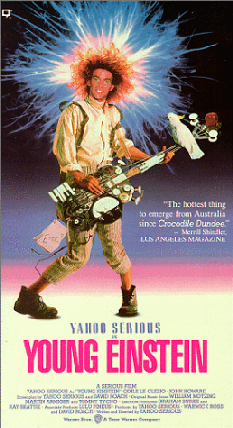
Be warned: Get the dose slightly wrong and it can make you more Young Einstein than Albert Einstein. After taking the recommended dose my mind was on warp speed. But I was paranoid and loopy, too. It felt like drinking three Red Bulls and trying to meditate. I adjusted the doses, and the crazy-pill effects subdued — along with the memory help.
Vocab-Retention Score: 11/15
GRE Math Score: 22/30
WIRED You can strike Ginkgold practically anywhere (it’s widely available at natural food stores and supermarkets.)
TIRED More ups and downs than an afternoon at Magic Mountain. Increased blood flow created a series of overwhelming energy bursts, affecting quantitative test scores for the worse.

Planetary Herbals Bacopa Extract
Common to the Indian Ayurveda homeopathic medicine system, Bacopa monnieri is a flowering perennial that supposedly calms nerves and improves memory. But will it dust off your cranium? Unlikely. Bacopa extract performed the lowest in our memory tests and pretty poorly in quantitative study.
A slew of scientific evaluations show it might become more effective with long-term use, but side effects made me wary of taking it any longer than necessary. Bacopa made me groggy — and downright mopey. After a day of putzing around the house avoiding GRE books, all the studying lost was not worth any cognitive pathways gained.
Vocab-Retention Score: 7/15
GRE Math Score: 19/30
WIRED Immediate calming effects might help test-day jitters. Australian studies suggest long-term bacopa use improves short-term memory drastically. But what do Australians know? They gave the world Yahoo Serious.
TIRED Bacopa made me tired of life, tired of studying, but mostly tired of taking bacopa.


What’s your favorite study supplement? How do you use it? Submit your favorites here!

Google Algorithm Predicts When Species Will Go 404, Not Found

Biologists have figured out the most efficient way to destroy an ecosystem — and it’s based on the Google search algorithm.

Scientists have long known that the extinction of key species in a food web can cause collapse of the entire system, but the vast number of interactions between species makes it difficult to guess which animals and plants are the most important. Now, computational biologists have adapted the Google search algorithm, called PageRank, to the problem of predicting ecological collapse, and they’ve created a startlingly accurate model.

“While several previous studies have looked at the robustness of food webs to a variety of sequences of species loss, none of them have come up with a way to identify the most devastating sequence of extinctions,” said food web biologist Jennifer Dunne of the Santa Fe Institute, who was not involved in the research. Using a modified version of PageRank, Dunne said, the researchers were able to identify which species extinctions within a food web would lead to biggest chain-reaction of species death.

“If we can find the way of removing species so that the destruction of the ecosystem is the fastest, it means we’re ranking species by their importance,” said ecologist Stefano Allesina of the University of California, Santa Barbara, who co-authored the paper published Friday in PLoS Computational Biology.

Unlike previous solutions to the coextinction problem, the Google solution takes into account not only the number of connections between species, but also their relative importance. “In PageRank, you’re an important website if important websites point to you,” Allesina said. “We took that idea and reversed it: Species are important if they support important species.”

In other words, grass is important because it’s eaten by gazelles, and gazelles are important because they’re eaten by lions.

When the researchers tested the Google algorithm against existing models for predicting ecosystem collapse, they found that the new solution outperformed the old ones in each of the 12 food webs they looked at. “In every case that we tested, the algorithm returned either the best possible solution, out of the billions of possibilities, or very close to it,” Allesina said. In this case, the “best possible solution” is the one that predicts total ecosystem collapse using the fewest number of species extinctions.

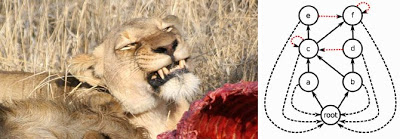
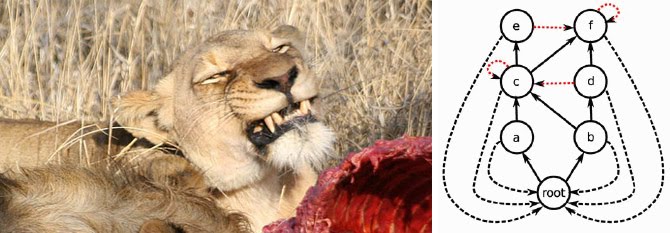
To make the circular PageRank algorithm work for food webs, which are traditionally considered unidirectional, the researchers had to solve the problem of what to do with dead ends: Not much eats a lion, but that doesn’t necessarily mean lions aren’t critical to the food chain. The scientists solved this problem by adding what Allesina calls a “root node,” which is based on the idea that all living creatures contribute to the food chain through their excrement and eventual decay.

“What we found is that the importance of a species can be connected to the amount of matter that flows to it,” Allesina said. “If species eat a lot of things, and a lot of things eat them, they tend to be important.” Previous solutions to the problem tended to underestimate the importance of species that are lower on the food chain, Allesina said, and he hopes the new solution will encourage conservation biologists to take a broader view of species extinctions.

“What I hope is that people will pick up interest and start thinking about conservation in a more network-based way,” Allesina said. “Right now, most conservationists are focused on a single species, and they just study that species. But you really have to take into account that this species is not independent, it’s really tangled in a network of multi-species interactions.”

For ecosystems on the brink of collapse, such as marine environments taxed by overfishing, Allesina said a network-based approach to conservation could make all the difference.