Los marginados son "Paisanos" desde que mandan dolares


Hoy por la mañana escuche al diputado federal Carlos Navarrete que la crisis global se manifiesta, entre otras cosas, «en la disminución de las remesas que mandan nuestros paisanos que estan del otro lado».

Yo me pongo a pensar, ¿Tuvieron que arriesgar su vida y soportar tratos indignos, así como la separación de su familia y seres queridos para que sean nuestros paisanos? Porque cuando estaban aca en México eran la clase más marginada y miserable, el campesinado mexicano.

Desde la concepción de México como país, los indígenas siempre han sido discriminados, marginados del progreso, olvidados y vejados por los mismos mexicanos mestizos, como el sindrome del hermano menor son aplastados por los mestizos, como estos, a su vez, fueron aplastados por los gachupines.

Este país merece sufrir los tormentos que sufre porque le ha dado la espalda a sus entrañas mismas, quiere arreglar la casa que se encuentra en la punta del iceberg, cuando por dentro estamos completamente divididos. Los mexicanos somos mexicanos sólo por el nombre porque la diversidad entre las culturas que habitan en su territorio son tan ajenas de las demás que no se comprende como podemos llamarnos Nación.

Hago un llamado a la unidad de hermanos mexicanos, al detener el racismo en todas sus expresiones, a los clasismos estúpidos y la segregación sistemática, cualquier persona se irrita sólo de pensar que no se le considere igual que a los demás. ¿Qué pasa con nuestros paisanos? Levantemos un país desde la valentía de su gente, unamonos nosotros ya que la clase política nunca lo va a hacer, demos ejemplo de sociedad y levantemos la mano, por los que no la pueden levantar.

You Deleted Your Cookies? Think Again


(By: Wired.com)

More than half of the internet’s top websites use a little known capability of Adobe’s Flash plugin to track users and store information about them, but only four of them mention the so-called Flash Cookies in their privacy policies, UC Berkeley researchers reported Monday.

Unlike traditional browser cookies, Flash cookies are relatively unknown to web users, and they are not controlled through the cookie privacy controls in a browser. That means even if a user thinks they have cleared their computer of tracking objects, they most likely have not.

What’s even sneakier?

Several services even use the surreptitious data storage to reinstate traditional cookies that a user deleted, which is called ‘re-spawning’ in homage to video games where zombies come back to life even after being “killed,” the report found. So even if a user gets rid of a website’s tracking cookie, that cookie’s unique ID will be assigned back to a new cookie again using the Flash data as the “backup.”

Even the Whitehouse.gov showed up in the report, with researchers reporting they found a Flash cookie with the name “userId.” The site does say in its privacy policy that it uses tracking technology but it does not mention Flash or tell users how to get rid of the Flash cookie.

The report is being submitted Monday as a comment in the government’s proceeding about the use of cookies on federal websites. Federal websites have traditionally been banned from using tracking cookies, despite being common around the web — a situation the Obama administration is proposing to change as part of an attempt to modernize government websites.

But the debate shouldn’t be about allowing browser cookies or not, according Ashkan Soltani, a UC Berkeley graduate student who helped lead the study.

“If users don’t want to be tracked and there is a problem with tracking, then we should regulate tracking, not regulate cookies,” Soltani said.

The study also comes as Congress and federal regulators are looking at ways of reining in the online tracking and advertising industry, whose attempts at self-regulation have conspicuously failed to make the industry transparent about when, how and why it collects data about internet users.

Websites and advertisers track users closely in order to improve services, prove to advertisers that an ad has been shown one time to 1 million users, and not 10 times to the same 100,000 people. Ad networks also collect the information in order to segment users into different groups, such as “car fanatic” or “fashionista,” in order to charge advertisers a premium for reaching just the slice of users the company thinks will be most receptive to its ad.

Smelling possible regulation coming, third party ad networks recently agreed to an updated voluntary code of conduct, though it prohibits little and has no enforcement mechanism. For instance, when it comes to sensitive health information, the networks are free to collect as much information as they like, so long as it does not involve an actual prescription.

Soltani led a summer research team at Berkeley, under the direction of Chris Hoofnagle, the Director of Information Privacy Programs at the Berkeley Center for Law and Technology. The team tested the top 100 sites to see what their privacy policies said, what their tracking technology actually does and what happens if a user blocks the Flash cookie.

Adobe’s Flash software is installed on an estimate 98 percent of personal computers, and has been a key component in the explosion of online video, powering video players for sites such as YouTube and Hulu.

Websites can store up to 100K of information in the plug-in, 25 times what a browser cookie can hold. Sites like Pandora.com also use Flash’s storage capability to preload portions of songs or videos to ensure smooth playback.

All modern browsers now include fine-grained controls to let users decide what cookies to accept and which to get rid of, but Flash cookies are handled differently. These are fixed through a web page on Adobe’s site, where the controls are not easily understood (There is a panel for Global Privacy Settings and another for Website Privacy Settings — the difference is unclear). In fact, the controls are so odd, the page has to tell you that it is the control, not just a tutorial on how to use the control.

This so-called behavioral targeting is coming under scrutiny, in part since Google bought one of the largest practitioners — DoubleClick — and recently announced it would start using its troves of user data to deliver targeted ads. Its main money makers, the small text ads next to search results and on websites across the net, simply rely on the words in a search or on a webpage to place ads, a tactic known as contextual ads.

Defenders of behavioral ads say that privacy shouldn’t be a concern since cookies really identify a browser, not a person. Moreover, they argue that users would prefer to have relevant ads. Targeted Behavioral Ads could also help save online journalism. Under this theory, Google text ads don’t work on a news story about the governor raising the sales tax, since there’s no product that goes with that context. But if the site knew the reader was in the market for a car, it could show an ad for the new Lexis and earn much more.

The report names two companies, Clearspring and QuantCast, as companies whose technologies reinstate cookies for other websites.

Clearspring, the makers of the popular AddThis tool that lets users share a link by e-mail or on social networking sites, used its Flash cookie to reinstated deleted browser cookies for AOL.com, Answers.com and Mapquest.com, according to the report.

The company defends its behavior, saying everyone uses Flash cookies these days, that it discloses its use of Flash in its privacy policy and that the copying of data back into cookies is a simply way to speed up pages by transferring data into HTML cookies, which browsers read faster.

Clearspring’s AddThis tool is used by more than 300,000 publishers and the company collects data on some 525 million unique internet users monthly, according to Clearspring CEO Hooman Radfar. The data will soon be used to personalize the AddThis widget, making it so that a user who has previously shared a story by Twitter and Friendfeed will see those options first, rather than social networks he doesn’t use.

“We have the president, the pope and the queen of England using us,” Hooman told Wired.com in an interview a few weeks ago. “If they can trust us, then you can.”

Shield by Dante Busquets

Mexico City – January 2006 Night View from the 44th floor of the Latinoamericana Tower in downtown Mexico City, overseeing «Eje Central» and the southern part of the city. Land and air traffic are captured during peak hours with a long exposure of the film. The Latinoamericana Tower was the first skyscraper of its kind to be built in Latin America, in 1956. ©2006 Danter Busquets

Más fotos en: http://freehole.org/

Azul


Hoy me diste las buenas tardes desde lo alto;
Acompañada de esponjosas nubes me besaste la frente;
Con suave viento acariciaste mi rostro y tomaste mi mano;
En tu brillante azul me llenaste de ti.

Mareado y lleno de los sentimientos de los hombres;
Me arrebata los miedos y me arrulla en los brazos del mundo;
Tu angelical mirada de brillos espirituales crea los colores;
El calor de mi cuerpo se transforma en entrega total a tí.

Meso mis cabellos despeinados mientras siento tu presencia;
Mis manos abrazan la imagen que imaginan de tus labios;
Vienen y van las olas de un mar perfecto;
Que las costas del mundo se llenan de tí.

Volver a Intentar

Son tu manos girasoles, tus dedos petalos y sueños luces de colores;
Es tu boca cascada, tus palabras gotas de lluvia que calman la sed del mundo;
Tu belleza es esperanza y sueños de todo lo vivo.

Fuerte como el viento de la tormenta;
Como los altos robles sostienes madurez infinita;
De los guerreros antigüos tienes el coraje;
Perdonas hasta que duele;
Tu voluntad nada la detiene;
Es tu miedo sabio y te habla la verdad;
Son mis miedos los que amenazan nuestras ilusiones;
Se desdibujan en la bruma los sueños que van.

Se vienen tiempos tempestuosos de guerra;
Lloverá fuego y se llenará el aire de cenizas tibias;
Es tiempo de luchar y de perder sangre en el camino;
Es hora intentar probar la punta de las nubes con nuestros besos;
Correr juntos por un mar azul sin fin;
Seguir escribiendo historias en la arena y en la piedra;
Sobre las lágrimas, sobre las rocas;
Bajo las noches de luna y las tardes de ardiente espera;
Hagamos de las sábanas que nos cobijaron, cortinas que nos protejan y difuminen el Sol para nosotros;
Cubramos nuestras almas del frío;
Comamos queso y bebamos vino;
Probemos un poco de tu boca enamorada;
A la luz de tus ojos verdes por la mañana.

Entre las rocas crecen los lirios;
Entre tus ojos encuentro el sentido;
Lógica es tu espera, tu miedo, tu dolor;
La suave arena vive y por siempre;
Lleva a aquellas rocas como ancenstros.

No pido segundos, ni pido tiempo;
Llenar tu vida de flores, hacer con nuestros sueños muchos colores;
Regalarte por siempre mi vida en pequeñas dosis;
Una por día… Y así para siempre;
Curar tu alma y la mía.

Los líderes del TLCAN inician reunión


(By: CNNExpansión.com)

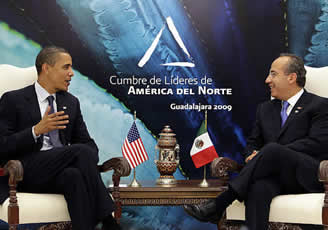
Los presidentes de México y EU y el premier canadiense abordarán temas económicos; la cumbre arrancó pasando las 17:00 horas, luego de que Obama llegara a Guadalajara.
Felipe Calderón y Barack Obama iniciaron la reunión bilateral de la cumbre norteamericana. Felipe Calderón y Barack Obama iniciaron la reunión bilateral de la cumbre norteamericana.

El presidente Felipe Calderón inició una reunión bilateral ampliada con el primer ministro de Canadá, Stephen Harper, con quien aborda temas de movilidad laboral, comercio e inversión, así como cooperación en materia de seguridad. El encuentro, que tiene lugar en uno de los salones del Instituto Cultural Cabañas de esta ciudad, inició pasando las 17:00 horas en el marco de la Cumbre de Líderes de América del Norte.

A los 20 minutos de iniciar la reunión, se permitió la entrada a los representantes de los medios de comunicación, momento en el que Calderón, quien lucía una corbata azul, y Harper se dieron un fuerte apretón de manos y sonrieron para la foto.

Para ingresar al lugar tanto la prensa nacional como extranjera, debe registrar su gafete a través de un lector que registra el código de barras.

En la entrevista, Calderón y Harper tratarán sobre soluciones alternativas a la imposición del gobierno de Canadá del requisito de visa a los viajeros mexicanos, con el objeto de revertir esa medida implementada el 13 de julio.

El premier canadiense y su comitiva fueron recibidos por la directora general Adjunta de Ceremonias, María Teresa Mercado y posteriormente, por el Ejecutivo federal mexicano.

La comitiva mexicana está integrada por la canciller Patricia Espinosa y los secretarios de Gobernación, Fernando Gómez Mont; de Economía, Gerardo Ruiz Mateos; del Trabajo, Javier Lozano, además del embajador de México en Canadá, Francisco Barrio Terrrazas.

Por el gobierno de la hoja de maple están el ministro de Seguridad Pública, Peter Van Loan; el de Estado para Asuntos Exteriores, Peter Kent; el subsecretario para Gabinete-Política Exterior y Defensa, Claude Carriere, y el embajador de Canadá en México, Guillermo Rishchynski.

También están el secretario principal de la Oficina del Primer Ministro, Ray Novak; el secretario de prensa de la oficina del premier, Dimitri Soudas y de la oficina del primer Ministro, Roos O»Connor.

En términos comerciales, el intercambio bilateral entre ambos países ascendió a 22,200 millones de dólares en 2008, equivalente a seis veces lo que se alcanzó en 1993, antes de la firma del Tratado de Libre Comercio (TLC).

Freaky Sleep Paralysis: Being Awake in Your Nightmares


(By: Wired.com)

You wake up, but you can’t move a muscle. Lying in bed, you’re totally conscious, and you realize that strange things are happening. There’s a crushing weight on your chest that’s humanoid. And it’s evil.

You’ve awakened into the dream world.

This is not the conceit for a new horror movie starring a ragged middle-aged Freddie Prinze Jr., it’s a standard description of the experience of a real medical condition: sleep paralysis. It’s a strange phenomenon that seems to happen to about half the population at least once.

People who experience it find themselves awake in the dream world for anywhere from a few seconds to 10 minutes, often experiencing hallucinations with dark undertones. Cultures from everywhere from Newfoundland to the Caribbean to Japan have come up with spiritual explanations for the phenomenon. Now, a new article in The Psychologist suggests sleep researchers are finally figuring out the neurological basis of the condition.

“This research strongly suggests that sleep paralysis is related to REM sleep, and in particular REM sleep that occurs at sleep onset,” write researchers Julia Santomauro and Christopher C. French of the Anomalistic Psychology Research Unit, Goldsmiths, at the University of London. “Shift work, jet lag, irregular sleep habits, overtiredness and sleep deprivation are all considered to be predisposing factors to sleep paralysis; this may be because such events disrupt the sleep–wake cycle, which can then cause [sleep-onset REM periods].”

In other words, you experience just a piece of REM sleep.

As David McCarty, a sleep researcher at Louisiana State University Health Sciences Center’s Sleep Medicine Program, explained it, humans tend to think about the elements of the different stages of sleep as packaged nicely together. So, in REM sleep, you’re unconscious, experiencing a variety of sensory experiences, and almost all of your muscles are paralyzed (that’s called atonia).

“But in reality you can disassociate those elements,” McCarty said.

In sleep paralysis, two of the key REM sleep components are present, but you’re not unconscious.

Narcolepsy, which can be linked with sleep paralysis, has a similar pathology. For narcoleptics, some of the elements of rapid eye movement can “come out of nowhere,” he McCarty said.

Sleep paralysis was first identified within the scientific community by psychologist Weir Mitchell in 1876. He laid down this syntactically old-school, but accurate description of how it works. “The subject awakes to consciousness of his environment but is incapable of moving a muscle; lying to all appearance still asleep. He is really engaged in a struggle for movement fraught with acute mental distress; could he but manage to stir, the spell would vanish instantly.”

But the condition lived in folklore long before anyone tried to subject it to even semi-rigorous study. The various responses have fascinated some researchers and they were cataloged in the 2007 book, Tall Tales About the Mind and Brain. In Japan, the problem was termed kanashibar. In Newfoundland, people called it “the old hag.” In China, “ghost oppression” was the preferred nomenclature.

A study released earlier this year found that more than 90 percent of Mexican adolescents know the phrase “a dead body climbed on top of me” to describe the disorder. More than 25 percent of them had experienced it themselves.

Having an element of REM sleep mix with your consciousness is scarier than it sounds. I experienced sleep paralysis on several occasions when I was in college. I can testify: It’s run-to-your-mama scary.

In my case, it would happen right as I was falling asleep on the two twin beds that I had taped together. The most vivid time, I “woke up” with the uneasy feeling that something awful was to my left, on the border of my peripheral vision. I couldn’t really see it, but I knew that it was evil and coming closer to me. I felt true terror, like you experience when you are about to get in a car crash. I was sure it was going to hurt me.

After a few minutes, I could finally move and took the opportunity to run across campus to a friend’s house and asked to sleep on the couch. With the lights on. It happened a few more times.

Then, it just stopped. It hasn’t ever happened again.

The good news, McCarty said, is that my experience is actually pretty standard. Sleep paralysis rarely persists or causes serious life damage.

“It’s very common, way more common than people realize, but usually it doesn’t recur,” he said. “It’s not frequent enough to make people come in and ask the doctor for help.”