Mexico Bicentenario

Cuando escuchas un comercial en la radio sobre el orgullo de ser mexicano, y te encuentras en un barrio bastante olvidado por el gobierno, viajando por unas calles sucias, llenas de baches, en un autobús deteriorado por la falta de consciencia de sus usuarios, y además ves que la gente que no se esta durmiendo, tiene una cara de ausencia y hartazgo que no pueden ocultar; por lo menos a mí, me parece irónico que cualquiera de los que estemos aquí nos enorgullezca vivir de esta manera.
Porque el interés de los medios de comunicación y el discurso del gobierno es hacernos sentir que esta realidad de mierda que vive más de la mitad de la población es soportable gracias a que se acerca el bicentenario de la independencia de México.
Independencia, como tal nunca lo ha sido, siempre hemos estado subyugados al poder de algún país de influencia como España, Francia y finalmente Estados Unidos.
No producimos ni lo suficiente para comer, dependemos del escaso petróleo que nos queda y no tenemos tecnología propia. La mayoría de la gente, ya ni se cuestiona el porqué de su realidad histórica y social, se conforman con su McDonald’s, su coca y los partidos de la selección por sky, somos como un grupo de esclavos hacinados, y en la espera de nuevos productos de bajísima calidad para adquirirlos por medio de créditos agiotistas.
Pero creo que después de todo si hay algunas cosas que celebrar, la desigualdad y la influencia de los grupos de poder, han generado un México de ensueño, donde la gente de piel morena en su mayoría es servidumbre, donde hemos integrado tan bien a los indígenas a la nueva dinámica social dándoles empleos como jardineros y policías de caseta. Además no se tienen que pagar los impuestos, ni enfrentar de ninguna manera a la ley, de hecho las autoridades trabajan en función de las necesidades de estos mexicanos orgullosos de mantener la homogeneidad por completo.
México, como gran parte de los países menos desarrollados en el mundo, está atrapado en una indiferencia silenciosa y cualquier tipo de cuestionamiento es mal visto por la sociedad, decir que no a la democracia o a las falsas celebraciones que pretenden paliar las condiciones deplorables en las cuales crecen nuestros hijos, es completamente fuera de lugar. «La izquierda es para los nacos»
Y aquí seguimos, después de horas hemos avanzado algunos metros, a empujones pasando unos sobre otros desgastándonos y mentándonos la madre, pero probablemente al compatriota que hoy quisiera madrear por la ira y la impotencia de que se metió antes que yo, mañana lo abrazare y al calor del alcohol con coca cola, lo llamare hermano.
Vamos bien México, en 200 años hemos vivido agachados, en silencio, con una sonrisa tímida y cara  de que no pasa nada. Somos una sociedad violenta, machista e hipócrita. Esta mal todo, y por eso se hace a escondidas, es mejor decir si mintiendo, que abiertamente expresar una negativa. Le hacemos de tapete a los extranjeros y somos profundamente racistas con nosotros mismos como pueblo. ¿200 anos de qué? ¿Ahora estamos mejor que quien? Yo no quiero celebrar hasta que vea a mi pueblo y a mi tierra reivindicada y pujante, cuando mis hermanos se sacudan el abuso milenario de sus espaldas y estén listos a luchar, cuando la gente entienda el trabajo como una bendición y no como un castigo, cuando dejemos de conmiserarnos y seguir creyendo que nuestra falsa humildad nos salvara de todo lo malo, solo trabajando duro y en equipo este país podrá celebrar algo, cuando todos sus hijos coman, cuando todos sus ciudadanos trabajen, cuando el poder sea de la gente y sean las empresas las que se ajusten a nuestras necesidades y no nosotros a sus demandas de recursos. Y eso solo va a suceder cuando la gente despierte, le pierda el miedo a vivir mejor, no sienta vergüenza de pedir ayuda, y que le valga madres lo que Televisa y Marco Antonio Regil piensen de ellos.
No desdeñemos lo poco bueno que tenemos y levantemos un mejor México, trabajando duro, ayudando a crecer y no ha mantener  a los demás, esforzarse todos los días, hasta que nuestro destino sea el que queremos vivir.

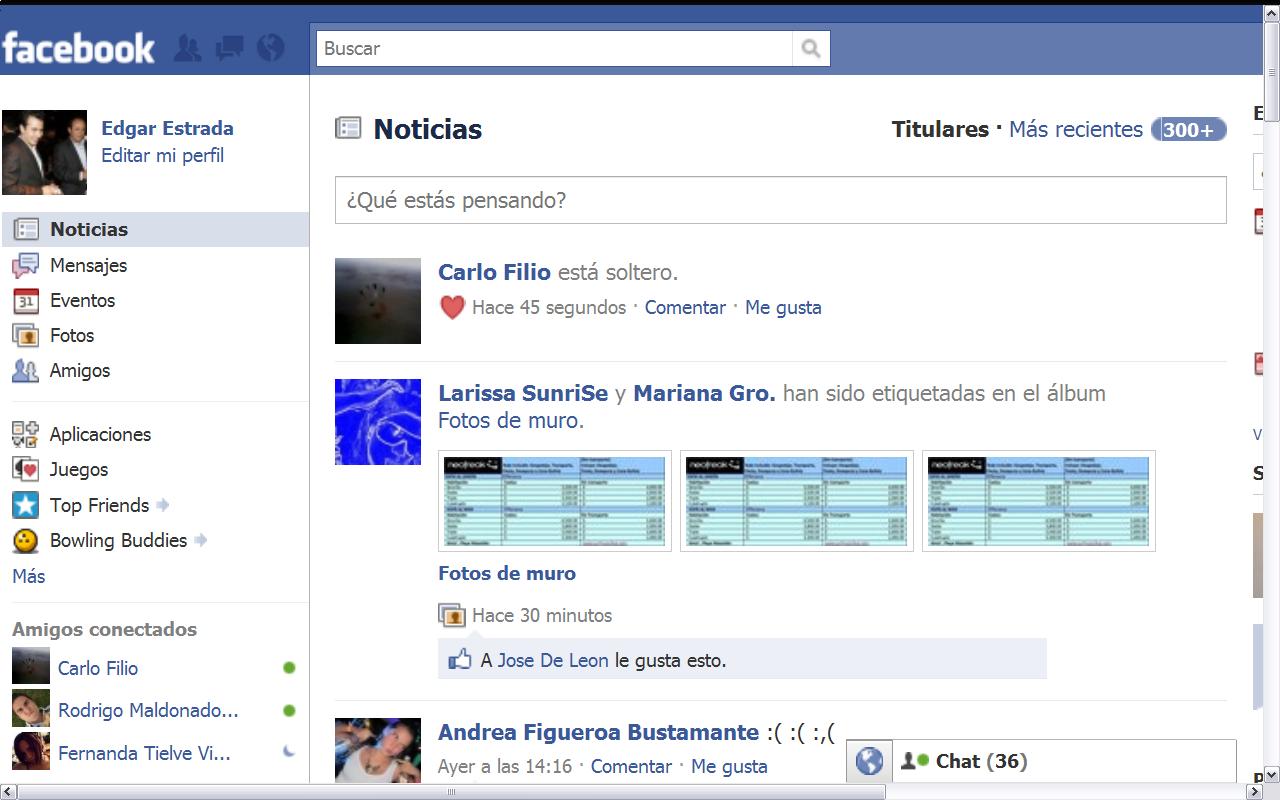
Carlo Filio ha pasado de "tener una relación" a estar "soltero"

Desde hace ya algunos meses he venido discutiendo con un gran número de personas el imapcto de las interacciones sociales virtuales por medio de facebook especificamente. El día de hoy se pone a prueba uno de estos paradigmas en los que una persona que sostiene una relación de pareja, cambiará su estado a «soltero» sólo para conocer las posibles reacciones que esto generará en su red social  y en su pareja.

En el Blog de Eddie daremos seguimiento a estas interacciones e iremos comentando lo que sucede.

Eddie

El cromo de tus sueños

El cromo de tus sueños

Como todas las semanas, FIFA.com abre el espacio para la expresión de sus lectores. Sin embargo, en esta oportunidad, queremos consultarte sobre un tópico distinto y particular: el Álbum Virtual de cromos de la Copa Mundial de la FIFA Sudáfrica 2010. ¿Ya lo estás coleccionando? ¿Cuál es la pegatina más complicada de conseguir?

Hicieron falta apenas un par de días para que el Álbum Virtual de Cromos de la Copa Mundial de la FIFA se convirtiera en una verdadera obsesión. La novedad, esperada por los fanáticos de todo el mundo, corrió como el agua y ya es todo un éxito entre nuestros usuarios. Ahora ha llegado el tiempo de tu opinión: ¿cuál es la pegatina más deseada? Esa que, en cuanto llegue, te hará más feliz que el resto… No seas tímido y comparte tu deseo, ¡otro podría leerlo aquí y ofrecerte un intercambio! ¿Se trata de tu jugador favorito? ¿Tal vez te emocione el logo de tu selección? ¿Te obsesiona el Trofeo de la Copa Mundial de la FIFA?

El espacio, como de costumbre, está abierto para que los internautas intercambien impresiones. Ya sabes lo que tienes que hacer: ¡haz clic en “Añade tu comentario” y cuéntanos cuál es la pegatina que no puedes sacar de tu cabeza!

Si todavía no estás coleccionando el Álbum de cromos Virtual de la Copa Mundial de la FIFA, todavía estás a tiempo. ¡Haz clic en el enlace de la derecha y comienza a abrir paquetes!

lee más en: http://es.fifa.com/worldcup/news/newsid=1204494/index.html#el+cromo+suenos

Did man really walk on the Moon ???

(By: Krishna.org) 

Did man really walk on the Moon or was it the ultimate camera trick, asks David Milne? The greater lunar lie. feetIn the early hours of May 16, 1990, after a week spent watching old video footage of man on the Moon, a thought was turning into an obsession in the mind of Ralph Rene.

Did  man really walk on the Moon ???

“How can the flag be fluttering,” the 47 year old American kept asking himself, “when there’s no wind on the atmosphere free Moon?” That moment was to be the beginning of an incredible Space odyssey for the self-taught engineer from New Jersey. He started investigating the Apollo Moon landings, scouring every NASA film, photo and report with a growing sense of wonder, until finally reaching an awesome conclusion: America had never put a man on the Moon. The giant leap for mankind was fake.
It is of course the conspiracy theory to end all conspiracy theories. But Rene has now put all his findings into a startling book entitled NASA Mooned America. Published by himself, it’s being sold by mail order – and is a compelling read.
The story lifts off in 1961 with Russia firing Yuri Gagarin into space, leaving a panicked America trailing in the space race.
At an emergency meeting of Congress, President Kennedy proposed the ultimate face saver, put a man on the Moon. With an impassioned speech he secured the plan an unbelievable 40 billion dollars. And so, says Rene (and a growing number of astro-physicists are beginning to agree with him), the great Moon hoax was born.
Between 1969 and 1972, seven Apollo ships headed to the Moon. Six claim to have made it, with the ill fated Apollo 13–whose oxygen tanks apparently exploded halfway–being the only casualties.
But with the exception of the known rocks, which could have been easily mocked up in a lab, the photographs and film footage are the only proof that the Eagle ever landed. And Rene believes they’re fake. For a start, he says, the TV footage was hopeless. The world tuned in to watch what looked like two blurred white ghosts gambol threw rocks and dust. Part of the reason for the low quality was that, strangely, NASA provided no direct link up. So networks actually had to film “man’s greatest achievement” from a TV screen in Houston–a deliberate ploy, says Rene, so that nobody could properly examine it.
By contrast, the still photos were stunning. Yet that’s just the problem. The astronauts took thousands of pictures, each one perfectly exposed and sharply focused. Not one was badly composed or even blurred. As Rene points out, that’s not all:

  • The cameras had no white meters or view finders. So the astronauts achieved this feat without being able to see what they were doing.
  • Their film stock was unaffected by the intense peaks and powerful cosmic radiation on the Moon, conditions that should have made it useless.
  • They managed to adjust their cameras, change film and swap filters in pressurized clubs. It should have been almost impossible to bend their fingers. .

Award winning British photographer David Persey is convinced the pictures are fake. His astonishing findings are explained alongside the pictures on these pages, but the basic points are as follows:

  • The shadows could only have been created with multiple light sources and, in particular, powerful spotlights. But the only light source on the Moon was the sun.
  • The American flag and the words “United States” are always brightly lit, even when everything around is in shadow.
  • Not one still picture matches the film footage, yet NASA claims both were shot at the same time.
  • The pictures are so perfect, each one would have taken a slick advertising agency hours to put them together. But the astronauts managed it repeatedly.

David Persey believes the mistakes were deliberate, left there by “whistle blowers”, who were keen for the truth to one day get out. If Persey is right and the pictures are fake, then we’ve only NASA’s word that man ever went to the Moon. And, asks Rene, why would anyone fake pictures of an event that actually happened?
The questions don’t stop there. Outer space is awash with deadly radiation that emanates from solar flares firing out from the sun. Standard astronauts orbiting earth in near space, like those who recently fixed the Hubble telescope, are protected by the earth’s Van Allen belt. But the Moon is 240,000 miles distant, way outside this safe band. And, during the Apollo flights, astronomical data shows there were no less than 1,485 such flares.
John Mauldin, a physicist who works for NASA, once said shielding at least two meters thick would be needed. Yet the walls of the Lunar Landers which took astronauts from the spaceship to the moons surface were, said NASA, “about the thickness of heavy duty aluminum foil”. How could that stop this deadly radiation? And if the astronauts were protected by their space suits, why didn’t rescue workers use such protective gear at the Chernobyl meltdown, which released only a fraction of the dose astronauts would encounter? Not one Apollo astronaut ever contracted cancer–not even the Apollo 16 crew who were on their way to the Moon when a big flare started.
“They should have been fried,” says Rene. Furthermore, every Apollo mission before number 11 (the first to the Moon) was plagued with around 20,000 defects a-piece. Yet, with the exception of Apollo 13, NASA claims there wasn’t one major technical problem on any of their Moon missions. Just one defect could have blown the whole thing. “The odds against this are so unlikely that God must have been the co-pilot,” says Rene.
Several years after NASA claimed its first Moon landing, Buzz Aldrin “the second man on the Moon”–was asked at a banquet what it felt like to step on to the lunar surface.
Aldrin staggered to his feet and left the room crying uncontrollably. It would not be the last time he did this. “It strikes me he’s suffering from trying to live out a very big lie,” says Rene. Aldrin may also fear for his life. Virgil Grissom, a NASA astronaut, was due to pilot Apollo 1. In January 1967, he baited the Apollo program by hanging a lemon on his Apollo capsule (in the US, unroadworthy cars are called lemons) and told his wife Betty: “if there is ever a serious accident in the space program, it’s likely to be me.”
Nobody knows what fuelled his fears, but by the end of the month he and his two co-pilots were dead, burnt to death during a test run when their capsule, pumped full of high pressure pure oxygen, exploded. Scientists couldn’t believe NASA’s carelessness–even a chemistry student in high school knows high pressure oxygen is extremely explosive. In fact, before the first manned Apollo fight even cleared the launch pad, a total of 11 would be astronauts were dead. Apart from the three who were incinerated, seven died in plane crashes and one in a car smash. Now this is a spectacular accident rate.
“One wonders if these ‘accidents’ weren’t NASA’s way of correcting mistakes,” says Rene. “Of saying that some of these men didn’t have the sort of ‘right stuff’ they were looking for.”
NASA won’t respond to any of these claims, their press office will only say that the Moon landings happened and the pictures are real. But a NASA public affairs officer called Julian Scheer once delighted 200 guests at a private party with footage of astronauts apparently on a lunar landscape. It had been made on a mission film set and was identical to what NASA claimed was they real lunar landscape.
“The purpose of this film,” Scheer told the enthralled group, “is to indicate that you really can fake things on the ground, almost to the point of deception.” He then invited his audience to “come to your own decision about whether or not man actually did walk on the Moon”. A sudden attack of honesty? You bet, says Rene, who claims the only real thing about the Apollo missions were the lift offs. The astronauts simply have to be on board, he says, in case the rocket exploded. “It was the easiest way to ensure NASA wasn’t left with three astronauts who ought to be dead,” he claims, adding that they came down a day or so later, out of the public eye (global surveillance wasn’t what it is now) and into the safe hands of NASA officials, who whisked them off to prepare for the big day a week later.
And now NASA is planning another giant step–project Outreach, a one trillion dollar manned mission to Mars. “Think what they’ll be able to mock up with today’s computer graphics,” says Rene chillingly. “Special effects was in its infancy in the 60’s. This time round will have no way of determining the truth.”
Space oddities:

  • Apollo 14 astronaut Allen Shepard played golf on the Moon. In front of a worldwide TV audience, Mission Control teased him about slicing the ball to the right. Yet a slice is caused by uneven air flow over the ball. The Moon has no atmosphere and no air.
  • A camera panned upwards to catch Apollo 16’s Lunar Lander lifting off the Moon. Who did the filming?
  • One NASA picture from Apollo 11 is looking up at Neil Armstrong about to take his giant step for mankind. The photographer must have been lying on the planet surface. If Armstrong was the first man on the Moon, then who took the shot?
  • The pressure inside a space suit was greater than inside a football. The astronauts should have been puffed out like the Michelin Man, but were seen freely bending their joints.
  • The Moon landings took place during the Cold War. Why didn’t America make a signal on the Moon that could be seen from Earth? The PR would have been phenomenal and it could have been easily done with magnesium flares.
  • Text from pictures in the article show only two men walked on the Moon during the Apollo 12 mission. Yet the astronaut reflected in the visor has no camera. Who took the shot?
  • The flags shadow goes behind the rock so doesn’t match the dark line in the foreground, which looks like a line cord. So the shadow to the lower right of the spaceman must be the flag. Where is his shadow? And why is the flag fluttering?
  • How can the flag be brightly lit when its not facing any light ?
  • And where, in all of these shots, are the stars?
  • The Lander weighed 17 tons yet the astronauts feet seem to have made a bigger dent in the dust.
  • The powerful booster rocket at the base of the Lunar Lander was fired to slow descent to the moons service. Yet it has left no traces of blasting on the dust underneath. It should have created a small crater, yet the booster looks like it’s never been fired…

Secret of Googlenomics: Data-Fueled Recipe Brews Profitability

As the amount of data at Google’s disposal grows, the opportunities to exploit it multiply.

In the midst of financial apocalypse, the gadflies and gurus of the global marketplace are gathered at the San Francisco Hilton for the annual meeting of the American Economics Association. The mood is similar to a seismologist convention in the wake of the Big One. Yet surprisingly, one of the most popular sessions has nothing to do with toxic assets, derivatives, or unemployment curves.
«I’m going to talk about online auctions,» says Hal Varian, the session’s first speaker. Varian is a lanky 62-year-old professor at UC Berkeley’s Haas School of Business and School of Information, but these days he’s best known as Google’s chief economist. This morning’s crowd hasn’t come for predictions about the credit market; they want to hear about Google’s secret sauce.

Varian is an expert on what may be the most successful business idea in history: AdWords, Google’s unique method for selling online advertising. AdWords analyzes every Google search to determine which advertisers get each of up to 11 «sponsored links» on every results page. It’s the world’s biggest, fastest auction, a never-ending, automated, self-service version of Tokyo’s boisterous Tsukiji fish market, and it takes place, Varian says, «every time you search.» He never mentions how much revenue advertising brings in. But Google is a public company, so anyone can find the number: It was $21 billion last year.
His talk quickly becomes technical. There’s the difference between the Generalized Second Price auction model and the Vickrey-Clark-Groves alternative. Game theory takes a turn; so does the Nash Equilibrium.

Terms involving the c-word—as in clicks—get tossed around like beach balls at a summer rock festival. Clickthrough rate. Cost per click. Supply curve of clicks. The audience is enthralled.
During the question-and-answer period, a man wearing a camel-colored corduroy blazer raises his hand. «Let me understand this,» he begins, half skeptical, half unsure. «You say that an auction happens every time a search takes place? That would mean millions of times a day!»
Varian smiles. «Millions,» he says, «is actually quite an understatement.»

Why does Google even need a chief economist? The simplest reason is that the company is an economy unto itself. The ad auction, marinated in that special sauce, is a seething laboratory of fiduciary forensics, with customers ranging from giant multinationals to dorm-room entrepreneurs, all billed by the world’s largest micropayment system.

Google depends on economic principles to hone what has become the search engine of choice for more than 60 percent of all Internet surfers, and the company uses auction theory to grease the skids of its own operations. All these calculations require an army of math geeks, algorithms of Ramanujanian complexity, and a sales force more comfortable with whiteboard markers than fairway irons.
Varian, an upbeat, avuncular presence at the Googleplex in Mountain View, California, serves as the Adam Smith of the new discipline of Googlenomics. His job is to provide a theoretical framework for Google’s business practices while leading a team of quants to enforce bottom-line discipline, reining in the more propellerhead propensities of the company’s dominant engineering culture.
Googlenomics actually comes in two flavors: macro and micro. The macroeconomic side involves some of the company’s seemingly altruistic behavior, which often baffles observers. Why does Google give away products like its browser, its apps, and the Android operating system for mobile phones? Anything that increases Internet use ultimately enriches Google, Varian says. And since using the Web without using Google is like dining at In-N-Out without ordering a hamburger, more eyeballs on the Web lead inexorably to more ad sales for Google.

The microeconomics of Google is more complicated. Selling ads doesn’t generate only profits; it also generates torrents of data about users’ tastes and habits, data that Google then sifts and processes in order to predict future consumer behavior, find ways to improve its products, and sell more ads. This is the heart and soul of Googlenomics. It’s a system of constant self-analysis: a data-fueled feedback loop that defines not only Google’s future but the future of anyone who does business online.
When the American Economics Association meets next year, the financial crisis may still be topic A. But one of the keynote speakers has already been chosen: Googlenomist Hal Varian.
Ironically, economics was a distant focus in the first days of Google. After Larry Page and Sergey Brin founded the company in 1998, they channeled their energy into its free search product and left much of the business planning to a 22-year-old Stanford graduate named Salar Kamangar, Google’s ninth employee. The early assumption was that although ads would be an important source of revenue, licensing search technology and selling servers would be just as lucrative. Page and Brin also believed that ads should be useful and welcome—not annoying intrusions. Kamangar and another early Googler, Eric Veach, set out to implement that ideal. Neither had a background in business or economics. Kamangar had been a biology major, and Veach’s field of study was computer science.

Hal Varian, high priest of Googlenomics.
Photo: Joe Pugliese

Google’s ads were always plain blocks of text relevant to the search query. But at first, there were two kinds. Ads at the top of the page were sold the old-fashioned way, by a crew of human beings headquartered largely in New York City. Salespeople wooed big customers over dinner, explaining what keywords meant and what the prices were. Advertisers were then billed by the number of user views, or impressions, regardless of whether anyone clicked on the ad. Down the right side were other ads that smaller businesses could buy directly online. The first of these, for live mail-order lobsters, was sold in 2000, just minutes after Google deployed a link reading see your ad here.
But as the business grew, Kamangar and Veach decided to price the slots on the side of the page by means of an auction. Not an eBay-style auction that unfolds over days or minutes as bids are raised or abandoned, but a huge marketplace of virtual auctions in which sealed bids are submitted in advance and winners are determined algorithmically in fractions of a second. Google hoped that millions of small and medium companies would take part in the market, so it was essential that the process be self-service. Advertisers bid on search terms, or keywords, but instead of bidding on the price per impression, they were bidding on a price they were willing to pay each time a user clicked on the ad. (The bid would be accompanied by a budget of how many clicks the advertiser was willing to pay for.) The new system was called AdWords Select, while the ads at the top of the page, with prices still set by humans, was renamed AdWords Premium.
One key innovation was that all the sidebar slots on the results page were sold off in a single auction. (Compare that to an early pioneer of auction-driven search ads, Overture, which held a separate auction for each slot.) The problem with an all-at-once auction, however, was that advertisers might be inclined to lowball their bids to avoid the sucker’s trap of paying a huge amount more than the guy just below them on the page. So the Googlers decided that the winner of each auction would pay the amount (plus a penny) of the bid from the advertiser with the next-highest offer. (If Joe bids $10, Alice bids $9, and Sue bids $6, Joe gets the top slot and pays $9.01. Alice gets the next slot for $6.01, and so on.) Since competitors didn’t have to worry about costly overbidding errors, the paradoxical result was that it encouraged higher bids.
«Eric Veach did the math independently,» Kamangar says. «We found out along the way that second-price auctions had existed in other forms in the past and were used at one time in Treasury auctions.» (Another crucial innovation had to do with ad quality, but more on that later.)

Google’s homemade solution to its ad problem impressed even Paul Milgrom, the Stanford economist who is to auction theory what Letitia Baldridge is to etiquette. «I’ve begun to realize that Google somehow stumbled on a level of simplification in ad auctions that was not included before,» he says. And applying a variation on second-price auctions wasn’t just a theoretical advance. «Google immediately started getting higher prices for advertising than Overture was getting.»
Google hired Varian in May 2002, a few months after implementing the auction- based version of AdWords. The offer came about when Google’s then-new CEO, Eric Schmidt, ran into Varian at the Aspen Institute and they struck up a conversation about Internet issues. Schmidt was with Larry Page, who was pushing his own notions about how some of the big problems in business and science could be solved by using computation and analysis on an unprecedented scale. Varian remembers thinking, «Why did Eric bring his high-school nephew?»

Schmidt, whose father was an economist, invited Varian to spend a day or two a week at Google. On his first visit, Varian asked Schmidt what he should do. «Why don’t you take a look at the ad auction?» Schmidt said.
Google had already developed the basics of AdWords, but there was still plenty of tweaking to do, and Varian was uniquely qualified to «take a look.» As head of the information school at UC Berkeley and coauthor (with Carl Shapiro) of a popular book called Information Rules: A Strategic Guide to the Network Economy, he was already the go-to economist on ecommerce.
At the time, most online companies were still selling advertising the way it was done in the days of Mad Men. But Varian saw immediately that Google’s ad business was less like buying traditional spots and more like computer dating. «The theory was Google as yenta—matchmaker,» he says. He also realized there was another old idea underlying the new approach: A 1983 paper by Harvard economist Herman Leonard described using marketplace mechanisms to assign job candidates to slots in a corporation, or students to dorm rooms. It was called a two-sided matching market. «The mathematical structure of the Google auction,» Varian says, «is the same as those two-sided matching markets.»
Varian tried to understand the process better by applying game theory. «I think I was the first person to do that,» he says. After just a few weeks at Google, he went back to Schmidt. «It’s amazing!» Varian said. «You’ve managed to design an auction perfectly.»
To Schmidt, who had been at Google barely a year, this was an incredible relief. «Remember, this was when the company had 200 employees and no cash,» he says. «All of a sudden we realized we were in the auction business.»

It wasn’t long before the success of AdWords Select began to dwarf that of its sister system, the more traditional AdWords Premium. Inevitably, Veach and Kamangar argued that all the ad slots should be auctioned off. In search, Google had already used scale, power, and clever algorithms to change the way people accessed information. By turning over its sales process entirely to an auction-based system, the company could similarly upend the world of advertising, removing human guesswork from the equation.
The move was risky. Going ahead with the phaseout—nicknamed Premium Sunset—meant giving up campaigns that were selling for hundreds of thousands of dollars, for the unproven possibility that the auction process would generate even bigger sums. «We were going to erase a huge part of the company’s revenue,» says Tim Armstrong, then head of direct sales in the US. (This March, Armstrong left Google to become AOL’s new chair and CEO.) «Ninety-nine percent of companies would have said, ‘Hold on, don’t make that change.’ But we had Larry, Sergey, and Eric saying, ‘Let’s go for it.'»

News of the switch jacked up the Maalox consumption among Google’s salespeople. Instead of selling to corporate giants, their job would now be to get them to place bids in an auction? «We thought it was a little half-cocked,» says Jeff Levick, an early leader of the Google sales team. The young company wasn’t getting rid of its sales force (though the system certainly helped Google run with far fewer salespeople than a traditional media company) but was asking them to get geekier, helping big customers shape online strategies as opposed to simply selling ad space.

Levick tells a story of visiting three big customers to inform them of the new system: «The guy in California almost threw us out of his office and told us to fuck ourselves. The guy in Chicago said, ‘This is going to be the worst business move you ever made.’ But the guy in Massachusetts said, ‘I trust you.'»
That client knew math, says Levick, whose secret weapon was the numbers. When the data was crunched—and Google worked hard to give clients the tools needed to run the numbers themselves—advertisers saw that the new system paid off for them, too.

AdWords was such a hit that Google went auction-crazy. The company used auctions to place ads on other Web sites (that program was dubbed AdSense). «But the really gutsy move,» Varian says, «was using it in the IPO.» In 2004, Google used a variation of a Dutch auction for its IPO; Brin and Page loved that the process leveled the playing field between small investors and powerful brokerage houses. And in 2008, the company couldn’t resist participating in the FCC’s auction to reallocate portions of the radio spectrum.
Google even uses auctions for internal operations, like allocating servers among its various business units. Since moving a product’s storage and computation to a new data center is disruptive, engineers often put it off. «I suggested we run an auction similar to what the airlines do when they oversell a flight. They keep offering bigger vouchers until enough customers give up their seats,» Varian says. «In our case, we offer more machines in exchange for moving to new servers. One group might do it for 50 new ones, another for 100, and another won’t move unless we give them 300. So we give them to the lowest bidder—they get their extra capacity, and we get computation shifted to the new data center.»

The transition to an all-auction sales model was a milestone for Google, ensuring that its entire revenue engine would run with the same computer-science fervor as its search operation. Now, when Google recruits alpha geeks, it is just as likely to have them focus on AdWords as on search or apps.

The across-the-board emphasis on engineering, mathematical formulas, and data-mining has made Google a new kind of company. But to fully understand why, you have to go back and look under AdWords’ hood.
Most people think of the Google ad auction as a straightforward affair. In fact, there’s a key component that few users know about and even sophisticated advertisers don’t fully understand. The bids themselves are only a part of what ultimately determines the auction winners. The other major determinant is something called the quality score. This metric strives to ensure that the ads Google shows on its results page are true, high-caliber matches for what users are querying. If they aren’t, the whole system suffers and Google makes less money.
Google determines quality scores by calculating multiple factors, including the relevance of the ad to the specific keyword or keywords, the quality of the landing page the ad is linked to, and, above all, the percentage of times users actually click on a given ad when it appears on a results page. (Other factors, Google won’t even discuss.) There’s also a penalty invoked when the ad quality is too low—in such cases, the company slaps a minimum bid on the advertiser. Google explains that this practice—reviled by many companies affected by it—protects users from being exposed to irrelevant or annoying ads that would sour people on sponsored links in general. Several lawsuits have been filed by would-be advertisers who claim that they are victims of an arbitrary process by a quasi monopoly.

You can argue about fairness, but arbitrary it ain’t. To figure out the quality score, Google needs to estimate in advance how many users will click on an ad. That’s very tricky, especially since we’re talking about billions of auctions. But since the ad model depends on predicting clickthroughs as perfectly as possible, the company must quantify and analyze every twist and turn of the data. Susan Wojcicki, who oversees Google’s advertising, refers to it as «the physics of clicks.»

During Varian’s second summer in Mountain View, when he was still coming in only a day or two a week, he asked a recently hired computer scientist from Stanford named Diane Tang to create the Google equivalent of the Consumer Price Index, called the Keyword Pricing Index. «Instead of a basket of goods like diapers and beer and doughnuts, we have keywords,» says Tang, who is known internally as the Queen of Clicks.
The Keyword Pricing Index is a reality check. It alerts Google to any anomalous price bubbles, a sure sign that an auction isn’t working properly. Categories are ranked by the cost per click that advertisers generally have to pay, weighted by distribution, and then separated into three bundles: high cap, mid cap, and low cap. «The high caps are very competitive keywords, like ‘flowers’ and ‘hotels,'» Tang says. In the mid-cap realm you have keywords that may vary seasonally—the price to place ads alongside results for «snowboarding» skyrockets during the winter. Low caps like «Massachusetts buggy whips» are the stuff of long tails.
Tang’s index is just one example of a much broader effort. As the amount of data at the company’s disposal grows, the opportunities to exploit it multiply, which ends up further extending the range and scope of the Google economy. So it’s utterly essential to calculate correctly the quality scores that prop up AdWords.
«The people working for me are generally econometricians—sort of a cross between statisticians and economists,» says Varian, who moved to Google full-time in 2007 (he’s on leave from Berkeley) and leads two teams, one of them focused on analysis.

«Google needs mathematical types that have a rich tool set for looking for signals in noise,» says statistician Daryl Pregibon, who joined Google in 2003 after 23 years as a top scientist at Bell Labs and AT&T Labs. «The rough rule of thumb is one statistician for every 100 computer scientists.»

Keywords and click rates are their bread and butter. «We are trying to understand the mechanisms behind the metrics,» says Qing Wu, one of Varian’s minions. His specialty is forecasting, so now he predicts patterns of queries based on the season, the climate, international holidays, even the time of day. «We have temperature data, weather data, and queries data, so we can do correlation and statistical modeling,» Wu says. The results all feed into Google’s backend system, helping advertisers devise more-efficient campaigns.

To track and test their predictions, Wu and his colleagues use dozens of onscreen dashboards that continuously stream information, a sort of Bloomberg terminal for the Googlesphere. Wu checks obsessively to see whether reality is matching the forecasts: «With a dashboard, you can monitor the queries, the amount of money you make, how many advertisers you have, how many keywords they’re bidding on, what the rate of return is for each advertiser.»

Wu calls Google «the barometer of the world.» Indeed, studying the clicks is like looking through a window with a panoramic view of everything. You can see the change of seasons—clicks gravitating toward skiing and heavy clothes in winter, bikinis and sunscreen in summer—and you can track who’s up and down in pop culture. Most of us remember news events from television or newspapers; Googlers recall them as spikes in their graphs. «One of the big things a few years ago was the SARS epidemic,» Tang says. Wu didn’t even have to read the papers to know about the financial meltdown—he saw the jump in people Googling for gold. And since prediction and analysis are so crucial to AdWords, every bit of data, no matter how seemingly trivial, has potential value.

Since Google hired Varian, other companies, like Yahoo, have decided that they, too, must have a chief economist heading a division that scrutinizes auctions, dashboards, and econometric models to fine-tune their business plan. In 2007, Harvard economist Susan Athey was surprised to get a summons to Redmond to meet with Steve Ballmer. «That’s a call you take,» she says. Athey spent last year working in Microsoft’s Cambridge, Massachusetts, office.

Can the rest of the world be far behind? Although Eric Schmidt doesn’t think it will happen as quickly as some believe, he does think that Google-style auctions are applicable to all sorts of transactions. The solution to the glut in auto inventory? Put the entire supply of unsold cars up for bid. That’ll clear out the lot. Housing, too: «People use auctions now in cases of distress, like auctioning a house when there are no buyers,» Schmidt says. «But you can imagine a situation in which it was a normal and routine way of doing things.»
Varian believes that a new era is dawning for what you might call the datarati—and it’s all about harnessing supply and demand. «What’s ubiquitous and cheap?» Varian asks. «Data.» And what is scarce? The analytic ability to utilize that data. As a result, he believes that the kind of technical person who once would have wound up working for a hedge fund on Wall Street will now work at a firm whose business hinges on making smart, daring choices—decisions based on surprising results gleaned from algorithmic spelunking and executed with the confidence that comes from really doing the math.

It’s a satisfying development for Varian, a guy whose career as an economist was inspired by a sci-fi novel he read in junior high. «In Isaac Asimov’s first Foundation Trilogy, there was a character who basically constructed mathematical models of society, and I thought this was a really exciting idea. When I went to college, I looked around for that subject. It turned out to be economics.» Varian is telling this story from his pied-è0-Plex, where he sometimes stays during the week to avoid driving the 40-some miles from Google headquarters to his home in the East Bay. It happens to be the ranch-style house, which Google now owns, where Brin and Page started the company.

There’s a wild contrast between this sparsely furnished residence and what it has spawned—dozens of millionaire geeks, billions of auctions, and new ground rules for businesses in a data-driven society that is far weirder than the one Asimov envisioned nearly 60 years ago. What could be more baffling than a capitalist corporation that gives away its best services, doesn’t set the prices for the ads that support it, and turns away customers because their ads don’t measure up to its complex formulas? Varian, of course, knows that his employer’s success is not the result of inspired craziness but of an early recognition that the Internet rewards fanatical focus on scale, speed, data analysis, and customer satisfaction. (A bit of auction theory doesn’t hurt, either.) Today we have a name for those rules: Googlenomics. Learn them, or pay the price.


Read More http://www.wired.com/culture/culturereviews/magazine/17-06/nep_googlenomics?currentPage=all#ixzz0nMW5X2Q2

Facebook’s Gone Rogue; It’s Time for an Open Alternative

(By: Wired.com)

Facebook has gone rogue, drunk on founder Mark Zuckerberg’s dreams of world domination. It’s time the rest of the web ecosystem recognizes this and works to replace it with something open and distributed.

Facebook used to be a place to share photos and thoughts with friends and family and maybe play a few stupid games that let you pretend you were a mafia don or a homesteader. It became a very useful way to connect with your friends, long-lost friends and family members. Even if you didn’t really want to keep up with them.

Soon everybody — including your uncle Louie and that guy you hated from your last job — had a profile.

And Facebook realized it owned the network.

Then Facebook decided to turn “your” profile page into your identity online — figuring, rightly, that there’s money and power in being the place where people define themselves. But to do that, the folks at Facebook had to make sure that the information you give it was public.

So in December, with the help of newly hired Beltway privacy experts, it reneged on its privacy promises and made much of your profile information public by default. That includes the city that you live in, your name, your photo, the names of your friends and the causes you’ve signed onto.

This spring Facebook took that even further. All the items you list as things you like must become public and linked to public profile pages. If you don’t want them linked and made public, then you don’t get them — though Facebook nicely hangs onto them in its database in order to let advertisers target you.

This includes your music preferences, employment information, reading preferences, schools, etc. All the things that make up your profile. They all must be public — and linked to public pages for each of those bits of info — or you don’t get them at all. That’s hardly a choice, and the whole system is maddeningly complex.

Simultaneously, the company began shipping your profile information off pre-emptively to Yelp, Pandora and Microsoft — so that if you show up there while already logged into Facebook, the sites can “personalize” your experience when you show up. You can try to opt out after the fact, but you’ll need a master’s in Facebook bureaucracy to stop it permanently.

Care to write a status update to your friends? Facebook sets the default for those messages to be published to the entire internet through direct funnels to the net’s top search engines. You can use a dropdown field to restrict your publishing, but it’s seemingly too hard for Facebook to actually remember that’s what you do. (Google Buzz, for all the criticism it has taken, remembers your setting from your last post and uses that as the new default.)

Now, say you you write a public update, saying, “My boss had a crazy great idea for a new product!” Now, you might not know it, but there is a Facebook page for “My Crazy Boss” and because your post had all the right words, your post now shows up on that page. Include the words “FBI” or “CIA,” and you show up on the FBI or CIA page.

Then there’s the new Facebook “Like” button littering the internet. It’s a great idea, in theory — but it’s completely tied to your Facebook account, and you have no control over how it is used. (No, you can’t like something and not have it be totally public.)

Then there’s Facebook’s campaign against outside services. There was the Web 2.0 suicide machine that let you delete your profile by giving it your password. Facebook shut it down.

Another company has an application that will collect all your updates from services around the web into a central portal — including from Facebook — after you give the site your password to log in to Facebook. Facebook is suing the company and alleging it is breaking criminal law by not complying with its terms of service.

No wonder 14 privacy groups filed a unfair-trade complaint with the FTC against Facebook on Wednesday.

Mathew Ingram at GigaOm wrote a post entitled “The Relationship Between Facebook and Privacy: It’s Really Complicated.”

No, that’s just wrong. The relationship is simple: Facebook thinks that your notions of privacy — meaning your ability to control information about yourself — are just plain old-fashioned. Head honcho Zuckerberg told a live audience in January that Facebook is simply responding to changes in privacy mores, not changing them — a convenient, but frankly untrue, statement.

In Facebook’s view, everything (save perhaps your e-mail address) should be public. Funny too about that e-mail address, for Facebook would prefer you to use its e-mail–like system that censors the messages sent between users.

Ingram goes onto say, “And perhaps Facebook doesn’t make it as clear as it could what is involved, or how to fine-tune its privacy controls — but at the same time, some of the onus for doing these things has to fall to users.”

What? How can it fall to users when most of the choices don’t’ actually exist? I’d like to make my friend list private. Cannot.

I’d like to have my profile visible only to my friends, not my boss. Cannot.

I’d like to support an anti-abortion group without my mother or the world knowing. Cannot.

Setting up a decent system for controlling your privacy on a web service shouldn’t be hard. And if multiple blogs are writing posts explaining how to use your privacy system, you can take that as a sign you aren’t treating your users with respect, It means you are coercing them into choices they don’t want using design principles. That’s creepy.

Facebook could start with a very simple page of choices: I’m a private person, I like sharing some things, I like living my life in public. Each of those would have different settings for the myriad of choices, and all of those users could then later dive into the control panel to tweak their choices. That would be respectful design – but Facebook isn’t about respect — it’s about re-configuring the world’s notion of what’s public and private.

So what that you might be a teenager and don’t get that college-admissions offices will use your e-mail address to find possibly embarrassing information about you. Just because Facebook got to be the world’s platform for identity by promising you privacy and then later ripping it out from under you, that’s your problem. At least, according to the bevy of privacy hired guns the company brought in at high salaries to provide cover for its shenanigans.

Clearly Facebook has taught us some lessons. We want easier ways to share photos, links and short updates with friends, family, co-workers and even, sometimes, the world.

But that doesn’t mean the company has earned the right to own and define our identities.

It’s time for the best of the tech community to find a way to let people control what and how they’d like to share. Facebook’s basic functions can be turned into protocols, and a whole set of interoperating software and services can flourish.

Think of being able to buy your own domain name and use simple software such as Posterous to build a profile page in the style of your liking. You’d get to control what unknown people get to see, while the people you befriend see a different, more intimate page. They could be using a free service that’s ad-supported, which could be offered by Yahoo, Google, Microsoft, a bevy of startups or web-hosting services like Dreamhost.

“Like” buttons around the web could be configured to do exactly what you want them to — add them to a protected profile or get added to a wish list on your site or broadcast by your micro-blogging service of choice. You’d be able to control your presentation of self — and as in the real world, compartmentalize your life.

People who just don’t want to leave Facebook could play along as well — so long as Facebook doesn’t continue creepy data practices like turning your info over to third parties, just because one of your contacts takes the “Which Gilligan Island character are you?” quiz? (Yes, that currently happens)

Now, it might not be likely that a loose confederation of software companies and engineers can turn Facebook’s core services into shared protocols, nor would it be easy for that loose coupling of various online services to compete with Facebook, given that it has 500 million users. Many of them may be fine having Facebook redefine their cultural norms, or just be too busy or lazy to leave.

But in the internet I’d like to live in, we’d have that option, instead of being left with the choice of letting Facebook use us, or being left out of the conversation altogether.

Read More http://www.wired.com/epicenter/2010/05/facebook-rogue/#ixzz0nMFT5zOM

Una foto de Zlatan Ibrahimovic y Gerard Piqué genera polémica


(By: 100goles.com)

Una fotografía que circula en Internet desde hace unos días en la que aparecen los jugadores del Barcelona Gerard Piqué y Zlatan Ibrahimovic ha generado polémica y ya capturó la atención de toda España.

La comprometedora imagen comenzó a circular en la red social Facebook bajo el título Yo también me quedé traspuesto al ver la foto de Ibra y Piqué, que precisa que la fotografía les parece curiosa pero no que se trata de una protesta homofóbica o campaña de sectores madridistas contra los azulgranas.

En la imagen se les ve a Ibrahimovic y Piqué conversando tomados de la mano muy cerca uno del otro. Pese a toda la polémica ni los jugadores ni el equipo se han pronunciado al respecto.