Bear With Us – Excelente puntada de Grooveshark

Going down for a bit. That’s what she said.

To those of you who were redirected here, we apologize.
In an attempt to befriend Asian investors and increase office morale, we here at Grooveshark established some connections with the Chinese black market and imported our very own black-and-white Giant Panda (hereby known as «Pickles»). Unfortunately, due to circumstances no one could have foreseen, Pickles became agitated at the fluorescent lights and near-constant belly rubs and began clawing at our computers.
Pickles is currently thrashing about in the server room, causing the technical difficulties and temporary outage you just experienced. As soon as our interns return from Pier 1 with synthetic bamboo, a picnic basket and an oversized net, we will be able to return the servers back to normal and, if we can, rescue the coder that Pickles has taken as a prize.
Thank you for your patience.

Would You Buy an iPad? Wired Readers Weigh In

(By:Wired.com)

ipad42
The Apple iPad tablet is finally here, but it hasn’t drawn quite the same cheer from Apple enthusiasts and gadget fans that some observers expected.
About 60 percent of the 1,114 readers that took Wired.com’s iPad poll said they would not buy the iPod. Some 41 percent of the 892 readers who took a separate poll said the tablet did not live up to its hype, though they expect it to find a home among high-end consumers.
The quick verdict: “It’s an iPod Touch on steroids.”
ipad-poll-snapshot1
The iPad name was the focus of many jokes with, predictably, the comments hitting the “pad” aspect of it.
“I think they should have gone with iSlate for the name,” commenter Navi101 wrote in response to our live coverage of the event. “iPad makes me think of feminine products.”
There’s more. The Jezebel blog, written for women, published an entire article summing up the “best period-related iPad jokes.”
“Not gonna lie, the name iPad makes me shudder a bit,” tweeted Lisa Gumerman. “Kind of even makes me less interested in buying it.”
The iPad name is also symptomatic of the lack of women engineers in IT, said Eve Tahmincioglu on the Huffington Post blog.
“I suspect a room full of female computer engineers would not have named Apple’s new cybertablet the iPad,” she wrote. “This naming faux pas is a perfect example of why we need more women IT professionals in this world. Apple wants women to buy these gizmos, but is anyone really thinking about us gals?”
Still some Apple fans says that customers are likely to warm up to the name after the initial reaction. “It’s a poorly chosen name. But so was Wii, and everyone got over those jokes after the first week,” tweeted Rob Sheridan, creative director for Nine Inch Nails.
Other users focused on the real shortcomings of the device. “What? iPad has no [Adobe] Flash player. That’s what it needs for so many websites. That’s not good,” tweeted Andrea Bakes.
Others pointed to the lack of USB port and multitasking in the device as features that will be missed.
“I don’t understand no multitasking, I mean how can you expect anyone to use this for work?” commented ’spitfiredd’ on Wired.com.
Though Apple’s Steve Jobs introduced the iPad as a device that would occupy the world between smartphones and laptops, potential customers aren’t convinced. A full 71 percent of 934 readers polled said they won’t buy an iPad, because they are happy with their smartphone and notebook.

ipad-poll-2
Some Apple fans are not ready to give up on the device.
“I am not a fanboy at all, and I find it absolutely awe inspiring,” commented NickSA. “This is the future. Hats off to Apple, they have done it again — though personally I would wait till the second generation [of the device] for all the bugs to get ironed out.”
Ultimately, the question is, who really needs an iPad and is the data plan worth it. “Why would you take a iPad with you if you have a iPhone? Do you need to have both?,” commented jescott418. “Why spend an amount on two service plans with AT&T two basically do the same thing? I am scratching my head at who really needs this except for the base model for a coffee table piece.”
And as for the publishing industry, where some had pinned their hopes on the tablet, the iPad is unlikely to prove to be the digital savior that was wished for. About 59 percent of 824 readers who took the poll say the iPad won’t save the publishing industry.
That’s a few hundred readers that publishers won’t be able to count on.

Read More http://www.wired.com/gadgetlab/2010/01/apples-ipad-muted-response/#ixzz0dvBKXCve

Porqué te amo

Si no te amara me quedaría aquí un rato más,
esperaría a que todo saliera mal para poderme ir,
podría ver en tus ojos el dolor y el odio,
y entonces irme cuando ya absolutamente todo,
arda en llamas.

Pero te amo tanto que prefiero irme,
y privarme del placer de tu cariño,
de tus besos y tu absoluta perfección,
prefiero verte en otros brazos feliz,
que llorar contra mi pecho,
prefiero sufrir en silencio,
que seguirnos gritando.

Te amo tanto que debo ser fuerte,
y dejar de pensar con mis instintos,
debo poner antes que mis deseos,
nuestro amor,
Pensar como te puedo dar más amor,
y tal vez es estando lejos de tí.

Al final tu belleza te acompañará siempre,
y más de mil noches tus manos extrañaré,
pero prefiero llorar tu ausencia,
a sufrir nuestra presencia,
quedarme aquí en este punto amandote,
que ver como se nos muere el amor en las manos.

No sé si tenga el valor de afrontarlo,
o la fuerza de llevarlo a cabo,
pero debo hacerlo,
o moriré sin haberlo decidio.

Y ya no seré yo.

Hate on me – Jill Scott

If I could give you the world on a silver platter
Would it even matter? You’d still be mad at me
If I could find in all this a dozen roses
Which I would give to you, you’d still be miserable

In reality I’m gon’ be who I be and I don’t feel no faults
For all the lies that you bought
You can try as you may, break me down when I say
That it ain’t up to you, gonna do what you do

Hate on me, hater, now or later
‘Cause I’m gonna do me, you’ll be mad, baby
Go ‘head and hate on me, hater, I’m not afraid of
What I got I paid for, you can hate on me

Ooh, if I gave you peaches outta my own garden
And I made you a peach pie, would you slap me out?
Wonder if I gave you diamonds out of my own womb
Would you feel the love in that or ask why not the moon?

If I gave you sanity for the whole of humanity
Handed all the solutions for the pain and pollution
No matter where I live, despite the things I give
You’ll always be this way, so go ‘head and

Hate on me, hater, now or later
‘Cause I’m gonna do me, you’ll be mad, baby
Go ‘head and hate on me, hater, I’m not afraid of
What I got I paid for, you can hate on me

Hate on me, hater, now or later
‘Cause I’m gonna do me, you’ll be mad, baby
Go ‘head and hate on me, hater, I’m not afraid of
What I got I paid for, you can hate on me

You cannot hate on me ‘cause my mind is free
Feel my destiny, so shall it be
You cannot hate on me ‘cause my mind is free
Feel my destiny, so shall it be

Hate on me, hater, now or later
‘Cause I’m gonna do me, you’ll be mad, baby
Go ‘head and hate on me, hater, I’m not afraid of
What I got I paid for, you can hate on me

Carta en una botella que llegó a la playa de Tulum

Nota Importante: Continuando con esta colección de texto robados, quiero dejarles este. Muy honesto, muy real, es la historia que todos podemos contar jugando con las etiquetas de sustantivos de Bretón. Dejad que la magia hable por si misma.

hola!

no sé quien eres, pero encontré una botella en el mar de tulum. en esta botella era una carta para ti:

Bichito:

Con una canción melancólica en mi Ipod (the promise, Tracy Ch.) y unas copas de más, pasado el enojo y la desepción sentada en la playa en la que me enamoré perdidamente de ti… soy ahora otra mujer crecí, cerré las heridas y aprendí de lo nuestro, pero no puedo evitar suspirar de vez en cuando de lo lindo que vivimos aquí, ver tus ojos sonriendo, ser felices sin $, amarnos hasta el amanecer, hacer el amor en la playa y ser uno solo, sin necesidad de títulos ni explicaciones por que 10 años tarde pero los 2 sabiamos que amarnos era algo que no podíamos evadir sobre lo que pienso de ti ahorita, no vale la pena plasmada aquí no se si te llegue este mensaje si es así prefiero que requerdes sólo lo lindo, el resto solo tu sabes por que lo hiciste…

Te ame con toda mi alma y mi corazon no tuvo ojos para nadie más estando a tu lado, erpero que cuando madurez y pienses en nosotros me recuerdes como soy y no como crees que soy ahorita para poder olvidarme, que recuerdes mi luz, mi paciencia, mi admiración hacia ti, lo chingon que creí que eras y la esperanza que tuve de que tu te dieras cuenta, nuestros besos y caricias y nuestros sueños compartidos…

Se feliz y la luz que te compartí multiplicala hasta acostar el ocho

tu princesa…
… ahora libre sirena

Affair’s scent

Nota Importante: En uno de mis misteriosos encuentros con lo desconocido, encontré esta carta de amor, un amor distinto al convencional y correcto, un amor que no le da a nadie orgullo presumir. Socialmente penado por el morbo de las costumbres y el compromiso, peligra entre lo aceptable y el odio.

Dear Little Jebi,
Please keep in your mind that there is a pretty girl in California who often thinks of you. Know in your heart that there is a warm place in mine for you.

Remember always that life is made up of moments, like the moment you walked into a restaurant in Madrid and our eyes met. It was a pleasure to meet you that night, and I am so thankful to know you. I’ve looked at your profile many times and I must admit that I’ve seen you are in a relationship and do not care at all. You are beautiful and intelligent, a sexy man who must have his needs met. You deserve a girlfriend. I want nothing more than for you to be happy every moment of your life. Please don’t feel wrong for having a girlfriend and talking to me; I don’t want you to think ill of me.

Every girl has dreams about a tall, dark and handsome man who comes and sweeps them off of their feet and that is what you are to me. My dream come true. You and I have separate lives–different countries, schools, languages, friends–but I will come to see you (I’ll get a hotel) and expect you to detach from your life to enter into a romantic dream with me. A romantic affair. With me. And I will do nothing other than expand your heart and mind, deepen your spirituality and fuel your confidence. Trust in love. Be true to yourself. You’re heart does not lie so listen to it.

Don’t let your girlfriend see the package I sent you. I don’t want to get you into trouble; you have all of my respect. I adore you.

Peace and love, LEW

Are Face-Detection Cameras Racist?

(By: Time)

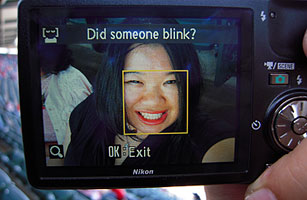
When Joz Wang and her brother bought their mom a Nikon Coolpix S630 digital camera for Mother’s Day last year, they discovered what seemed to be a malfunction. Every time they took a portrait of each other smiling, a message flashed across the screen asking, «Did someone blink?» No one had. «I thought the camera was broken!» Wang, 33, recalls. But when her brother posed with his eyes open so wide that he looked «bug-eyed,» the messages stopped.
Wang, a Taiwanese-American strategy consultant who goes by the Web handle «jozjozjoz,» thought it was funny that the camera had difficulties figuring out when her family had their eyes open. So she posted a photo of the blink warning on her blog under the title, «Racist Camera! No, I did not blink… I’m just Asian!» The post was picked up by Gizmodo and Boing Boing, and prompted at least one commenter to note, «You would think that Nikon, being a Japanese company, would have designed this with Asian eyes in mind.» (See Techland’s top 10 gadgets of 2009.)
Nikon isn’t the only big brand whose consumer cameras have displayed an occasional — though clearly unintentional — bias toward Caucasian faces. Face detection, which is one of the latest «intelligent» technologies to trickle down to consumer cameras, is supposed to make photography more convenient. Some cameras with face detection are designed to warn you when someone blinks; others are programmed to automatically take a picture when somebody smiles — a feature that, theoretically, makes the whole problem of timing your shot to catch the brief glimpse of a grin obsolete. Face detection has also found its way into computer webcams, where it can track a person’s face during a video conference or enable face-recognition software to prevent unauthorized access.
The principle behind face detection is relatively simple, even if the math involved can be complex. Most people have two eyes, eyebrows, a nose and lips — and an algorithm can be trained to look for those common features, or more specifically, their shadows. (For instance, when you take a normal image and heighten the contrast, eye sockets can look like two dark circles.) But even if face detection seems pretty straightforward, the execution isn’t always smooth.
Indeed, just last month, a white employee at an RV dealership in Texas posted a YouTube video showing a black co-worker trying to get the built-in webcam on an HP Pavilion laptop to detect his face and track his movements. The camera zoomed in on the white employee and panned to follow her, but whenever the black employee came into the frame, the webcam stopped dead in its tracks. «I think my blackness is interfering with the computer’s ability to follow me,» the black employee jokingly concludes in the video. «Hewlett-Packard computers are racist.» (See the 50 best inventions of 2009.)
The «HP computers are racist» video went viral, with almost 2 million views, and HP, naturally, was quick to respond. «Everything we do is focused on ensuring that we provide a high-quality experience for all our customers, who are ethnically diverse and live and work around the world,» HP’s lead social-media strategist Tony Welch wrote on a company blog within a week of the video’s posting. «We are working with our partners to learn more.» The post linked to instructions on adjusting the camera settings, something both Consumer Reports and Laptop Magazine tested successfully in Web videos they put online.
Still, some engineers question how a webcam even made it onto the market with this seemingly glaring flaw. «It’s surprising HP didn’t get this right,» says Bill Anderson, president of Oculis Labs in Hunt Valley, Md., a company that develops security software that uses face recognition to protect work computers from prying eyes. «These things are solvable.» Case in point: Sensible Vision, which develops the face-recognition security software that comes with some Dell computers, said their software had no trouble picking up the black employee’s face when they tested the YouTube video.
YouTube commenters expressed what was on a lot of people’s minds. «Seems they rushed the product to market before testing thoroughly enough,» wrote one. «I’m guessing it’s because all the people who tested the software were white,» wrote another. HP declined to comment on their methods for testing the webcam or how involved they were in designing the software, but they did say the software was based on «standard algorithms.» Often, the manufacturers of the camera parts will also supply the software to well-known brands, which might explain why HP isn’t the only company whose cameras have exhibited an accidental prejudice against minorities, since many brands could be using the same flawed code. TIME tested two of Sony’s latest Cyber-shot models with face detection (the DSC-TX1 and DSC-WX1) and found they, too, had a tendency to ignore camera subjects with dark complexions.
But why? It’s not necessarily the programmers’ fault. It comes down to the fact that the software is only as good as its algorithms, or the mathematical rules used to determine what a face is. There are two ways to create them: by hard-coding a list of rules for the computer to follow when looking for a face, or by showing it a sample set of hundreds, if not thousands, of images and letting it figure out what the ones with faces have in common. In this way, a computer can create its own list of rules, and then programmers will tweak them. You might think the more images — and the more diverse the images — that a computer is fed, the better the system will get, but sometimes the opposite is true. The images can begin to generate rules that contradict each other. «If you have a set of 95 images and it recognizes 90 of those, and you feed it five more, you might gain five, but lose three,» says Vincent Hubert, a software engineer at Montreal-based Simbioz, a tech company that is developing futuristic hand-gesture technology like the kind seen in Minority Report. It’s the same kind of problem speech-recognition software faces in handling unusual accents.
And just as the software is only as good as its code and the hardware it lives in, it’s also only as good as the light it’s got to work with. As HP noted in its blog post, the lighting in the YouTube video was dim, and, the company said, there wasn’t enough contrast to pick up the facial shadows the computer needed for seeing. (An overlit person with a fair complexion might have had the same problem.) A better camera wouldn’t necessarily have guaranteed a better result, because there’s another bottleneck: computing power. The constant flow of images is usually too much for the software to handle, so it downsamples them, or reduces the level of detail, before analyzing them. That’s one reason why a person watching the YouTube video can easily make out the black employee’s face, while the computer can’t. «A racially inclusive training set won’t help if the larger platform is not capable of seeing those details,» says Steve Russell, founder and chairman of 3VR, which creates face recognition for security cameras.
The blink problem Wang complained about has less to do with lighting than the plain fact that her Nikon was incapable of distinguishing her narrow eye from a half-closed one. An eye might only be a few pixels wide, and a camera that’s downsampling the images can’t see the necessary level of detail. So a trade-off has to be made: either the blink warning would have a tendency to miss half blinks or a tendency to trigger for narrow eyes. Nikon did not respond to questions from TIME as to how the blink detection was designed to work.
Why these glitches weren’t ironed out before the cameras hit Best Buy is not something that HP, Nikon or Sony, when contacted by TIME, were willing to answer. Perhaps in this market of rapidly developing technologies, consumers who fork over a few hundred dollars for the latest gadget are the test market. A few years ago, speech-recognition software was teeth-gnashingly unreliable. Today, it’s up to 99% accurate. With the flurry of consumer complaints out there, most of the companies seem to be responding. HP has offered instructions on how to adjust its webcam’s sensitivity to backlighting. Nikon says it’s working to improve the accuracy of the blink-warning function on its Coolpix cameras. (Sony wouldn’t comment on the performance of its Cyber-shot cameras and said only that it’s «not possible to track the face accurately all the time.») Perhaps in a few years’ time, the only faces cameras won’t be able to pick up will be those of the blue-skinned humanoids from Avatar.

Eating Late Won’t Make You Fat, Poses for Little Yogis, and Why Sleeping In Makes You More Tired

(By: Health.com)

  • You know you should eat more fruits and veggies and cut out the fatty snacks, but changing your healthy eating habits isn’t always so simple. Make the changes stick with a lifestyle change—improve your eating style. [MyRecipes.com]
  • Just because they’re not the breadwinners or in charge of getting dinner on the table doesn’t mean that kids and teens aren’t stressed. In fact, research shows stress levels among children are increasing. Help them unplug and recharge with these five easy poses for little yogis. [MomLogic]
  • Consider this diet myth busted once and for all: Eating after 7 isn’t causing your weight gain. Rather than torturing yourself to stay nibble-free after dark, focus instead on controlling portion sizes throughout the day. [FitSugar]

Aide: Clinton will address China in Internet freedom speech

(By: CNN)

(CNN) — Secretary of State Hillary Clinton’s Thursday speech on Internet freedom will address the Google censorship fight in China, but won’t stop there, a top adviser said Wednesday.
Alec Ross, Clinton’s senior adviser for innovation, said the address will roll out a new set of policies meant to encourage online freedom worldwide.
«We don’t just view the issue of Internet freedom as an issue of freedom of expression … » said Ross, speaking at a panel hosted by the nonprofit New America Foundation and Slate magazine in Washington. «But it also goes to the issue of what kind of world we want to live in.
«Do we want to live in a world where there is one Internet … or do we want to live in a world where the information you have access to, the knowledge you have access to, is based on what country you live in?»
The conversation comes as search-engine giant Google is threatening to shut down its operations in China, five years after agreeing to allow some censorship in exchange for the right to work in that country’s massive emerging technology market.
Google said on January 12 that the company and at least 20 others were victims of a «highly sophisticated and targeted attack» originating in China in mid-December, evidently to gain access to the e-mail accounts of Chinese human rights activists.
In a statement that day, Clinton said that Google’s allegations of censorship and online attacks by China raised «very serious concerns.»
var currExpandable = «expand1»; var currExpandableHeight = 360;

Days later, foreign correspondents in at least two China bureaus of news organizations had their Google e-mail accounts attacked, with e-mails forwarded to a mysterious address, according to the Foreign Correspondents’ Club of China.
Google now says it’s no longer willing to be censored in China and will consider other options, including leaving the country, if it is not allowed to work without government filters.
Officials at Google briefed State Department staff about last week’s attacks, and the department has officially lodged its concerns with China.
«We’ve asked for an explanation,» Ross said. «We’ve had conversations over the years where we have made clear our concerns about the issue.»
But he said the Obama administration also knows that the situation is primarily a dispute between a U.S.-based corporation and a foreign government.
«We’re taking this very seriously but, all that said, the State Department is not the foreign policy arm of Google,» Ross said.
He said Clinton’s proposals will address China, but noted that it’s far from the only place where the government is known to interfere with online access. Ross said that 31 percent of the world’s population is in countries where there is some Internet censorship.
«It’s something that’s been of a great deal of concern because it really exists at the convergence of economic issues, human rights issues and security issues,» Ross said.
Evgeny Morozov, a Georgetown University fellow and contributing editor at Foreign Policy magazine, said that cyberattacks have been recorded more frequently in places like Russia and Eastern Europe than in China, and that such attacks are increasingly being used against activists everywhere.
«Many [nongovernment organizations] and many activists around the globe are now subject to these attacks, which make their sites inaccessible for a few days a month or a few days a week,» said Morozov, also a panelist Wednesday. «They’re seeing it as a new form of censorship.»
Clinton’s speech is scheduled for 9:30 a.m. ET at the Newseum in Washington, D.C., and will be streamed live at http://www.state.gov.

In it, Clinton «will lay out the Administration’s strategy for protecting freedom in the networked age of the 21st Century,» according to a State department news release.