Ya casi nunca escribo

Pero hoy estoy muy de buenas, ire a comer por 3era vez en el día y hace un maravilloso Sol allá afuera.

No todo sale como uno quiere, no todas las cosas son siempre agradables, pero hay un gran número de ellas que si, y por esas, es que hay que dar gracias, ¿a qué? no lo sé, no puedo ser más ateo.

Finalmente lo que único de lo que estoy seguro es que no me quiero detener, por un lado no puedo evitar seguir mi camino y por otro lado, tengo que ser paciente, todo va salir bien, tengo que entender que las mejores cosas de la vida llegan cuando uno está listo y que además debemos valorarlas, entenderlas, cuidarlas y hacer que duren lo más posible.

La vida es un momento, hay que hacer que ese momento valga la pena.

Make Your Office Eco-Friendly

(By: Wired.com)

 According to a 2009 Gallup poll, the average employed adult works between 35-44 hours a week.

That’s a huge amount of time to spend in the office, and yet the same people who change all their light bulbs to CFLs rarely give a second thought to getting their to-go coffee in a paper cup.

It only takes minutes to make your workspace a little more environmentally friendly. Here are a few tips to get you started.

Mercedes Benz This article is part of a wiki anyone can edit. Got extra advice for greening up your desk at work? Log in and contribute.

1. Turn off the equipment when you leave for the day. Yes, even though Billy from accounting likes to stay late. An action as simple as turning off a 75-watt desktop monitor when you leave can save up to as much as 750 pounds of carbon emissions a year. A power strip can make turning all the equipment off easier at the end of the day, including coffee makers and microwaves. Just make sure the printer is powered down properly, as printers need to seal their cartridges before shutting off.

2. Buy green materials. Switching to recycled printer paper could save thousands of innocent trees a year — and that’s not including paper towels, toilet paper, water cups and all the other products that make working in an office a comfortable enterprise. Many offices have already stopped buying the formerly ubiquitous bottled water. Talk to your office manager about stocking recycled printer paper or replacing the break room cookies with locally grown fruit. And nix printing out separate agendas for everyone at the morning meeting — slides or e-mailed agendas work just fine.

3. Green your duds. If you’re not lucky enough to work in an office where jeans and Chuck Taylors are de rigeur, you already know that great thing about office clothes is that they’re not supposed to be particularly trendy. Consider buying your crisply pressed trousers and blouses from thrift or consignment stores. Also, avoid dry-cleaning. Most dry cleaners use a chemical known as perchloroethylene, which is dangerous for both you and the environment. «Perc» is a known carcinogen that erodes the ozone layer and can easily contaminate groundwater. Most materials, like silk and wool, can be hand-washed. If you must go to a dry cleaner, look for one that uses green cleaning techniques, such as liquid carbon.

4. Telecommute. E-mailing, instant-messaging and videoconferencing have made working from home easier than ever before. Take advantage of it! Getting off the road even one day a week significantly reduces the amount of gasoline you burn, and you can even use the time you save on the trip to have an extra cup of coffee in your reusable ceramic mug. If telecommuting isn’t a possibility for you, consider asking your boss about instituting a commuter credit program for use on public transportation, or putting up a bulletin board for carpooling.

5. Reusable Cups. Avoid using styrofoam cups for anything. Use a mug for coffee and a water bottle for water. If you recycle at home, you can recycle, reduce and reuse at the office too.

6. Recycle Everything. You can recycle everything from your paper and plastics that might come from the vending machines at work, or paper that might otherwise get thrown away. Some companies will even take your old office furniture to recycle the desks and chairs. You could even donate the furniture to a school near by to not only help the community, but also increase the tax write off for the company. Here is a site to reference: Planet Green.

I, Google

(By:Wired.com)

Google’s announcement that it intends to build and test superfast fiber-optic broadband networks in a few communities around the United States has a few locations pulling out all the stops to be chosen with some attention-getting stunts that scream to the search giant: “Pick me! Pick me!”

Some cities have (temporarily) renamed themselves with some sort of Google-ish name. Others have seen that and raised, promising to include “Google” in the name of every newborn. And the negative ads are starting to coming out, with some candidates exposing the shortcomings of others.

I understand the high temperature that this particular fever brings. Ultrahigh-speed broadband from a company such as Google would be massive. The thought of having internet speeds one hundred times faster than my current service is pretty damn appealing. So it didn’t really surprise me when my own hometown of Sarasota, Florida, joined the ranks of Duluth, Minnesota, or Topeka, Kansas, or Buffalo, New York, and others in some sort of publicity stunt to draw the attention of Google.

It’s not unfounded. Sarasota has a lot to offer and of course, I’m biased. The whole thing is a great use of social media, with hundreds of Facebook groups popping up and towns making their own viral videos. Trust me, if you’ve ever been to Central Florida along the coast you wouldn’t think that the populace here would even know what a viral video is, much less be able to comprehend making one.

So far, the most popular stunts have been Topeka renaming their town Google for one month, and Duluth making a set of tongue-in-cheek videos with their mayor proclaiming that every first-born child will be named either Google Fiber or Googlette Fiber. Sarasota has made their own video, showing that Duluth is very cold and Topeka doesn’t have much of a view, while Sarasota is paradise (Tip to Sarasota: Put the video on Google-owned YouTube instead of only Facebook. Just sayin’).

Sarasota currently ranks fifth on the list, while Grand Rapids, Michigan, leads the pack so far with over 20,000 votes. Sarasota’s stunt is renaming the popular park, City Island, to Google Island. Unoriginal at best, but the point is the same.

What is the point? The point is that Google has most likely already chosen a destination for their ultrahigh-speed broadband testing grounds. It’s going to be a town with fiber already in the ground, and it’s going to be a town that has something that will really test the broadband. Google is going to need the right kind of technology and industry in order to truly test their network. A hundred times faster than our current internet speeds is fast, really fast. As individuals, do we really need that type of speed in our homes? Well, of course we do. What kind of question is that?

A great side effect of Google Fiber even thinking about coming into a market such as Sarasota, where Comcast or Verizon are the only options, is that it will prompt both of those companies to adjust their current behavior when it comes to high-speed broadband. Comcast has mentioned restricting broadband, while Verizon is still limited to certain areas. Both these activities will have to change in order to compete. Comcast will have to keep unrestricted broadband, while Verizon might want to think about expanding past the highway, not to mention competitive pricing. Google plans on creating an open-access provider network; that is, they’ll provide their service to independent ISPs who will then sell to you, similar to how the phone system operates.

Which again, filters back to price point. Ultrahigh-speed broadband? The future is here, and its name is Google Fiber. Of course, this could be just the start of Google Skynet for all we know. I for one, welcome my new Google overlords to Sarasota, and I’ll let you all know how superfast and awesome their broadband is.

Towns have until March 26 to nominate themselves through Google’s RFI site.

Read More http://www.wired.com/geekdad/2010/03/i-have-renamed-my-house-google/#ixzz0hoRVtDkq

The Top 10 Movies That Should Never, Ever Be Converted to 3-D

(By: Wired.com)

Photo by Alan Levine; used under Creative Commons Attribution license.

Photo by Alan Levine; used under Creative Commons Attribution license.

Why, really, did the 3-D movie trend start? Does anybody remember, before the trend began, thinking “You know the problem with movies? They’re too two-dimensional?” We didn’t think so. 3-D is so entrenched in the movie industry now that commercials for the upcoming remake of Clash of the Titans actually point out that it is “also in 2-D” — as though that wasn’t the norm.

Now there’s talk of re-releasing classic films, converted to 3-D. You really would think people would learn a lesson from the hue and cry over colorization of old black and white films in the 1980s, but apparently you’d be wrong.

Here, then, are the top 10 movies that, for one reason or another, we at GeekDad fervently hope are never … what would the word be? “3-D-ized?” “Depth-ized?” We need a word that evokes the concept of things that looked fine to begin with getting alterations for superficial, faux-cosmetic reasons in order to earn more money. Perhaps something involving Cher.

10. Alien — The chest-burst scene is quite scary and gory enough, without the baby coming out of the screen towards the audience, thank you very much.

9. The Pirates of the Caribbean films — Orlando Bloom is wooden enough in two dimensions. And besides, with the exception of Jack, virtually all of the characters are one-dimensional, so displaying them in three really seems like overkill.

8. The Evil Dead films — Honestly, we’re just afraid someone might injure himself running away for fear of losing an eye to Bruce Campbell’s chin.

7. The Big Lebowski — While the bowling scenes might look pretty cool in 3-D, consider the scene where the thug pees on The Dude’s rug. Or the scene where Walter bites off a guy’s ear. Some things we’re better off not seeing in 3-D.

6. Die Hard — We’re pretty sure we’re better off not being any closer to the bloodied, sweaty John McClane. We’re afraid that people with overactive imaginations might start to think they can smell him, which is certainly not something to be wished for.

5. Star Trek IV: The Voyage Home — With all due respect to the late, great James Doohan, nobody wants Scotty’s stomach any closer to them than absolutely necessary. Plus, in 3-D, it would probably be pretty obvious that the closeups of the whales were done with models.

4. E.T.: The Extra-Terrestrial — If you or someone you love is the sort who gets emotional at movies, consider how much more powerful the emotions would be if E.T. weren’t just reaching out to Elliott, but to you.

3. The Lord of the Rings trilogy – It would be far too likely that all the careful perspective shots director Peter Jackson used to establish the differences in characters’ size would be lost, or at least badly screwed up, by the 3-D conversion process.

2. The Muppet Movie — This is a near-perfect movie, with, at most a few sour notes in an otherwise symphonic masterpiece. It works, as does anything involving Muppets, because it was meticulously filmed so the Muppets were utterly believable as characters. Converting it to 3-D would be bound to make the Muppets look more like they do in real life — that is to say, less like living beings.

1. The Star Wars saga — As though he hadn’t tinkered with the Star Wars films enough already, George Lucas has publicly stated his intentions to release 3-D versions of them. It wasn’t bad enough that he made Greedo shoot first; now he wants to mess around with the whole look and feel of the movies. If we haven’t made our case yet, we have but three more words for you: 3-D Jar Jar.

There are of course plenty more where those came from — feel free to add your own ideas in the comments. Interestingly, while compiling this list, a few films stuck out as ones that might actually be improved by 3-D conversion — look for a list of those next week.

Read More http://www.wired.com/geekdad/2010/03/the-top-10-movies-that-should-never-ever-be-converted-to-3d/#ixzz0hoPR3ayv

Así es En las Rocas

No hace mucho tiempo, conocí a un grupo de jóvenes músicos que se hacen llamar en las Rocas. 5 talentos y dedicados visionarios, que buscan por medio de la música darle al mundo algo de regreso.

elR han ido forjando cuidadosamente canciones, y sonidos distintos y al mismo tiempo suenan tan familiares, como si siempre hubiesen estado con nosotros. Con mezclas de estilos como Jazz, Blues, Latin, Ska, Rock y algo de Bossa, generan una sensación de calidez, fiesta y festejo sin perder la sensibilidad ni el profesionalismo que exige la creación y la composición musical.

Con estilo propio y auténtico paso a paso están generando una alternativa musical única, digna de representar a su país y a Latinoamérica, estos muchachos están buscando, como todas las bandas, un lugar en el gusto de la gente.

Desde el primer ensayo que los escuché, supe que había algo en ellos que podía, y debía alcanzar la trascendencia en el ambito musical, puesto que la pasión y el trabajo que imprimen en sus melodías es digno de quien hace lo que le gusta para vivir.

Cuando me invitaron a colaborar con ellos, honestamente nunca hubo duda alguna y para mi es un honor y un compromiso dejarlo todo en el escenario junto a ellos, desde el backstage.

elR es un proyecto que cada vez más tiene el rostro de una realidad consolidada, en sus primeros encuentros con el público han recibido una respuesta inapelable, y en la cara de quienes los escuchan, me queda claro que el límite es el cielo.

Pero aún más importante es detenerme ahora y dejar que su música suene, que los acordes terminen de explicar, todo lo anterior a lo que me he venido refiriendo. No me crean pues probablemente es mi emoción la que este dirigiendo en este momento mis pasos y mis enunciados. Los invito a escucharlos en la primera oportunidad estamos programando nuestro siguiente concierto por lo que les pido no dejen de revisar la fanpage y el grupo en facebook, unanse y mantenganse al tanto de la evolución de esta banda, que creanme si no lo hacen desde ahora, hinundaremos la radio en poco tiempo.

Los links son:

http://www.facebook.com/#!/pages/En-las-Rocas/310721595645?ref=ts – Fan Page en las Rocas

http://www.facebook.com/#!/group.php?gid=139860946821&ref=ts – Grupo en las Rocas

y sigan conectados a mi blog, que me encargaré que no pierdan un detalle.

Un abrazo

Marcial Maciel abusó también de sus hijos

 
Marcial MacielEn el programa de Carmen Aristegui, dos jóvenes revelaron cómo el fundador de Los Legionarios de Cristo inventó una identidad para engañar a su madre.
Los hijos de Maciel aseguran que siempre tuvieron una buena imagen de él. (Foto: Archivo)

Detective privado, a veces agente de la CIA, de nombre «Raúl Rivas», con deseos de formar una familia después de enviudar, así se presentaba el sacerdote Marcial Maciel sin hábito. Así abusó sexualmente de sus hijos.

La identidad “secreta” del fundador de los Legionarios de Cristo le ayudó a acercarse a Blanca Estela Lara Gutiérrez, con quien procreó dos hijos y adoptó de un matrimonio anterior de ella. Maciel registró a los niños como «González Lara».

En entrevista con la periodista Carmen Aristegui, la familia Gutiérrez habló por primera vez sobre la vida con “Raúl Rivas” y de los abusos sexuales que cometió con sus hijos.

Blanca Estela conoció a Maciel a finales de la década de 1970, en Tijuana, Baja California. “Lo idolatraba, alguna vez le dije ‘eres mi dios’”. Nunca se casaron, él viajaba continuamente para pasar un tiempo con su familia en Cuernavaca, Morelos (centro del país) y en ocasiones los llevaba con ellos.

“Para obtener el pasaporte, él me hacía pasar por lo difícil, porque un día era Rivas, otro González, pero siempre le creí, nunca dudé de él porque era una buena persona”.

Sus hijos Omar, José Raúl y Cristian también pensaban lo mismo. “Siempre lo vimos como el patriarca de la familia, nos decía que no fumáramos, que tuviéramos novia hasta los 25 años… nunca tuvimos una mala imagen de él”.

Ni las dudas saltaban cuando los extraños se dirigían a él.

“Cuando desayunábamos fuera —cuenta Omar— algunos le decían ‘buenos días, padre’, y teníamos la orden de retirarnos. Nunca nos preguntábamos por qué le decían ‘padre’, suponíamos que era porque tenía muchos hijos”.

Este miércoles, Omar y Raúl contaron que en esos casos, también se encuentran sus historias.

“En 1997, yo estaba haciendo deportes cuando en los puestos de periódicos vi la revista Contenido, vi su foto (de Marcial Maciel) y su nombre. No lo podía creer. Él estaba en Nueva York (EU) y le marqué: ‘¿Por qué dicen que eres esta persona?’. ‘No les creas’, me dijo”.

Desde allí, le ordenó a su hijo Omar que esperara a un hombre, llamado Antonio, que lo llevaría a Cuernavaca, y comprara todos los ejemplares de la publicación. Y así lo hizo.

En el hogar de los «González Lara» no se tocó mucho el tema hasta dos años después cuando Raúl comenzó a sentirse “raro, dudé de mi sexualidad”.

“Primero le conté a mi mamá, le dije que mi padre había abusado de mí y de mi hermano Omar”.

El primer abuso, contó, fue en Colombia cuando tenía 7 años.

“Estaba acostado con él, como cualquier hijo, sin malicia, me bajé mi calzoncillo y me quiso violar. Se da cuenta, no me fuerza. Fue tan impresionante ese momento que hasta el día de hoy recuerdo qué desayuné ese día”.

En el caso de Raúl, le ocurrió en Madrid. “Nos encontrábamos en Madrid, en el mismo cuarto. Él se hacía el dormido, pero nos pedía que lo masturbáramos. Tomaba fotos y se las quedaba. Nos decía que su tío le hacía lo mismo, que ensayáramos con él”.
Más información en CNNMmexico.

Cyberwar Hype Intended to Destroy the Open Internet

(By:Wired.com)

The biggest threat to the open internet is not Chinese government hackers or greedy anti-net-neutrality ISPs, it’s Michael McConnell, the former director of national intelligence.
McConnell’s not dangerous because he knows anything about SQL injection hacks, but because he knows about social engineering. He’s the nice-seeming guy who’s willing and able to use fear-mongering to manipulate the federal bureaucracy for his own ends, while coming off like a straight shooter to those who are not in the know.
When he was head of the country’s national intelligence, he scared President Bush with visions of e-doom, prompting the president to sign a comprehensive secret order that unleashed tens of billions of dollars into the military’s black budget so they could start making firewalls and building malware into military equipment.
And now McConnell is back in civilian life as a vice president at the secretive defense contracting giant Booz Allen Hamilton. He’s out in front of Congress and the media, peddling the same Cybaremaggedon! gloom.
And now he says we need to re-engineer the internet.

We need to develop an early-warning system to monitor cyberspace, identify intrusions and locate the source of attacks with a trail of evidence that can support diplomatic, military and legal options — and we must be able to do this in milliseconds. More specifically, we need to re-engineer the Internet to make attribution, geo-location, intelligence analysis and impact assessment — who did it, from where, why and what was the result — more manageable. The technologies are already available from public and private sources and can be further developed if we have the will to build them into our systems and to work with our allies and trading partners so they will do the same.

Re-read that sentence. He’s talking about changing the internet to make everything anyone does on the net traceable and geo-located so the National Security Agency can pinpoint users and their computers for retaliation if the U.S. government doesn’t like what’s written in an e-mail, what search terms were used, what movies were downloaded. Or the tech could be useful if a computer got hijacked without your knowledge and used as part of a botnet.
The Washington Post gave McConnell free space to declare that we are losing some sort of cyberwar. He argues that the country needs to get a Cold War strategy, one complete with the online equivalent of ICBMs and Eisenhower-era, secret-codenamed projects. Google’s allegation that Chinese hackers infiltrated its Gmail servers and targeted Chinese dissidents proves the United States is “losing” the cyberwar, according to McConnell.
But that’s not warfare. That’s espionage.
McConnell’s op-ed then pointed to breathless stories in The Washington Post and The Wall Street Journal about thousands of malware infections from the well-known Zeus virus. He intimated that the nation’s citizens and corporations were under unstoppable attack by this so-called new breed of hacker malware.
despite the masterful PR about the Zeus infections from security company NetWitness (run by a former Bush Administration cyberczar Amit Yoran), the world’s largest security companies McAfee and Symantec downplayed the story. But the message had already gotten out — the net was under attack.
Brian Krebs, one of the country’s most respected cybercrime journalists and occasional Threat Level contributor, described that report: “Sadly, this botnet documented by NetWitness is neither unusual nor new.”
Those enamored with the idea of “cyberwar” aren’t dissuaded by fact-checking.
They like to point to Estonia, where a number of the government’s websites were rendered temporarily inaccessible by angry Russian citizens. They used a crude, remediable denial-of-service attack to temporarily keep users from viewing government websites. (This attack is akin to sending an army of robots to board a bus, so regular riders can’t get on. A website fixes this the same way a bus company would — by keeping the robots off by identifying the difference between them and humans.) Some like to say this was an act of cyberwar, but if it that was cyberwar, it’s pretty clear the net will be just fine.
In fact, none of these examples demonstrate the existence of a cyberwar, let alone that we are losing it.
But this battle isn’t about truth. It’s about power.
For years, McConnell has wanted the NSA (the ultra-secretive government spy agency responsible for listening in on other countries and for defending classified government computer systems) to take the lead in guarding all government and private networks. Not surprisingly, the contractor he works for has massive, secret contracts with the NSA in that very area. In fact, the company, owned by the shadowy Carlyle Group, is reported to pull in $5 billion a year in government contracts, many of them Top Secret.
Now the problem with developing cyberweapons — say a virus, or a massive botnet for denial-of-service attacks, is that you need to know where to point them. In the Cold War, it wasn’t that hard. In theory, you’d use radar to figure out where a nuclear attack was coming from and then you’d shoot your missiles in that general direction. But online, it’s extremely difficult to tell if an attack traced to a server in China was launched by someone Chinese, or whether it was actually a teenager in Iowa who used a proxy.
That’s why McConnell and others want to change the internet. The military needs targets.
But McConnell isn’t the only threat to the open internet.
Just last week the National Telecommunications and Information Administration — the portion of the Commerce Department that has long overseen the Internet Corporation for Assigned Names and Numbers — said it was time for it to revoke its hands-off-the-internet policy.
That’s according to a February 24 speech by Assistant Commerce Secretary Lawrence E. Strickling.

In fact, “leaving the Internet alone” has been the nation’s internet policy since the internet was first commercialized in the mid-1990s. The primary government imperative then was just to get out of the way to encourage its growth. And the policy set forth in the Telecommunications Act of 1996 was: “to preserve the vibrant and competitive free market that presently exists for the Internet and other interactive computer services, unfettered by Federal or State regulation.”
This was the right policy for the United States in the early stages of the Internet, and the right message to send to the rest of the world. But that was then and this is now.

Now the NTIA needs to start being active to prevent cyberattacks, privacy intrusions and copyright violations, according to Strickling. And since NTIA serves as one of the top advisers to the president on the internet, that stance should not be underestimated.
Add to that — a bill looming in the Senate would hand the president emergency powers over the internet — and you can see where all this is headed. And let the past be our guide.
Following years of the NSA illegally spying on Americans’ e-mails and phone calls as part of a secret anti-terrorism project, Congress voted to legalize the program in July 2008. That vote allowed the NSA to legally turn America’s portion of the internet into a giant listening device for the nation’s intelligence services. The new law also gave legal immunity to the telecoms like AT&T that helped the government illegally spy on American’s e-mails and internet use. Then-Senator Barack Obama voted for this legislation, despite earlier campaign promises to oppose it.
As anyone slightly versed in the internet knows, the net has flourished because no government has control over it.
But there are creeping signs of danger.
Where can this lead? Well, consider England, where a new bill targeting online file sharing will outlaw open internet connections at cafes or at home, in a bid to track piracy.
To be sure, we could see more demands by the government for surveillance capabilities and backdoors in routers and operating systems. Already, the feds successfully turned the Communications Assistance for Law Enforcement Act (a law mandating surveillance capabilities in telephone switches) into a tool requiring ISPs to build similar government-specified eavesdropping capabilities into their networks.
The NSA dreams of “living in the network,” and that’s what McConnell is calling for in his editorial/advertisement for his company. The NSA lost any credibility it had when it secretly violated American law and its most central tenet: “We don’t spy on Americans.”
Unfortunately, the private sector is ignoring that tenet and is helping the NSA and contractors like Booz Allen Hamilton worm their way into the innards of the net. Security companies make no fuss, since a scared populace and fear-induced federal spending means big bucks in bloated contracts. Google is no help either, recently turning to the NSA for help with its rather routine infiltration by hackers.
Make no mistake, the military industrial complex now has its eye on the internet. Generals want to train crack squads of hackers and have wet dreams of cyberwarfare. Never shy of extending its power, the military industrial complex wants to turn the internet into yet another venue for an arms race.
And it’s waging a psychological warfare campaign on the American people to make that so. The military industrial complex is backed by sensationalism, and a gullible and pageview-hungry media. Notable examples include the New York Times’s John “We Need a New Internet” Markoff, 60 Minutes’Hackers Took Down Brazilian Power Grid,” and the WSJ’s Siobhan Gorman, who ominously warned in an a piece lacking any verifiable evidence, that Chinese and Russian hackers are already hiding inside the U.S. electrical grid.
Now the question is: Which of these events can be turned into a Gulf of Tonkin-like fakery that can create enough fear to let the military and the government turn the open internet into a controlled, surveillance-friendly net.
What do they dream of? Think of the internet turning into a tightly monitored AOL circa the early ’90s, run by CEO Big Brother and COO Dr. Strangelove.
That’s what McConnell has in mind, and shame on The Washington Post and the Senate Commerce, Science and Transportation Committee for giving McConnell venues to try to make that happen — without highlighting that McConnell has a serious financial stake in the outcome of this debate.
Of course, the net has security problems, and there are pirated movies and spam and botnets trying to steal credit card information.
But the online world mimics real life. Just as I know where online to buy a replica of a Coach handbag or watch a new release, I know exactly where I can go to find the same things in the city I live in. There are cons and rip-offs in the real world, just as there are online. I’m more likely to get ripped off by a restaurant server copying down the information on my credit card than I am having my card stolen and used for fraud while shopping online. “Top Secret” information is more likely to end up in the hands of a foreign government through an employee-turned-spy than from a hacker.
But cyber-anything is much scarier than the real world.
The NSA can help private companies and networks tighten up their security systems, as McConnell argues. In fact, they already do, and they should continue passing along advice and creating guides to locking down servers and releasing their own secure version of Linux. But companies like Google and AT&T have no business letting the NSA into their networks or giving the NSA information that they won’t share with the American people.
Security companies have long relied on creating fear in internet users by hyping the latest threat, whether that be Conficker or the latest PDF flaw. And now they are reaping billions of dollars in security contracts from the federal government for their PR efforts. But the industry and its most influential voices need to take a hard look at the consequences of that strategy and start talking truth to power’s claims that we are losing some non-existent cyberwar.
The internet is a hack that seems forever on the edge of falling apart. For awhile, spam looked like it was going to kill e-mail, the net’s first killer app. But smart filters have reduced the problem to a minor nuisance as anyone with a Gmail account can tell you. That’s how the internet survives. The apocalypse looks like it’s coming and it never does, but meanwhile, it becomes more and more useful to our everyday lives, spreading innovation, weird culture, news, commerce and healthy dissent.
But one thing it hasn’t spread is “cyberwar.” There is no cyberwar and we are not losing it. The only war going on is one for the soul of the internet. But if journalists, bloggers and the security industry continue to let self-interested exaggerators dominate our nation’s discourse about online security, we will lose that war — and the open internet will be its biggest casualty.
UPDATE: In an interesting coincidence, the Obama administration unclassified on Tuesday portions of the secret Comprehensive National Cybersecurity Initiative it inherited from President Bush, including unclassified summaries all of the 12 initiatives. Note the veiled references to deterrence.
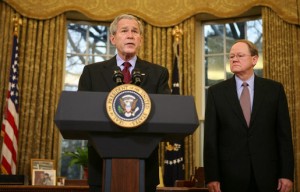
Photo: Michael McConnell, then-Director of National Intelligence, watches on in 2008 as President Bush announced the Protect America Act. White House file photo.