Are Face-Detection Cameras Racist?

(By: Time)

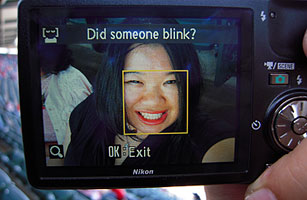
When Joz Wang and her brother bought their mom a Nikon Coolpix S630 digital camera for Mother’s Day last year, they discovered what seemed to be a malfunction. Every time they took a portrait of each other smiling, a message flashed across the screen asking, «Did someone blink?» No one had. «I thought the camera was broken!» Wang, 33, recalls. But when her brother posed with his eyes open so wide that he looked «bug-eyed,» the messages stopped.
Wang, a Taiwanese-American strategy consultant who goes by the Web handle «jozjozjoz,» thought it was funny that the camera had difficulties figuring out when her family had their eyes open. So she posted a photo of the blink warning on her blog under the title, «Racist Camera! No, I did not blink… I’m just Asian!» The post was picked up by Gizmodo and Boing Boing, and prompted at least one commenter to note, «You would think that Nikon, being a Japanese company, would have designed this with Asian eyes in mind.» (See Techland’s top 10 gadgets of 2009.)
Nikon isn’t the only big brand whose consumer cameras have displayed an occasional — though clearly unintentional — bias toward Caucasian faces. Face detection, which is one of the latest «intelligent» technologies to trickle down to consumer cameras, is supposed to make photography more convenient. Some cameras with face detection are designed to warn you when someone blinks; others are programmed to automatically take a picture when somebody smiles — a feature that, theoretically, makes the whole problem of timing your shot to catch the brief glimpse of a grin obsolete. Face detection has also found its way into computer webcams, where it can track a person’s face during a video conference or enable face-recognition software to prevent unauthorized access.
The principle behind face detection is relatively simple, even if the math involved can be complex. Most people have two eyes, eyebrows, a nose and lips — and an algorithm can be trained to look for those common features, or more specifically, their shadows. (For instance, when you take a normal image and heighten the contrast, eye sockets can look like two dark circles.) But even if face detection seems pretty straightforward, the execution isn’t always smooth.
Indeed, just last month, a white employee at an RV dealership in Texas posted a YouTube video showing a black co-worker trying to get the built-in webcam on an HP Pavilion laptop to detect his face and track his movements. The camera zoomed in on the white employee and panned to follow her, but whenever the black employee came into the frame, the webcam stopped dead in its tracks. «I think my blackness is interfering with the computer’s ability to follow me,» the black employee jokingly concludes in the video. «Hewlett-Packard computers are racist.» (See the 50 best inventions of 2009.)
The «HP computers are racist» video went viral, with almost 2 million views, and HP, naturally, was quick to respond. «Everything we do is focused on ensuring that we provide a high-quality experience for all our customers, who are ethnically diverse and live and work around the world,» HP’s lead social-media strategist Tony Welch wrote on a company blog within a week of the video’s posting. «We are working with our partners to learn more.» The post linked to instructions on adjusting the camera settings, something both Consumer Reports and Laptop Magazine tested successfully in Web videos they put online.
Still, some engineers question how a webcam even made it onto the market with this seemingly glaring flaw. «It’s surprising HP didn’t get this right,» says Bill Anderson, president of Oculis Labs in Hunt Valley, Md., a company that develops security software that uses face recognition to protect work computers from prying eyes. «These things are solvable.» Case in point: Sensible Vision, which develops the face-recognition security software that comes with some Dell computers, said their software had no trouble picking up the black employee’s face when they tested the YouTube video.
YouTube commenters expressed what was on a lot of people’s minds. «Seems they rushed the product to market before testing thoroughly enough,» wrote one. «I’m guessing it’s because all the people who tested the software were white,» wrote another. HP declined to comment on their methods for testing the webcam or how involved they were in designing the software, but they did say the software was based on «standard algorithms.» Often, the manufacturers of the camera parts will also supply the software to well-known brands, which might explain why HP isn’t the only company whose cameras have exhibited an accidental prejudice against minorities, since many brands could be using the same flawed code. TIME tested two of Sony’s latest Cyber-shot models with face detection (the DSC-TX1 and DSC-WX1) and found they, too, had a tendency to ignore camera subjects with dark complexions.
But why? It’s not necessarily the programmers’ fault. It comes down to the fact that the software is only as good as its algorithms, or the mathematical rules used to determine what a face is. There are two ways to create them: by hard-coding a list of rules for the computer to follow when looking for a face, or by showing it a sample set of hundreds, if not thousands, of images and letting it figure out what the ones with faces have in common. In this way, a computer can create its own list of rules, and then programmers will tweak them. You might think the more images — and the more diverse the images — that a computer is fed, the better the system will get, but sometimes the opposite is true. The images can begin to generate rules that contradict each other. «If you have a set of 95 images and it recognizes 90 of those, and you feed it five more, you might gain five, but lose three,» says Vincent Hubert, a software engineer at Montreal-based Simbioz, a tech company that is developing futuristic hand-gesture technology like the kind seen in Minority Report. It’s the same kind of problem speech-recognition software faces in handling unusual accents.
And just as the software is only as good as its code and the hardware it lives in, it’s also only as good as the light it’s got to work with. As HP noted in its blog post, the lighting in the YouTube video was dim, and, the company said, there wasn’t enough contrast to pick up the facial shadows the computer needed for seeing. (An overlit person with a fair complexion might have had the same problem.) A better camera wouldn’t necessarily have guaranteed a better result, because there’s another bottleneck: computing power. The constant flow of images is usually too much for the software to handle, so it downsamples them, or reduces the level of detail, before analyzing them. That’s one reason why a person watching the YouTube video can easily make out the black employee’s face, while the computer can’t. «A racially inclusive training set won’t help if the larger platform is not capable of seeing those details,» says Steve Russell, founder and chairman of 3VR, which creates face recognition for security cameras.
The blink problem Wang complained about has less to do with lighting than the plain fact that her Nikon was incapable of distinguishing her narrow eye from a half-closed one. An eye might only be a few pixels wide, and a camera that’s downsampling the images can’t see the necessary level of detail. So a trade-off has to be made: either the blink warning would have a tendency to miss half blinks or a tendency to trigger for narrow eyes. Nikon did not respond to questions from TIME as to how the blink detection was designed to work.
Why these glitches weren’t ironed out before the cameras hit Best Buy is not something that HP, Nikon or Sony, when contacted by TIME, were willing to answer. Perhaps in this market of rapidly developing technologies, consumers who fork over a few hundred dollars for the latest gadget are the test market. A few years ago, speech-recognition software was teeth-gnashingly unreliable. Today, it’s up to 99% accurate. With the flurry of consumer complaints out there, most of the companies seem to be responding. HP has offered instructions on how to adjust its webcam’s sensitivity to backlighting. Nikon says it’s working to improve the accuracy of the blink-warning function on its Coolpix cameras. (Sony wouldn’t comment on the performance of its Cyber-shot cameras and said only that it’s «not possible to track the face accurately all the time.») Perhaps in a few years’ time, the only faces cameras won’t be able to pick up will be those of the blue-skinned humanoids from Avatar.

Eating Late Won’t Make You Fat, Poses for Little Yogis, and Why Sleeping In Makes You More Tired

(By: Health.com)

  • You know you should eat more fruits and veggies and cut out the fatty snacks, but changing your healthy eating habits isn’t always so simple. Make the changes stick with a lifestyle change—improve your eating style. [MyRecipes.com]
  • Just because they’re not the breadwinners or in charge of getting dinner on the table doesn’t mean that kids and teens aren’t stressed. In fact, research shows stress levels among children are increasing. Help them unplug and recharge with these five easy poses for little yogis. [MomLogic]
  • Consider this diet myth busted once and for all: Eating after 7 isn’t causing your weight gain. Rather than torturing yourself to stay nibble-free after dark, focus instead on controlling portion sizes throughout the day. [FitSugar]

Aide: Clinton will address China in Internet freedom speech

(By: CNN)

(CNN) — Secretary of State Hillary Clinton’s Thursday speech on Internet freedom will address the Google censorship fight in China, but won’t stop there, a top adviser said Wednesday.
Alec Ross, Clinton’s senior adviser for innovation, said the address will roll out a new set of policies meant to encourage online freedom worldwide.
«We don’t just view the issue of Internet freedom as an issue of freedom of expression … » said Ross, speaking at a panel hosted by the nonprofit New America Foundation and Slate magazine in Washington. «But it also goes to the issue of what kind of world we want to live in.
«Do we want to live in a world where there is one Internet … or do we want to live in a world where the information you have access to, the knowledge you have access to, is based on what country you live in?»
The conversation comes as search-engine giant Google is threatening to shut down its operations in China, five years after agreeing to allow some censorship in exchange for the right to work in that country’s massive emerging technology market.
Google said on January 12 that the company and at least 20 others were victims of a «highly sophisticated and targeted attack» originating in China in mid-December, evidently to gain access to the e-mail accounts of Chinese human rights activists.
In a statement that day, Clinton said that Google’s allegations of censorship and online attacks by China raised «very serious concerns.»
var currExpandable = «expand1»; var currExpandableHeight = 360;

Days later, foreign correspondents in at least two China bureaus of news organizations had their Google e-mail accounts attacked, with e-mails forwarded to a mysterious address, according to the Foreign Correspondents’ Club of China.
Google now says it’s no longer willing to be censored in China and will consider other options, including leaving the country, if it is not allowed to work without government filters.
Officials at Google briefed State Department staff about last week’s attacks, and the department has officially lodged its concerns with China.
«We’ve asked for an explanation,» Ross said. «We’ve had conversations over the years where we have made clear our concerns about the issue.»
But he said the Obama administration also knows that the situation is primarily a dispute between a U.S.-based corporation and a foreign government.
«We’re taking this very seriously but, all that said, the State Department is not the foreign policy arm of Google,» Ross said.
He said Clinton’s proposals will address China, but noted that it’s far from the only place where the government is known to interfere with online access. Ross said that 31 percent of the world’s population is in countries where there is some Internet censorship.
«It’s something that’s been of a great deal of concern because it really exists at the convergence of economic issues, human rights issues and security issues,» Ross said.
Evgeny Morozov, a Georgetown University fellow and contributing editor at Foreign Policy magazine, said that cyberattacks have been recorded more frequently in places like Russia and Eastern Europe than in China, and that such attacks are increasingly being used against activists everywhere.
«Many [nongovernment organizations] and many activists around the globe are now subject to these attacks, which make their sites inaccessible for a few days a month or a few days a week,» said Morozov, also a panelist Wednesday. «They’re seeing it as a new form of censorship.»
Clinton’s speech is scheduled for 9:30 a.m. ET at the Newseum in Washington, D.C., and will be streamed live at http://www.state.gov.

In it, Clinton «will lay out the Administration’s strategy for protecting freedom in the networked age of the 21st Century,» according to a State department news release.

Internet vía CFE

(By: Milenio.com)


Alfredo Elías Ayub, director general de la CFE, entrará a la competencia en telecomunicaciones y antes de concluir este mes dará detalles de un nuevo servicio para empresas públicas y privadas: internet a través de los 22 mil kilómetros de fibra óptica que tiene CFE Telecom que podrá hacer enlaces nacionales e internacionales. La velocidad de conexión estará en el rango de 2, 10 y 100 megabytes por segundo (MBPS) o uno y 10 gigabytes por segundo (GBPS).
La empresa promete “transformar la conectividad de internet de México, contribuyendo con una oferta muy competitiva, transparente y sencilla”, incluso en localidades donde anteriormente no existía. Un aspecto importante es que el servicio para todos los clientes será simétrico, es decir, el mismo ancho de banda de entrada y salida de datos.
Se cobrará una renta mensual por megabayte y otra por puerto en contratos de un año. Por dos MBPS se pagarán mil 574 y tres mil 147 pesos, respectivamente; por 10 MBPS serán mil 142 y 11 mil 423 pesos; por 100 MBPS serán 662 y 72 mil 242 pesos; por un GBPS los pagos respectivos serán de 457 y 456 mil 867 pesos y por 10 GBPS de 289 y dos millones 889 mil 282 pesos.
El servicio que se ofrecerá a partir de enero, dice CFE Telecom —salvo el correspondiente a uno y 10 gigas que se facilitará a mediados de año—, será de “clase mundial” en las “localidades y hoteles Telecom con que contamos actualmente” (220 en todo el país); el precio será uno solo a escala nacional; el servicio será de las más alta “confiabilidad y seguridad” en su operación, para clientes que “requieren una conexión de alto desempeño” y versatilidad. Sobre la seguridad dice que la red está “diseñada para soportar ataques tales como DDoS, hacking, spoofing, etc.”
También proporcionará valores agregados como Direcciones IP y Resolución de Nombres de Dominio (DNS) sin cargo adicional.
Cuarto de junto
El pasado 15 de enero se integró el Comité de Elección de la Concamín para decidir quién dirigirá los destinos del principal organismo de los industriales del país para el periodo 2010-2011. Participarán dos ex presidentes: Ernesto Rubio del Cueto y Vicente Bortoni, y dos industriales: Jesús de la Rosa y Gabriel Garza; el secretario es Manuel Reguera. Salomón Presburger busca la reelección.

Chinese Internet users praise Google’s threat to exit

<a href=»http://ad.doubleclick.net/jump/trb.latimes/news;ptype=s;slug=la-fi-china-google-2010jan14;rg=ur;pos=T;sz=728×90;tile=1;at=Computing and Information Technology;at=Online;at=Computer Crime;at=Microsoft Corp;at=Parties and Movements;at=Demonstration;at=Hillary Clinton;at=Unrest Conflicts and War;at=Censorship;at=Human Rights;at=Crimes;at=Google Inc;at=Crime Law and Justice;at=Beijing China;at=Economy Business and Finance;at=Companies and Corporations;at=Activism;at=Corruption;at=Internet;at=Mountain View Santa Clara California;at=Berlin Wall’s Fall 1989;at=Corporate Crime;at=China;at=Justice and Rights;at=Civil Rights;at=Arts and Culture;at=Politics;at=South Broward Hospital District;u=http://www.latimes.com/news/la-fi-china-google-2010jan14,0,1274986.story;ord=25913147?» target=»_blank» rel=»nofollow»><img src=»http://ad.doubleclick.net/ad/trb.latimes/news;ptype=s;slug=la-fi-china-google-2010jan14;rg=ur;pos=T;dcopt=ist;sz=728×90;tile=1;at=Computing and Information Technology;at=Online;at=Computer Crime;at=Microsoft Corp;at=Parties and Movements;at=Demonstration;at=Hillary Clinton;at=Unrest Conflicts and War;at=Censorship;at=Human Rights;at=Crimes;at=Google Inc;at=Crime Law and Justice;at=Beijing China;at=Economy Business and Finance;at=Companies and Corporations;at=Activism;at=Corruption;at=Internet;at=Mountain View Santa Clara California;at=Berlin Wall’s Fall 1989;at=Corporate Crime;at=China;at=Justice and Rights;at=Civil Rights;at=Arts and Culture;at=Politics;at=South Broward Hospital District;u=http://www.latimes.com/news/la-fi-china-google-2010jan14,0,1274986.story;ord=25913147?» width=»728″ height=»90″ border=»0″ alt=»»></a>

(By: LA times)

Online word spread quickly of Google’s possible departure from the country rather than tolerate more censorship of its Chinese-language site. Beijing downplays the news.

Reporting from Beijing – Bouquets of flowers were laid in front of Google Inc.’s headquarters in China today, a show of support for a company whose threat to exit China rather than tolerate more censorship is a dramatic shot across the bow of the Chinese Communist Party.

But while Chinese cyberspace was awash with chatter on Google’s gambit, state-media downplayed the news Tuesday, saying Google had been a victim of cyber attacks in China but made no mention that the company also alleged human rights activists had their e-mail accounts hacked.

Nevertheless, word spread quickly among China’s savvier Internet users that the Mountain View, Calif., company was no longer willing to censor its Chinese-language search engine. Some noticed that Google searches for the 1989 Tiananmen crackdown turned up the banned, but iconic, photograph of a protester standing in front of a line of tanks.

«It is the first time a company this size has made a stand like this. People are cheering Google,» said Jeremy Goldkorn, whose influential website, danwei.org, has been blocked since last summer by China’s Internet filtering technology, known as the Great Firewall.

Bei Feng, a blogger who led a campaign to abolish the firewall, said losing Google would be a big blow. However, he and many others like him would likely use proxy servers to continue accessing their products.

«I admire Google’s decision a lot,» said Bei, whose e-mail account has been hacked into in the past. «Obviously it is a huge loss for Chinese Internet users. Sometimes such a price has to be paid for the long term. It’s a huge slap in the face for the Chinese communist party. I think they will try to retaliate.»

Beijing has yet to respond in name to the search engine’s announcement. The government’s New China News Agency reported today that an unnamed lower official in China’s Cabinet was seeking more information on Google’s new stance.

«It is still hard to say whether Google will quit China or not. Nobody knows,» the official said.

U.S. Secretary of State Hillary Rodham Clinton said Tuesday that Google’s allegations raised serious concerns.

«We look to the Chinese government for an explanation,» she said in Honolulu. «The ability to operate with confidence in cyberspace is critical in a modern society and economy.»

China stepped up its Internet controls in 2009, launching a campaign against pornography and illegal downloading that critics say was a guise to limit more freedom of information.

Chinese bloggers are increasingly clamoring for the government to tear down the firewall with language evoking the fall of the Berlin Wall in 1989.

President Obama made internet censorship a central theme of his maiden visit to China in November, inviting bloggers to submit questions at a «town hall» meeting in Shanghai.

Human rights groups viewed Google’s decision to make its allegations public as a step in the right direction — explaining it placed pressure on Beijing to reconsider its approach to the Internet because of the purported cyber attacks on, not only Google, but various foreign companies.

«The ball is now in the Chinese government’s court,» said Sharon Hom of Human Rights in China. «They have to prove that doing business in China is safe, fair and predictable.»

Google has always played second fiddle to China’s most popular search engine, Baidu.com. It struggled to resonate with the majority of China’s 300 million Internet users, many who favor easy access to pirated songs and chat forums.

Where the search engine succeeded was in appealing to many of China’s young and progressive voices — often a minority of bloggers, activists and proponents of information freedom.

The company invested deeply in research and development by hiring university graduates. After a protracted legal battle with Microsoft, they lured away executive Kai-Fu Lee, a hero to China’s tech-savvy urbanites with his top-selling motivational books.

An online survey of over 13,000 people on the news site, huanqiu.com, asked if the Chinese government should accommodate Google. About three-quarters said «yes» by late today.

But not all were sympathetic to Google’s stand. Fang Xingdong, an IT blogger, said he felt betrayed by the company.

«I think it’s a stupid decision for Google,» Fang said. «They didn’t consult Chinese Internet users. It is extremely irresponsible. . . . In terms of innovation, Google is a world leader. If they pull out, it is going to be a huge blow to the Internet industry in China.»

david.pierson@latimes.com

barbara.demick@latimes.com

Tommy Yang in the Times’ Beijing bureau contributed to this report.

textSize()

How to Hollow a Book in 80 Easy Steps

Lessons borne of trial and error and error

Pick out a hardcover book. Pick out a hardcover book.
Make sure it's structurally sound and kind of pretty, but wouldn't stick out too much on a bookshelf. Bonus points for a nice book jacket too, but more on that later. Make sure it’s structurally sound and kind of pretty, but wouldn’t stick out too much on a bookshelf. Bonus points for a nice book jacket too, but more on that later.
Gather materials: Ruler, X-Acto knife, 3 or 4 fresh blades, pencil, tape, scrap paper, plastic wrap. Gather materials: Ruler, X-Acto knife, 3 or 4 fresh blades, pencil, tape, scrap paper, plastic wrap.
Wait, there's more! Glue, a little cup for glue, and an old paintbrush. Wait, there’s more! Glue, a little cup for glue, and an old paintbrush.
Take a minute and appreciate the book you're about to totally destroy. Go on, feel a little guilty. Remind yourself that true art is ephemeral and move on. Take a minute and appreciate the book you’re about to totally destroy. Go on, feel a little guilty. Remind yourself that true art is ephemeral and move on.
Open up the book and find the prettiest page. Not this one … Open up the book and find the prettiest page. Not this one …
Meh … Meh …
Plants are so weird … Plants are so weird …
Nah … Nah …
It's perfect! It’s perfect!
Use the X-Acto knife to carefully cut the page out of the book as close to the spine as you can. Don't use too much pressure if it's a fresh blade; you only need to extract The One. Use the X-Acto knife to carefully cut the page out of the book as close to the spine as you can. Don’t use too much pressure if it’s a fresh blade; you only need to extract The One.
Set it aside, out of harm's way. While you're at it, take off the cover if it has one and set that aside, too. You won't need them anytime soon. Set it aside, out of harm’s way. While you’re at it, take off the cover if it has one and set that aside, too. You won’t need them anytime soon.
You will, however, need that plastic wrap soon, so whip it out. You will, however, need that plastic wrap soon, so whip it out.
Tape, too! Tape, too!
Flip to the back cover. Get a nice big piece of plastic wrap and line it up with the inside of the spine. Flip to the back cover. Get a nice big piece of plastic wrap and line it up with the inside of the spine.
Close the book so you're looking at the back cover. Close the book so you’re looking at the back cover.
Wrap the plastic around the cover and tape it in place because you're a cautious person. Wrap the plastic around the cover and tape it in place because you’re a cautious person.
A really cautious person. A really cautious person.
Now open up the front of the book and flip through the first few pages. Choose your favorite left-side page. (There was nothing too great in this one, so I just chose the table of contents.) Now – this is important! – turn exactly one more page. You should not be able to see your chosen page anymore! Now open up the front of the book and flip through the first few pages. Choose your favorite left-side page. (There was nothing too great in this one, so I just chose the table of contents.) Now – this is important! – turn exactly one more page. You should not be able to see your chosen page anymore!
Wrap these pages up with the cover the same way as before. Wrap these pages up with the cover the same way as before.
Make sure the plastic on both sides is as close to the spine as you can get it. Make sure the plastic on both sides is as close to the spine as you can get it.
Squeeze some glue into your glue cup. Squeeze some glue into your glue cup.
Now add a little water to the glue. I find that 80% glue, 20% water works best. If you make it too thick, the glue will be harder to spread and more noticeable on the edge of the pages. If you make it too watery, it will be weaker, warp the pages and take forever to dry. It's a delicate balance. Now add a little water to the glue. I find that 80% glue, 20% water works best. If you make it too thick, the glue will be harder to spread and more noticeable on the edge of the pages. If you make it too watery, it will be weaker, warp the pages and take forever to dry. It’s a delicate balance.
Mix it up with your paintbrush. Mix it up with your paintbrush.
Start applying your glue mixture to the page edges, working your way out from the spine. Don't be afraid to use a lot of glue; it will dry more or less invisibly. Start applying your glue mixture to the page edges, working your way out from the spine. Don’t be afraid to use a lot of glue; it will dry more or less invisibly.
… not that it's particularly visible at this stage, either. No matter. … not that it’s particularly visible at this stage, either. No matter.
Gather up your roommate's MCAT review and cookbooks (unless you are that weird roommate who likes cooking and going to med school, in which case, use your own, freak). Plop 'em on top of your book. If necessary, enlist the help of your heavy fish bowl. Gather up your roommate’s MCAT review and cookbooks (unless you are that weird roommate who likes cooking and going to med school, in which case, use your own, freak). Plop ‘em on top of your book. If necessary, enlist the help of your heavy fish bowl.
Hi, Maurice! Hi, Maurice!
Make yourself a nice hot beverage while you wait for your book to dry. Make yourself a nice hot beverage while you wait for your book to dry.
Go ahead and dick around with your camera while you wait, too. Go ahead and dick around with your camera while you wait, too.
Oh my god, is this thing seriously still drying? It's been like 20 minutes. Oh my god, is this thing seriously still drying? It’s been like 20 minutes.
Uggghhh. Can I start slicing yet? Uggghhh. Can I start slicing yet?
It's dry! Test for structural integrity. If the pages aren't pretty well bound together at the edges, apply another coat of glue and wait for it to dry again. It’s dry! Test for structural integrity. If the pages aren’t pretty well bound together at the edges, apply another coat of glue and wait for it to dry again.
Open to the first page that's not wrapped in plastic. Open to the first page that’s not wrapped in plastic.
Use your ruler to measure and mark a half inch border around this page. Use your ruler to measure and mark a half inch border around this page.
Don't worry if you go overboard with the pencil; it will be covered later. Don’t worry if you go overboard with the pencil; it will be covered later.
Line your ruler up carefully with one of the corners. Use your X-Acto knife to trace the line, as neatly as you can, around the whole page. Tip: You can speed up the cutting later, but now is the time to cut with extreme patience and care! Line your ruler up carefully with one of the corners. Use your X-Acto knife to trace the line, as neatly as you can, around the whole page. Tip: You can speed up the cutting later, but now is the time to cut with extreme patience and care!
Remove however many pages your slicing has now freed. In general, don't force pages out; make sure you've cut all the way through, especially at the corners. Remove however many pages your slicing has now freed. In general, don’t force pages out; make sure you’ve cut all the way through, especially at the corners.
This pile is about to get a lot bigger. This pile is about to get a lot bigger.
Continue slicing and removing pages. At this point you shouldn't need the ruler anymore. Continue slicing and removing pages. At this point you shouldn’t need the ruler anymore.
Whenever it starts getting harder to cut, feel free to swap out your X-Acto blade. I usually go through at least three per book. If you try to make them last, the cutting process will take a lot longer, and you're not allowed to sue me if you develop chronic wrist pain. Whenever it starts getting harder to cut, feel free to swap out your X-Acto blade. I usually go through at least three per book. If you try to make them last, the cutting process will take a lot longer, and you’re not allowed to sue me if you develop chronic wrist pain.
Keeping your corners clean is the hardest part, but once you get sloppy it only becomes harder, so it's worth it. Keeping your corners clean is the hardest part, but once you get sloppy it only becomes harder, so it’s worth it.
You have an audio book, right? At least some podcasts, I hope. I recommend This American Life and The Moth if you're into that kind of thing. You have an audio book, right? At least some podcasts, I hope. I recommend This American Life and The Moth if you’re into that kind of thing.
Check how far you are from the back so you know when you're close to finishing. Check how far you are from the back so you know when you’re close to finishing.
You made it! You made it!
You weren't as attentive as you thought and sliced right through to the back cover. Way to go, champ. You weren’t as attentive as you thought and sliced right through to the back cover. Way to go, champ.
Say your goodbyes. Say your goodbyes.
You probably want to rewrap the back cover at this point since you carelessly sliced through the plastic. You probably want to rewrap the back cover at this point since you carelessly sliced through the plastic.
Apply an unholy amount of glue to the inside of the book, and to the ½ inch border of the first page. Really, go nuts! If it doesn't look like a six year old was responsible when you're done, you screwed up. Apply an unholy amount of glue to the inside of the book, and to the ½» border of the first page. Really, go nuts! If it doesn’t look like a six year old was responsible when you’re done, you screwed up.
Carefully pull one page out of the plastic wrapped pages and press it down on top of the glue-covered border. Smooth it out as well as you can, starting at the spine. Carefully pull one page out of the plastic wrapped pages and press it down on top of the glue-covered border. Smooth it out as well as you can, starting at the spine.
Close the book again … Close the book again …
… and reacquaint it with Maurice, MCAT reviews, and The Joy of Cooking. Let it dry for a few hours; since the inside is completely enclosed, it will take a little longer than the edges did. … and reacquaint it with Maurice, MCAT reviews, and The Joy of Cooking. Let it dry for a few hours; since the inside is completely enclosed, it will take a little longer than the edges did.
Open it up when you're pretty sure it's dry. Open it up when you’re pretty sure it’s dry.
Carefully slice the first page open (bonus points for autopsy-style), starting at the corners. Carefully slice the first page open (bonus points for autopsy-style), starting at the corners.
Now carefully cut the page along the edges. Now carefully cut the page along the edges.
This part is really satisfying. This part is really satisfying.
Tadaaa! Tadaaa!
Admire your handiwork some more. Admire your handiwork some more.
Hollowed book pr0n Hollowed book pr0n
Okay, enough of that. Remember how you haphazardly sliced up the back cover? Here's where we fix it. Okay, enough of that. Remember how you haphazardly sliced up the back cover? Here’s where we fix it.
Go get that page you set aside at the beginning. Go get that page you set aside at the beginning.
Line it up so it looks nice when the pages are laid against the back cover. Line it up so it looks nice when the pages are laid against the back cover.
Mark where you want to cut the page so that it doesn't hang over the edges … Mark where you want to cut the page so that it doesn’t hang over the edges …
… and slice as needed to make it fit where you want it. … and slice as needed to make it fit where you want it.
Ah, much better. Ah, much better.
Okay, now set your pretty, cut-to-fit page aside once more and get out the book jacket, if you have one. (If not, just scroll past all this book jacket stuff.) Okay, now set your pretty, cut-to-fit page aside once more and get out the book jacket, if you have one. (If not, just scroll past all this book jacket stuff.)
Wrap the book jacket around the back cover, under the pages, so that it would look natural if the book were closed. Wrap the book jacket around the back cover, under the pages, so that it would look natural if the book were closed.
This is how you'll be gluing it. This is how you’ll be gluing it.
Now, apply glue to the back of the interior-facing book jacket fold and press it against the back cover. Close the pages to help it dry flat. Now, apply glue to the back of the interior-facing book jacket fold and press it against the back cover. Close the pages to help it dry flat.
If the edge is sticking up, place your ruler over it to hold it down while it dries. If the edge is sticking up, place your ruler over it to hold it down while it dries.
It shouldn't take long. It shouldn’t take long.
Once it's dry, glue the loose page on top of it. Once it’s dry, glue the loose page on top of it.
Use the ruler to get rid of that pesky bump, then simply glue the pages to the back cover. Use the ruler to get rid of that pesky bump, then simply glue the pages to the back cover.
The book jacket should be able to move freely; there's no need to glue more than that one strip on the back. The book jacket should be able to move freely; there’s no need to glue more than that one strip on the back.
You're done! Give it to someone who has a lot to hide, perhaps with a heartfelt card to that effect. You’re done! Give it to someone who has a lot to hide, perhaps with a heartfelt card to that effect.
Finished product Finished product

Addendum: Making a hollowed-book coin bank

You can make a hollowed-book bank for coins without too many adjustments to the process above You can make a hollowed-book bank for coins without too many adjustments to the process above:

  1. don’t bother saving any pages when you cover the front in plastic wrap
  2. cut out a rough coin slot at the top before you glue the edges
  3. be as sloppy as you want when cutting out the pages
  4. stick your ruler in the coin slot as the pages dry to keep it open
  5. glue both covers to the pages at the end
This excessively picture-based guide to hollowing out a book is brought to you by Heather Rivers, who begs forgiveness for her sins against bookdom and would offer to the appalled that her book-lovin’ karma is still in great shape after having spent two years of college working in a book preservation lab preserving priceless treasures that they might continue to be celebrated by book fetishists like you for many years to come.

Las tonterias que Tweetea el señor diputado Fernandez Noroña

  1. @Pajaropolitico En política se puede uno reunir con todo mundo y en la vida cada quien es responsable de sus actos

  2. @geckorules Es cierto lo del arancel cero, es gravísimo, se sigue atentando contra la planta productiva mexicana

  3. Estoy en la Cámara un rato y me retiro a mis aposentos para acabar de salir de la gripe

  4. Buena cobertura en la quema de recibos de la CFE. Llegó la plana mayor del SME. Aparato se dizque seguridad impresionante en el zócalo

  5. Jóvenes ilsutres, andaba agripado (sigo aún), así que estuve recuperándome. Hoy buena protesta en Palacio Nacional

  6. Ayoooos ayoooos ayooos D-E-F-I-N-I-T-IV-O jejeje ayooooos

  7. Ah y quiero la felicidad para todos prianista, paniaguados, reaccionarios sin partido y, sobre todo, para le gente más pobre de este país

  8. Ya, ayooos ayoooos, me voy a leer y a dormir ahora si, ayoooos

  9. @_maxiturbe En eso andamos, hay que sumar gente en esa línea

  10. @hectorgr Pues ya puedes votar por Ebrard, si logra ser candidato, claro, jejeje

  11. @pepmac Unos recibos de la CFE hechos ceinizas, que cosas

  12. @arieligh ¿En serio le suspendieron la cuenta a Adela Micha?

  13. Que descansen, soy feliz muy feliz, paniaguados, ni se imaginan cuan feliz soy, inmensamente feliz ayoooos

  14. @hectorgr ¿Entonces será Paredes o Beltrones?

  15. Ayoooos ayoooos, mañana hay sesión de la Permanente e iré de visita. Miércoles regalo de reyes a FECAL

  16. @VivaPancho Vale, estamos en contacto ayoooos

  17. @traviesomex ¿Por que e juzgas tan duramente? Capullín, se menos exigente contigo y, sobre todo, menos racista y memo, jejeje

  18. @Gpo_Juanitos No es chilito pero ardió, verdad, capullito de alhelí, jejeje ayoooos

  19. @hectorgr Ahí la llevas, porristo de Peña Neutrón, Enrique IX o simplemnte neoliberal, represor y fatúo, que cosas

  20. @Gpo_Juanitos Pero los parió, jejeje ayooos capullito de alhelí

  21. @VivaPancho Pero bueno de ladilla que es, jejeje

  22. @foreingaffairs Son la crema y nata, en realidad son bastante natas

  23. @VivaPancho Uh que la, te oigo la mar de raro. En fin, si no se puede que remedio

  24. @hectorgr Capullo, al primero en exigir el máximo rendimiento es a mi mismo. Pero harás bien en esfúmarte, jejeje

  25. @VivaPancho órale, ¿Lo estás defendiendo en serio?

  26. @Gpo_Juanitos Dile a tu madre que hoy no llego, jejeje

  27. @VivaPancho Es más bruto que una tapia. ¿Cómo va tu tarea de reconstrucción? Se me hace que ya valió bolillo, jejeje

  28. @liligcancun Muchas gracias, un abrazote

  29. @Pitayezca Cierto, hay muchos pero dos son los reyes de los subnormales, jejeje

  30. Les digo, @Jan_Herzog Hernández en realidad, acepta ser subnormal, acomplejado y pelmazo, pero no mentiroso, la verdad también lo es, jejeje

Okay, It’s 2010. Is the Future Here Yet?


“I remember when I used to think the year 2000 was the future. What an IDIOT I was.” – Jonathan Coulton (Jan 4, 2010 via Twitter)
As a free society we’ve always had a Utopian view of the future. This view has been reflected in movies, in literature and with cutting edge technology. From the realization of an actual hand held tablet similar to the one Picard held as he strolled around the Enterprise, to the imagined designs of futuristic electric cars – the future has always been one step ahead of the present. I guess that’s why it’s called the future. Growing up in the 1980’s and 1990’s, the 2000’s were always “the future.” Well, now the 2000’s are gone. So where are my flying cars? Where is my floating skateboard?
These ideals and visions of the future were ingrained into our brains as children, little did we realize that it was strictly fiction. However, the bright point is that all “future” technologies are based on a vision, in effect – fiction. The Dick Tracy comic strip envisioned video phone watches in the 1930’s. Electric cars have always been a stable of science fiction novels. Even the movie “Demolition Man” wasn’t far off in it’s envisioning of future mergers of companies and PC behavior. So in another way of looking at it, the future is here. We’re living in it. Sure it’s not exactly as we imagined it to be, but it’s getting there. I always warn though, if we’re not careful we’ll all be wandering around a complex in jumpsuits, cautiously checking the crystal in our palm as we wait for Carousel.

I have an issue of Popular Mechanics from February 1950. I’m sure you’ve heard of this issue. This is the one where they wonder what kinds of innovations will take place by the year 2000. There are some very interesting ideas in the article, some of which have come to fruition, and some of which are just plain stupid. First off, the picture on the front of the article shows the fictional town of Tottenville. The has a center, then the roads and the town radiate out from it. It’s one big circle. While perhaps fictional in 1950, one would only have to look at the Florida town of Rotonda from space to see the reality of it.
Next up were some great and really bad ideas. The best is still something that hasn’t been fully realized. The article hypothesized that we’d drop our dependence on nuclear power and switch completely to solar power. In this sense, it’s not the future yet as we’ve yet to convince our politicians that the solar power lobby will have as many bags of cash as the nuclear & coal lobbies if we just get them going. The article suggests homes and office buildings being built on the cheap out of prefabricated metals and clay sheeting. While the price tag of $5000 for a home is still a dream, many office buildings are put up using prefabricated framework.
Switching to the home, it’s suggested that in the year 2000 men would be using a chemical solution to shave with. I don’t know any men that use Nair, but clearly it exists. What does the future hold for shaving? I’m guessing something with lasers. Oh wait, that exists too. We are clearly in the future of shaving. How about electric stoves that heat food in a fraction of the time it takes ovens? We have the microwave. What’s the next step? We only have to turn to Star Trek for the answer to that. Or Cloudy With a Chance of Meatballs. Food replication is the future. We’re not quite there yet. The magazine kind of suggests that with eating food that was made from sawdust. I’m not much of a physics honk, so I can’t really wrap my brain around how that might be possible. How about dishes that dissolve under hot water? Yeah, we have so-called “disposable” plates but those are thrown in the trash and really wasteful. Quit being lazy. Wash your dishes.
If you want to check out the February 1950 Issue of Popular Mechanics, this blog has a nice layout of the pages. And before you comment, I am aware Popular Mechanics revisited the subject in 2000 with another set of things we’ll see in the next 50 years. But since it’s only been ten since that was published, I decided not to feature it.
The point is, we’ll always be dreaming about the future and what it has to offer. Advances in technology and the daily advancement of micro-technology will ensure we’re all still dreaming of the future. While we take science fiction for granted these days (I don’t, I believe everything I read in sci-fi novels is possible) we can’t discount their influence on future generations of inventors and creators. While we might not have cars to fly around in, we do have electric ones. While we don’t have food replicators yet, we do have devices that we can hold in our hands and be connected to the world. There is a lot of the future that is here already, but we’ll always be in the present. So here’s to looking to the future, because by my observation, it’s not here yet.

The Problem of Diversity (the Kricher diagram)

In the diagram Kricher arranges eighteen objects in two vertical columns and then determines the number of arregments in which they can be combined. By the same method Kricher further estimates that 50 objects may be arreanged in 1,273,726,838,815,420,339,851,343,083,767,005,515,293,749,454,795, …473,408,000,000,000,000 combinations. From this it will be evident that infinite diversity is possible, for the countless parts of the universe may be related to each other in an incalculable number of ways; and through the various combinations of these limitless subdivisions of being, infinite individuality and infinite variety must inevitably result. Thus it is further evident that life can never become monotonous or exhaust the possibilities of variety.

Gracias a David Nazul Quijano

The good fight by Paulo Coehlo (fragment)

(By: Paulo Coelho)

– We must never stop dreaming. Dreams provide nourishment for the soul, just as a meal does for the body. Many times in our lives we see our dreams shattered and our desires frustrated, but we have to continue dreaming. If we don’t, our soul dies

‘The Good Fight is the one we Fight because our heart asks it of us.The Good Fight is the one that’s fought in the name of our dreams. When we are young our dreams first explode inside us with all of their force, we are very courageous, but we haven’t yet learned how to Fight. With great effort, we learn how to Fight, but by then we no longer have the courage to go into combat. So we turn against ourselves and do battle within. We become our own worst enemy. We say that our dreams were childish, or too difficult to realize, or the result or our not having known enough about life. We kill our dreams because we are afraid to Fight the Good Fight.

“The first symptom of the process of killing our dreams is lack of time. The busiest people I have known in my life always have time enough to do everything. Those who do nothing are always tired and pay no attention to the little amount of work they are required to do. They complain constantly that the day is too short. The Truth is, they are afraid to Fight the Good Fight…

“The second symptom of the death of our dreams lies in our certainties. Because we don’t want to see life as a grand adventure, we begin to think of ourselves as wise and fair and correct in asking so little of life. We look beyond the walls of our day-to-day existence, and we hear the sound of lances breaking, we smell the dust and the sweat, and we see the great defeats and the fire in the eyes of the warriors. But we never see the delight, the immense delight in the hearts of those engaged in the battle. For them, neither victory nor defeat is important; what’s important is only that they are Fighting the Good Fight.

“And, finally, the third symptom of the passing of our dreams is peace. Life becomes a Sunday afternoon; we ask for nothing grand, and we cease to demand anything more than we are willing to give. In that state we think of ourselves as being mature; we put aside the fantasies of our youth, and we seek personal and professional achievement. We are surprised when people our age say that they still want this or that out of life. But really, deep in our hearts, we know that what has happened is that we have renounced the battle for our dreams-we have refused to Fight the Good Fight.

“When we renounce our dreams and find peace, we go through a period of tranquility. But the dead dreams begin to rot within us and to infect our entire being. We become cruel to those around us, and then we begin to direct this cruelty against ourselves.
“What we sought to avoid in combat-disappointment and defeat-came upon us because of our cowardice. And one day, the dead, spoiled dreams make it difficult to breath, and we actually seek death. It’s death that frees us from out certainties, from our work, and from that terrible peace of Sunday afternoons.”

Paulo Coelho