Brain’s Wrinkles Protect Against Head Banging

(By: Wired.com)

As you greet the new week by banging your head on your desk in office despair, rest assured: The brain’s wrinkled surface protects you from non-existential damage.

The prevailing explanation for the brain’s crenellations is that they increase computational capacity by packing a large surface area into a small space. Exactly how this works is a matter of speculation, but abnormalities have been linked to disorders like autism and depression.

In a paper published online Monday in the Journal of Biomechanics, researchers simulated the effects of trauma on three-dimensional computer models of normal and wrinkle-free brains. In the smooth models, almost every brain structure, from brain stem to frontal lobe, was more vulnerable to damage. Our brains appear to have a built-in crumple zone.

The results should improve models of traumatic impacts used to design protective headgear and investigate injury. In the meantime, the protective effect of the wrinkles, known technically as sulci, doesn’t mean cognitive explanations are incorrect. The two features are complementary, a testament to the exquisite piece of evolutionary engineering that is the brain.

México 2-1 EUA… Ante Estados Unidos, sí se pudo

(By: mediotiempo.com)

Volver a retomar el camino hacia Sudáfrica era el objetivo y lo consiguieron. Y aunque tenían los mejores elementos dentro y fuera de la cancha para conseguirlo de forma sencilla, no fue así. A México le costó derrotar a Estados Unidos, pero a final de cuentas lo consiguió con un 2-1.

Hoy nuevamente el representativo mexicano y sus millones de seguidores pueden ilusionarse con asistir al Mundial en 2010, porque con los goles de Israel Castro y Miguel Sabah consiguieron los tres puntos que les permitió escalar un peldaño en la clasificación.

En el terreno probablemente haya quien piense que no estuvieron los mejores, el marco fue perfecto, con 106 mil personas apoyando al equipo, una escuadra mexicana que convirtió el miércoles en domingo, con todas las características de un fin de semana, al menos dentro de un estadio.

Si el regresar a Javier Aguirre a dirigir la Selección fue pensando en devolverle al Tri la esperanza de ir al Mundial, el “Vasco” lo está consiguiendo, porque lleva dos encuentros ganados de forma consecutiva y acumula nueve puntos que lo ponen en el tercer lugar del Hexagonal Final, sólo a tres del líder Costa Rica.

Al igual que en la Final de la Copa de Oro (apenas el pasado 26 de julio) México volvió a tener la paciencia con el rival, hasta conseguir el gol del triunfo. Si pretenden ir al Mundial tendrán que repetir la fórmula en cuatro ocasiones más, la siguiente el próximo 5 de septiembre cuando visiten Costa Rica.

EL PARTIDO

El panorama para México comenzó de la manera más oscura posible, pero de forma ideal para los visitantes con su clásico juego al contragolpe. Cuando habían pasado sólo nueve minutos de juego y el Tri lucía con plena posesión, un desborde por la banda izquierda y un descuido de Efraín Juárez permitió que Charles Davies marcara por su equipo. El desconcierto, pero sobre todo la impotencia de los mexicanos por verse abajo en el marcador tan temprano provocó que Alexis Lalas (ex jugador de los Estados Unidos) se reubicara en las gradas del Estadio antes de que pudiera ser presa de la impotencia mexicana.

Si hay algo impresionante en el actual Tri es la capacidad que han tenido en los dos juegos recientes para ser pacientes, aún con el marcador en contra.

En la Copa de Oro la paciencia le trajo al Tri una goleada de 5-0. Hoy, al menos le llegó la igualada diez minutos más tarde.

El autor del vital tanto fue Israel castro, un jugador que se ganó la titularidad en sólo 90 minutos, cuando aprovechó la lesión de Luis Miguel Noriega. Miguel Sabah, quien más adelante haría la diferencia en el marcador, también se ganó el puesto de una forma similar, pero él peleando además contra las críticas de los medios.

Y por no marcar de manera habitual, el gol de Castro hizo recordar aquel que le marcó al Madrid en su cancha en 2004, cuando jugaba con los Pumas la Copa Santiago Bernabéu. Tan valioso aquel como éste.

Desde ese momento y hasta el medio tiempo, México lució superior a su rival, con una rotación excesiva del esférico y con jugadas que concluyeron hasta después de más de 30 toques de balón continuas.

La falta de velocidad de Cuauhtémoc Blanco se evidenció en repetidas ocasiones, como al intentar alcanzar un trazo largo en la banda sin conseguirlo. Afortunadamente su carencia la suple con otras muchas cosas, como el provocar que todo un estadio se rinda a sus pies cuando pronuncian su nombre en el sonido local, o cuando cobró un tiro libre al 29′ metiendo en severos apuros al arquero Howard.

Sin embargo, el ritmo del “Temo” sólo le permitió estar 55′ en la cancha, hasta que dejó su puesto al joven Carlos Vela. El cambio significó más un proceso generacional, que una modificación cualquiera.

Al 58′, en la que tal vez fue la jugada más clara del equipo, Giovani dos Santos no pudo definirla. Guardado le había enviado un centro en el que tuvo tiempo hasta de acomodarse, pero que lamentablemente mandó a las manos del arquero.

En su afán por revolucionar al equipo, el “Vasco” mandó a Juárez a la contención y retrasó a Israel Castro a la lateral derecha. Diez minutos después optó por regresarlos.

Cuando ya se hacían las cuentas para saber qué tendría que ocurrir si México empataba este encuentro llegó el gol que cambió el escenario. Para ello, el “Vasco” debió sacar al “Guille” Franco, a quien le dio 77 minutos de oportunidad inútilmente.

Pero para que Sabah pudiera festejar, Efraín Juárez debió tomar el balón y limpiarle la zona desde su banda derecha llevándose a Donovan con velocidad y enmendando así el titubeo defensivo en el gol estadounidense. Juárez logró sacar un centro con dos hombres encima ya sobre la línea de fondo, el cual controló Sabah y de media vuelta, sacó un disparo que se incrustó en la parte superior del arco de Howard.

La clasificación de México al Mundial se definirá en los siguientes cuatro partidos, sin embargo hoy hizo lo que en sus manos estaba, aprovechar el entorno perfecto del Azteca y sus 106 mil almas. Su permanencia en el tercer lugar de la clasificación dependerá del resultado de esta noche entre Honduras y Costa Rica, equipos mejor ubicados que el Tri.

El ARBITRAJE

El trabajo de Roberto Moreno fue aceptable, una actuación discreta donde sacó correctamente las amarillas en los momentos necesarios, con tintes localistas pero sin influir en el marcador, dejó de sacar un par de tarjetas para ambos bandos en una pequeña bronca.

You Deleted Your Cookies? Think Again


(By: Wired.com)

More than half of the internet’s top websites use a little known capability of Adobe’s Flash plugin to track users and store information about them, but only four of them mention the so-called Flash Cookies in their privacy policies, UC Berkeley researchers reported Monday.

Unlike traditional browser cookies, Flash cookies are relatively unknown to web users, and they are not controlled through the cookie privacy controls in a browser. That means even if a user thinks they have cleared their computer of tracking objects, they most likely have not.

What’s even sneakier?

Several services even use the surreptitious data storage to reinstate traditional cookies that a user deleted, which is called ‘re-spawning’ in homage to video games where zombies come back to life even after being “killed,” the report found. So even if a user gets rid of a website’s tracking cookie, that cookie’s unique ID will be assigned back to a new cookie again using the Flash data as the “backup.”

Even the Whitehouse.gov showed up in the report, with researchers reporting they found a Flash cookie with the name “userId.” The site does say in its privacy policy that it uses tracking technology but it does not mention Flash or tell users how to get rid of the Flash cookie.

The report is being submitted Monday as a comment in the government’s proceeding about the use of cookies on federal websites. Federal websites have traditionally been banned from using tracking cookies, despite being common around the web — a situation the Obama administration is proposing to change as part of an attempt to modernize government websites.

But the debate shouldn’t be about allowing browser cookies or not, according Ashkan Soltani, a UC Berkeley graduate student who helped lead the study.

“If users don’t want to be tracked and there is a problem with tracking, then we should regulate tracking, not regulate cookies,” Soltani said.

The study also comes as Congress and federal regulators are looking at ways of reining in the online tracking and advertising industry, whose attempts at self-regulation have conspicuously failed to make the industry transparent about when, how and why it collects data about internet users.

Websites and advertisers track users closely in order to improve services, prove to advertisers that an ad has been shown one time to 1 million users, and not 10 times to the same 100,000 people. Ad networks also collect the information in order to segment users into different groups, such as “car fanatic” or “fashionista,” in order to charge advertisers a premium for reaching just the slice of users the company thinks will be most receptive to its ad.

Smelling possible regulation coming, third party ad networks recently agreed to an updated voluntary code of conduct, though it prohibits little and has no enforcement mechanism. For instance, when it comes to sensitive health information, the networks are free to collect as much information as they like, so long as it does not involve an actual prescription.

Soltani led a summer research team at Berkeley, under the direction of Chris Hoofnagle, the Director of Information Privacy Programs at the Berkeley Center for Law and Technology. The team tested the top 100 sites to see what their privacy policies said, what their tracking technology actually does and what happens if a user blocks the Flash cookie.

Adobe’s Flash software is installed on an estimate 98 percent of personal computers, and has been a key component in the explosion of online video, powering video players for sites such as YouTube and Hulu.

Websites can store up to 100K of information in the plug-in, 25 times what a browser cookie can hold. Sites like Pandora.com also use Flash’s storage capability to preload portions of songs or videos to ensure smooth playback.

All modern browsers now include fine-grained controls to let users decide what cookies to accept and which to get rid of, but Flash cookies are handled differently. These are fixed through a web page on Adobe’s site, where the controls are not easily understood (There is a panel for Global Privacy Settings and another for Website Privacy Settings — the difference is unclear). In fact, the controls are so odd, the page has to tell you that it is the control, not just a tutorial on how to use the control.

This so-called behavioral targeting is coming under scrutiny, in part since Google bought one of the largest practitioners — DoubleClick — and recently announced it would start using its troves of user data to deliver targeted ads. Its main money makers, the small text ads next to search results and on websites across the net, simply rely on the words in a search or on a webpage to place ads, a tactic known as contextual ads.

Defenders of behavioral ads say that privacy shouldn’t be a concern since cookies really identify a browser, not a person. Moreover, they argue that users would prefer to have relevant ads. Targeted Behavioral Ads could also help save online journalism. Under this theory, Google text ads don’t work on a news story about the governor raising the sales tax, since there’s no product that goes with that context. But if the site knew the reader was in the market for a car, it could show an ad for the new Lexis and earn much more.

The report names two companies, Clearspring and QuantCast, as companies whose technologies reinstate cookies for other websites.

Clearspring, the makers of the popular AddThis tool that lets users share a link by e-mail or on social networking sites, used its Flash cookie to reinstated deleted browser cookies for AOL.com, Answers.com and Mapquest.com, according to the report.

The company defends its behavior, saying everyone uses Flash cookies these days, that it discloses its use of Flash in its privacy policy and that the copying of data back into cookies is a simply way to speed up pages by transferring data into HTML cookies, which browsers read faster.

Clearspring’s AddThis tool is used by more than 300,000 publishers and the company collects data on some 525 million unique internet users monthly, according to Clearspring CEO Hooman Radfar. The data will soon be used to personalize the AddThis widget, making it so that a user who has previously shared a story by Twitter and Friendfeed will see those options first, rather than social networks he doesn’t use.

“We have the president, the pope and the queen of England using us,” Hooman told Wired.com in an interview a few weeks ago. “If they can trust us, then you can.”

Los líderes del TLCAN inician reunión


(By: CNNExpansión.com)

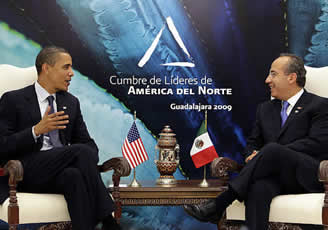
Los presidentes de México y EU y el premier canadiense abordarán temas económicos; la cumbre arrancó pasando las 17:00 horas, luego de que Obama llegara a Guadalajara.
Felipe Calderón y Barack Obama iniciaron la reunión bilateral de la cumbre norteamericana. Felipe Calderón y Barack Obama iniciaron la reunión bilateral de la cumbre norteamericana.

El presidente Felipe Calderón inició una reunión bilateral ampliada con el primer ministro de Canadá, Stephen Harper, con quien aborda temas de movilidad laboral, comercio e inversión, así como cooperación en materia de seguridad. El encuentro, que tiene lugar en uno de los salones del Instituto Cultural Cabañas de esta ciudad, inició pasando las 17:00 horas en el marco de la Cumbre de Líderes de América del Norte.

A los 20 minutos de iniciar la reunión, se permitió la entrada a los representantes de los medios de comunicación, momento en el que Calderón, quien lucía una corbata azul, y Harper se dieron un fuerte apretón de manos y sonrieron para la foto.

Para ingresar al lugar tanto la prensa nacional como extranjera, debe registrar su gafete a través de un lector que registra el código de barras.

En la entrevista, Calderón y Harper tratarán sobre soluciones alternativas a la imposición del gobierno de Canadá del requisito de visa a los viajeros mexicanos, con el objeto de revertir esa medida implementada el 13 de julio.

El premier canadiense y su comitiva fueron recibidos por la directora general Adjunta de Ceremonias, María Teresa Mercado y posteriormente, por el Ejecutivo federal mexicano.

La comitiva mexicana está integrada por la canciller Patricia Espinosa y los secretarios de Gobernación, Fernando Gómez Mont; de Economía, Gerardo Ruiz Mateos; del Trabajo, Javier Lozano, además del embajador de México en Canadá, Francisco Barrio Terrrazas.

Por el gobierno de la hoja de maple están el ministro de Seguridad Pública, Peter Van Loan; el de Estado para Asuntos Exteriores, Peter Kent; el subsecretario para Gabinete-Política Exterior y Defensa, Claude Carriere, y el embajador de Canadá en México, Guillermo Rishchynski.

También están el secretario principal de la Oficina del Primer Ministro, Ray Novak; el secretario de prensa de la oficina del premier, Dimitri Soudas y de la oficina del primer Ministro, Roos O»Connor.

En términos comerciales, el intercambio bilateral entre ambos países ascendió a 22,200 millones de dólares en 2008, equivalente a seis veces lo que se alcanzó en 1993, antes de la firma del Tratado de Libre Comercio (TLC).

Freaky Sleep Paralysis: Being Awake in Your Nightmares


(By: Wired.com)

You wake up, but you can’t move a muscle. Lying in bed, you’re totally conscious, and you realize that strange things are happening. There’s a crushing weight on your chest that’s humanoid. And it’s evil.

You’ve awakened into the dream world.

This is not the conceit for a new horror movie starring a ragged middle-aged Freddie Prinze Jr., it’s a standard description of the experience of a real medical condition: sleep paralysis. It’s a strange phenomenon that seems to happen to about half the population at least once.

People who experience it find themselves awake in the dream world for anywhere from a few seconds to 10 minutes, often experiencing hallucinations with dark undertones. Cultures from everywhere from Newfoundland to the Caribbean to Japan have come up with spiritual explanations for the phenomenon. Now, a new article in The Psychologist suggests sleep researchers are finally figuring out the neurological basis of the condition.

“This research strongly suggests that sleep paralysis is related to REM sleep, and in particular REM sleep that occurs at sleep onset,” write researchers Julia Santomauro and Christopher C. French of the Anomalistic Psychology Research Unit, Goldsmiths, at the University of London. “Shift work, jet lag, irregular sleep habits, overtiredness and sleep deprivation are all considered to be predisposing factors to sleep paralysis; this may be because such events disrupt the sleep–wake cycle, which can then cause [sleep-onset REM periods].”

In other words, you experience just a piece of REM sleep.

As David McCarty, a sleep researcher at Louisiana State University Health Sciences Center’s Sleep Medicine Program, explained it, humans tend to think about the elements of the different stages of sleep as packaged nicely together. So, in REM sleep, you’re unconscious, experiencing a variety of sensory experiences, and almost all of your muscles are paralyzed (that’s called atonia).

“But in reality you can disassociate those elements,” McCarty said.

In sleep paralysis, two of the key REM sleep components are present, but you’re not unconscious.

Narcolepsy, which can be linked with sleep paralysis, has a similar pathology. For narcoleptics, some of the elements of rapid eye movement can “come out of nowhere,” he McCarty said.

Sleep paralysis was first identified within the scientific community by psychologist Weir Mitchell in 1876. He laid down this syntactically old-school, but accurate description of how it works. “The subject awakes to consciousness of his environment but is incapable of moving a muscle; lying to all appearance still asleep. He is really engaged in a struggle for movement fraught with acute mental distress; could he but manage to stir, the spell would vanish instantly.”

But the condition lived in folklore long before anyone tried to subject it to even semi-rigorous study. The various responses have fascinated some researchers and they were cataloged in the 2007 book, Tall Tales About the Mind and Brain. In Japan, the problem was termed kanashibar. In Newfoundland, people called it “the old hag.” In China, “ghost oppression” was the preferred nomenclature.

A study released earlier this year found that more than 90 percent of Mexican adolescents know the phrase “a dead body climbed on top of me” to describe the disorder. More than 25 percent of them had experienced it themselves.

Having an element of REM sleep mix with your consciousness is scarier than it sounds. I experienced sleep paralysis on several occasions when I was in college. I can testify: It’s run-to-your-mama scary.

In my case, it would happen right as I was falling asleep on the two twin beds that I had taped together. The most vivid time, I “woke up” with the uneasy feeling that something awful was to my left, on the border of my peripheral vision. I couldn’t really see it, but I knew that it was evil and coming closer to me. I felt true terror, like you experience when you are about to get in a car crash. I was sure it was going to hurt me.

After a few minutes, I could finally move and took the opportunity to run across campus to a friend’s house and asked to sleep on the couch. With the lights on. It happened a few more times.

Then, it just stopped. It hasn’t ever happened again.

The good news, McCarty said, is that my experience is actually pretty standard. Sleep paralysis rarely persists or causes serious life damage.

“It’s very common, way more common than people realize, but usually it doesn’t recur,” he said. “It’s not frequent enough to make people come in and ask the doctor for help.”

Denial of Service Attack Knocks Twitter Offline (Updated)

(By: Wired.com)
By Eliot Van Buskirk
August 6, 2009
10:06 am
Categories: Social Media

Twitter was shut down for hours Thursday morning by what it described as an “ongoing” denial-of-service attack, silencing millions of Tweeters. It’s the first major outage the service has suffered in months and possibly the first ever due to sabotage. The outage appeared to begin mid-morning, EST, and affected users around the world.

The first official word about the outage came in a terse statement on Twitter’s status blog: “Site is down — We are determining the cause and will provide an update shortly.” That was followed by a more relaxed post on the main Twitter blog by co-founder Biz Stone, which nevertheless gave no indication of how the defense was going — or how long the service might be down.

“On this otherwise happy Thursday morning, Twitter is the target of a denial of service attack,” wrote Stone. “Attacks such as this are malicious efforts orchestrated to disrupt and make unavailable services such as online banks, credit card payment gateways, and in this case, Twitter for intended customers or users. We are defending against this attack now and will continue to update our status blog as we continue to defend and later investigate.”

A spokeswoman for Spark Capital, a major investor in Twitter, wouldn’t offer an official statement but implied that the company isn’t overly concerned about the outage and expects the site to come back online soon.

In a denial-of-service attack, a malicious party barrages a server with so many requests that it can’t keep up, or causes it to reset. As a result, legitimate users can only access the server very slowly — or not at all, as appears to be the case here.

Not only was the site down, but client applications that depend on the Twitter API could also not connect to the service, creating a complete Twitter blackout. According to June ComScore numbers Twitter has more than 44 million registered users and its user base has been growing rapidly for months as it becomes better known in the mainstream.

In the early minutes of the outage, we confirmed it in two New York boroughs and received word that it was down in Brazil as well. At that point, Twitter apparently didn’t know what had hit it. Subsequently readers saying they were in Russia, Denmark, Chile, the UK, Hong Kong, France and the Netherlands all weighed in below. Some were taking it in stride — “Too many toilets flushing tweets!” wrote one, in reference to a Wired.com story. Others urged the rest of us to “get a life.”

The world won’t come to a complete standstill as a result of the Twitter outage, of course, but its impact will be felt far and wide. The popular short messaging service has become an integral part of the communications ecosystem — our first question was, how do you confirm Twitter is down without Twitter? — and from its millions of inveterate users, we expect an outpouring of pent-up Tweeting when this gets sorted out.

An extended outage could have an impact on the spread of information — videos, music, and articles like this one — to say nothing of a growing number of businesses which depend on the service. The resiliency of the service as it begins to fashion a business plan and cater to enterprise customers would also be a concern to Twitter, which, in the glamorous tradition of Silicon Valley startups, makes no money but has big ambitions.

Twitter hasn’t had a significant outage since May 8, and has shown improved reliability since last year, when such outages were a regular occurrence. The last scheduled maintenance we know about was on June 16 — delayed by a day at the urging of the US State Department. This was during the height of the anti-government protests in Iran, much information was being disseminated to the world via Twitter, and the maintenance window, in the middle of the night in California, would have been prime daylight hours in Tehran.

We experienced a seemingly unrelated problem when accessing the Twitter blog through Google. The page greeted one Wired.com employee with an error message beginning “We’re sorry… but your query looks similar to automated requests from a computer virus or spyware application. To protect our users, we can’t process your request right now.” Another Wired.com employee was able to access the page as usual, with no virus warning. But with other users encountering the same error message, we wondered whether today’s Twitter outage was somehow related to Google’s virus warning. Judging from Twitter’s admission that it is under a denial-of-service attack, that appears to have been the case.

Why Is Obama’s Top Antitrust Cop Gunning for Google?

(By: Wired.com)


Christine Varney’s blunt assessment sent a buzz through the audience at the National Press Club in Washington, DC. Varney, a partner at Hogan & Hartson and one of the country’s foremost experts in online law, was speaking at the ninth annual conference of the American Antitrust Institute, a gathering of top monopoly attorneys and economists. Most of the day was filled with dry presentations like «Verticality Regains Relevance» and «The Future of Private Enforcement.» But Varney, tall and professorial, did not hide her message behind legalese or euphemism. The technology industry, she said, was coming under the sway of a dominant behemoth, one that had the potential to stifle innovation and squash its competitors. The last time the government saw a threat like this—Microsoft in the 1990s—it launched an aggressive antitrust case. But by the time of this conference, mid-June 2008, a new offender had emerged. «For me, Microsoft is so last century,» Varney said. «They are not the problem. I think we are going to continually see a problem, potentially, with Google.»

Coming from Varney, it was a particularly damning comparison. As an attorney who represented Netscape in the late 1990s, she was instrumental in painting Bill Gates and company as overeager bullies. Now, Varney was suggesting that Google was repeating Microsoft’s expansionist behavior. Instead of dominating the desktop, Varney said, Google was starting to colonize the emerging cloud-computing industry, amassing «enormous market power» and potentially creating an ecosystem that customers would be powerless to escape. She acknowledged that her remarks might ruffle some feathers at Google headquarters in Mountain View, California. «If any of my colleagues or friends from Google are here,» she said, «I invite you to jump up and scream and yell at me.»

Nobody took her up on that offer. But it is safe to assume that plenty of Googlers were jumping and screaming six months later when President Obama appointed Varney head of the Justice Department’s antitrust division, making her the government’s most powerful antimonopoly prosecutor. On May 11, during her first public speech on the job, Varney made it clear that her stance had not changed much since her presentation at the conference: She planned to take a forceful approach to applying the nation’s antitrust laws. «In the past, the antitrust division was a leader in its enforcement efforts in technology industries, and I believe we will take this mantle again,» she said. She did not mention Google by name, but there was little doubt to whom she was referring.

Ever since its founding 11 years ago, Google has seen itself as one of the Good Guys. Founders Larry Page and Sergey Brin conceived their company as a kind of public trust. «We believe a well-functioning society should have abundant, free, and unbiased access to high-quality information,» they wrote in the run-up to Google’s IPO five years ago, a goal that requires «a company that is trustworthy and interested in the public good.» They created a touchy-feely work environment with perks like onsite laundry facilities and free food. Prospective hires were grilled on not just their technical expertise but also their ethics—whether they were «Googley.» Google’s self-image was pithily summed up in its famous founding credo: «Don’t be evil.»

For most of its history, investors, users, and tech gurus shared Google’s view of itself. After all, the company’s rise to prominence—on the back of search algorithms so powerful and elegant they changed the Internet forever—is a case study in heroic entrepreneurialism. Its long-tail business model gives even the smallest Web sites a chance to make money. It routinely creates and distributes great products for free, even when there is no obvious benefit to the company. Its spirit of openness and collaboration laid the groundwork for the mash-upable, user-generated modern Web.
But recently, Google’s size and ambitions have begun to obscure its halo. Advertisers have watched nervously as the company’s share of the search-advertising market has jumped to 75 percent from 50 percent over the past three years. In 2007, Google attracted a yearlong antitrust review from US and European regulators after it announced plans to acquire online ad firm DoubleClick. In 2008, the DOJ swatted down a search-ad deal Google had made with Yahoo, arguing that it «would have furthered [Google’s] monopoly.» The company is currently under investigation by the DOJ for its ambitious book-scanning project, which aims to make every book ever published searchable on Google. And the Federal Trade Commission is looking into whether the Apple board seats held by Google CEO Eric Schmidt and board member Arthur Levinson violate federal antitrust law.

For much of its history, Google has responded to most criticism with two words: Trust us. The company has repeatedly persuaded skeptics that its immensity is a mere byproduct of its altruistic mission and that the algorithms it uses to organize the Internet, while proprietary, are objective and benevolent. But in an economy destroyed by bad faith, secretive formulas, and complicated mathematics, trust is in short supply, and Google’s assurances are losing their persuasive power. More than 15 years ago, federal regulators began making Microsoft the symbol of anticompetitive behavior in the tech industry. Now, a newly activist DOJ may try to do the same thing to Google.

Cómo atraer tráfico a tu sitio en red

by: CNNExpansión.com

Los expertos dan consejos para que las páginas de los pequeños negocios consigan más
visitantes; existen 3 elementos clave de un buen sitio Web: contenido, diseño y visibilidad ante los buscadores.

Un buen sitio de Internet es la puerta de entrada para potenciales clientes de tu empresa.
El sitio del despacho Conroy & Weinshenker no ofrece una guía clara de los contenidos del sitio.

Si tienes un pequeño negocio y necesitas aumentar tu mercado en la Web, tienes que empezar por definir a tu audiencia y dirigirte a ella. «Atraer el tráfico de búsqueda local es mucho más fácil que optimizar un sitio Web para una audiencia nacional o internacional», como dice Pamela Swingley de Savvy Internet Marketing, en Orinda, California. «La búsqueda local está empezando a tomar forma».
Hay tres elementos clave en los que necesitas enfocarte: contenido, medidores del motor de búsqueda y diseño.

Si tienes buen contenido, eso es un buen comienzo. «Lo mejor que puedes hacer es tomarte un tiempo y pensar en las tres cosas más importantes que un cliente quiere ver en el sitio», como recomienda Tom Grant, productor ejecutivo Web en Blue Ray Media, en Denver.

Si tienes un despacho legal, tu sitio debe resaltar las áreas de derecho en las que se concentra tu compañía, pero deberías ofrecer a tus visitantes más información. «Los clientes potenciales querrán saber si has tomado casos como los suyos. El sitio los debería ayudar a resolver sus preguntas», como dice Grant. «Algunas áreas del sitio pueden comenzar a resolver esa pregunta, pero cada una debería ofrecer más detalles de cada área de práctica».

Todas las secciones de tu sitio deben tener una explicación de lo que es y cómo afecta a las personas. Una firma legal puede ir más allá creando una sección de «Anécdotas de los clientes», donde pueda ofrecer a sus clientes una idea de cómo son los casos típicos que maneja.

«Esto les ayudará a conocer sus éxitos y les dará más probabilidades de llamarles en caso de que los casos se parezcan», dice.

Consejos de los expertos

Tomando como ejemplo el caso del sitio Web del depacho Conroy & Weinshenker, en Concord, Carolina del Norte, los expertos hacen una serie de recomendaciones.

Una manera de darle forma a las páginas especializadas por área es ofreciendo artículos de cada una. Muchas personas que necesitan asesoría legal intentarán encontrar respuestas por sí mismos antes de tomar otras acciones. Si publicas artículos, los clientes potenciales apreciarán la información gratuita y también tomarán más en cuenta a los abogados que las escribieron.

«Ellos piensan que si alguien está escribiendo de ese tema es porque sabe lo que está diciendo», como dice Grant. «Te das a conocer como un experto».

Comparte tus consejos

Si creas enlaces a recursos útiles, eso también te ayudará a aumentar tu credibilidad. La sección de «bancarrotas» de la página de Conroy & Weinshenker cuenta con un enlace a una clase de consejos crediticios recomendables, y explica el proceso de obtener un certificado de terminación. Este modelo es bueno, y se debería seguir en otras páginas. Por ejemplo, se puede crear conexiones entre visitantes al sitio Web en el que deben pagar las multas de tráfico, o a una página con información detallada de los abogados de divorcio de la misma región.

Para que el contenido esté siempre actualizado, intenta actualizar al menos un artículo al mes. Esto te da una ventaja adicional: le dice a los motores de búsqueda que tu información es relevante en cuanto a temporalidad; también podrías darle un propósito distinto a tus artículos si los mandas a manera de boletín regular a tus suscriptores.

«Si tu lema es «un despacho de por vida», deberías asegurarte de que tus servicios vayan más allá de los clientes que ya tienes y atiendas las necesidades de los prospectos de clientes», como dice Grant. «Algunos clientes no se dan cuenta de que tienes experiencia en más áreas, por lo que con esto estarán al tanto de que sigues ahí».

Ayuda a los motores de búsqueda

Al expandir tu contenido también estás impulsando la optimización de los motores de búsqueda (SEO, por sus siglas en inglés). Esto se logra porque tus artículos y enlaces estarán llenos de palabras clave que los motores de búsqueda encuentran cuando se realiza una búsqueda general en varios sitios.

La empresa de Grant, Blue Ray Media, ha trabajado en los sitios Web de varios despachos de abogados y ha mantenido registro de sus «puntos de entrada». «Vimos que los artículos con historias y estadísticas son los más visitados, particularmente con los despachos que actualizan sus noticias y artículos de forma regular», dice.

También puedes reforzar la optimización de motores de búsqueda reorganizando las páginas de tu sitio. Por ejemplo, las páginas de «Áreas de práctica» comprenden la parte más informativa de tu sitio. Para enfatizar su importancia tanto entre los motores de búsqueda como entre tus visitantes, Grant sugiere que los enlistes en una barra lateral que aparezca en todas las páginas de tu sitio, incluyendo la principal.

Recuerda que los enlaces rotos de tu página disuadirán a los clientes y enviarán al motor de búsqueda a otros sitios. Procura corregirlos.

«Da la impresión de que no te importa o no estás poniendo atención en los detalles», como dice Grant. «Definitivamente quiero que mi abogado ponga atención en los detalles».

Atender el mercado local

Las etiquetas de tu sitio describen su contenido. Un buen primer paso para capturar el tráfico local es incluir el lugar en el que estás y tu metro más cercano en todas las palabras clave de tus etiquetas.

Si formas parte de la Sección Amarilla en línea y de otras herramientas de búsqueda local como Google Maps y Yahoo Local, pero no estás evaluado en ninguno de esos sitios, lo que debes hacer para maximizar tu visibilidad es hacerte de testimonios de tus clientes y crear más enlaces relacionados a tu página desde otros sitios.

Puedes ir más allá de los motores de búsqueda tradicional estableciéndote en sitios de enfoque local, como Yelp, Judy’s Book y Citysearch.

«Cuando tienes que seleccionar algo tan importante como un servicio legal, las referencias son muy importantes», dice Swingley. «Es de suma importancia que hagas un monitoreo de lo que otros dicen de tus servicios y que ayudes en tus reseñas. Haz todo lo que puedas para animar a tus clientes a escribir sus comentarios».

Swingley sugiere que realices enlaces recíprocos a los programas comunitarios y asociaciones a las que perteneces, incluyendo la Cámara de Comercio y las oficinas de negocios. También intenta crear relaciones con los blogueros locales y tu canal de televisión local.

«Los enlaces de calidad nunca son suficientes», dice. «Si tu despacho es mencionado en la prensa, pide un enlace al sitio. Intercambia enlaces con profesionales que hagan referencia a tu negocio e incluye tu sitio Web cada vez que contestes una pregunta en algún foro, como Yahoo Answers o foros relacionados a tu área de especialización, como InjuryBoard.com».

Diseño

El trabajo no se acaba después de traer tráfico a tu sitio. Todos los enlaces y la información que tengas no valdrán la pena si tu sitio está desordenado y no es profesional.

«Si el diseño general no le hace justicia a tu despacho, escoge un solo tema y quédate con él», como dice Grant.

Si tu página de inicio es la «cubierta» del resto del sitio, le hace falta algo de brillo. El primer problema que detecta Grant es el color; «trata de utilizar sólo dos o tres colores, como azul y blanco y marcos dorados».

Anímalo un poco con imágenes y reorganiza la información que presentas para que los clientes pasen de la página de inicio directamente a la información que buscan.

«Si la página de inicio carece de jerarquía, debes saber que nada es más importante que nada», dice Grant. «Todo parece ser un desorden gráfico y no hay énfasis en lo que la gente busca con este sitio».

Grant se percató de que sólo hay una imagen en algunos sitios, en este caso es la foto de la corte bajo la página de «Contacto». Él recomienda que simplifiques la imagen y la apliques en el resto de las páginas, quizá junto con el logo de tu despacho. Esto generará cierta consistencia y contexto para que la gente relacione la imagen con tu empresa.

También asegúrate de no dejar que las herramientas de navegación desaparezcan mientras tus clientes navegan, lo que ocurre frecuentemente con algunos sitios. Mantén los tabuladores de forma consistente en todas las páginas de tu sitio.

En las páginas secundarias, intenta incluir imágenes relevantes, sobre todo en tu página de «Información de la empresa». «Si no hay gente ahí, es genérico; las fotografías de abogados y equipo de trabajo lo hacen más memorable», dice Grant.

Arregla las páginas de biografías para que tus visitantes sepan qué esperar. Si parece que cada enlace de un nombre te llevará a su biografía, hazlo, no dejes enlaces vacíos.

Una vez que arregles la parte estética, añade elementos que ayuden a los visitantes a relacionarse contigo, por ejemplo, crea una página de contacto con información básica para que llenen. Deja que los clientes potenciales elijan el área legal de un menú de opciones y escriban sus preguntas. Este tipo de información te traerá clientes y evitará los correos no deseados, pues tendrás una lista de correos electrónicos de tus contactos.

Swingley recomienda que busques un acuerdo de mercadeo en tu sitio, como media hora de asesoría gratuita o un descuento en la primera consulta; esto ayudará a aumentar el tráfico.

«Lo primero que pasa por la mente de muchos cuando consideran contratar un abogado es que les va a salir caro», dice. «Facilítales el principio».

Fight Fat With More Fat

(By: Wired.com)

* By Hadley Leggett Email Author
* July 29, 2009 |
* 1:02 pm |
* Categories: Biology, Health, Medicine

The latest candidate for an obesity-fighting wonder drug is not what you’d expect: It’s fat.

Adding fat sounds like a strange way to curb obesity, but scientists think boosting “brown fat” — a special kind of fat that burns calories to keep people warm — might bump up metabolism and help take off pounds. Now, researchers have figured out how to turn skin cells into brown fat that sucks up energy when transplanted into mice. They’re hoping a similar strategy could someday work in people.

“Brown fat is one of the body’s natural defenses against obesity,” said cell biologist Bruce Spiegelman of Harvard Medical School, who co-authored the paper published Wednesday in Nature. “We’re trying to tap into a natural pathway involved in this kind of biology.”

Previously, scientists thought only small mammals and newborn babies harbored brown fat. But in April, three different research teams reported the presence of metabolically active brown fat in adults, located on the front of the neck and around the spine.

“It looks like it’s present in different amounts in various people,” said endocrinologist Francesco Celi of the National Institutes of Health, who was not involved in the research. Heavier people appear to have less brown fat, while slim folks have more. Scientists have speculated that increasing stores of the energy-burning fat might help maintain a proper weight, but until now, making brown fat was a mystery.

Now, Spiegelman and colleagues have identified two proteins that act as molecular “switches” to turn on the production of brown fat. In the lab, the scientists forced young skin cells from both mice and humans to make these proteins, which then transformed the skin cells into what looks and acts like natural brown fat.

kajimura-ebat-11The fat is brown because it contains extra blood vessels and mitochondria, the energy factories of the cell. But unlike most cells, which take up glucose and turn it into chemical energy, brown fat sucks up glucose and generates heat instead.

“The purpose of brown fat is to be able to burn energy upon request,” Celi said. “The classical experiment is placing a rodent in a cold room at 4 degrees Celsius. The animal is able to maintain its core temperature by burning energy, and the amount of energy that’s consumed goes up in a very substantial manner through the increased metabolism of brown adipose tissue.”

Like natural brown fat, the engineered cells burned calories at an astonishing rate. When transplanted into mice, the artificial fat consumed even more energy than expected.

“The engineered brown fat cells have same thermogenic program, but it’s not regulated by hormones the way the natural brown fat cells are,” Spiegelman said. Instead of needing to be activated by a specific chemical messenger, the engineered fat cells are always active. “They’re basically in the on position all the time.”

Being stuck in the on position might not be a bad thing, Spiegelman said. It could mean that less of the engineered fat would be needed to boost metabolism and help people lose weight. “Now that we all know that brown fat can be engineered, and that adult humans have brown fat, the question is how much does it take to alter the metabolism of a human?” he said.

The researchers see two ways their findings could translate into treatment for obesity: Either a person’s own cells could be used to make a brown fat implant, or a drug could be developed that turns on the production of brown fat inside the body.

“If we could find chemical that turns this pathway on, that would be ideal,” Spiegelman said.

Don’t expect a brown fat treatment anytime soon, though. Humans evolved to conserve energy, not waste it, and so far our clever bodies have managed to foil nearly all of scientists’ attempts to treat obesity. Even if researchers can find a safe way to make extra brown fat, Celi said, the body might compensate for lost energy by eating more or slowing down other aspects of metabolism.

“It’s a very sound and solid study,” he said. “In the long run, this could be a strategy. But from this data to the clinic, there is a long, long time.”