Twitter and the telegraph

(By: kottke.org)

The 140-character limit of Twitter posts was guided by the 160-character limit established by the developers of SMS. However, there is nothing new about new technology imposing restrictions on articulation. During the late 19th-century telegraphy boom, some carriers charged extra for words longer than 15 characters and for messages longer than 10 words. Thus, the cheapest telegram was often limited to 150 characters.

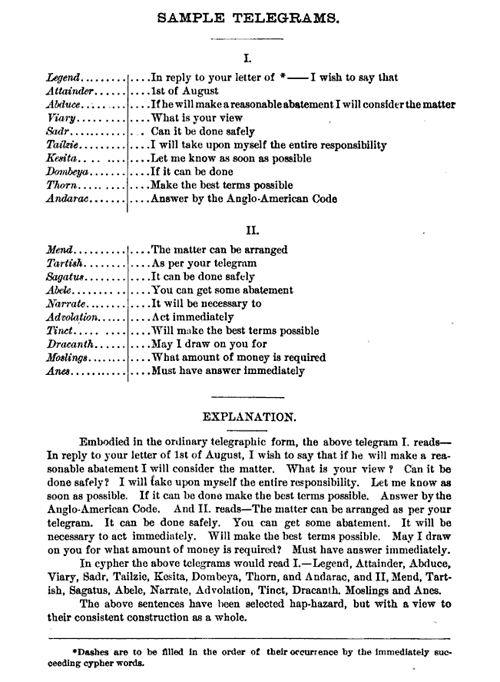
Schott also shares about 100 words from The Anglo-American Telegraphic Code, a code book that reduced long phrases into single words in order to cut down on telegraphic transmission costs. The full book is available for reading on Google and it includes over 27,000 code words on 460 pages!

13 Things to Do on Twitter Besides Tweet

(By: Mashable)

Thanks to an open API and a philosophy of interconnectivity, Twitter (Twitter)’s vast array of third-party services has you covered on a number of alternative uses for the famed microblogging tool.

Let’s take a look at a few of them.

1. Share Files

A service called FileSocial provides a great way to send files smaller than 50 MB. Simply sign-in with your Twitter credentials to share your file with all your followers. FileSocial uses OAuth to log you in, which is more secure than asking for your Twitter username and password.

If you want to send a person-to-person file privately, check out FileTwt. You’ll have to sign up for an account on the site to enable private file-sharing up to 20 MB in size. The downside is they don’t use OAuth for authentication.

2. Exchange Business Cards

twtBizCard

Routinely running out of those business cards made of dead trees? Work in an industry where almost everyone you meet is on Twitter? Check out twtBizCard, a simple service that lets you set up an electronic business card that can be easily tweeted to your new contacts by sending them an @reply with the hastag #twtBizCard.

When you sign up, the service will pull in the data from your Twitter profile as starter information, and you can add other details to customize your card.

3. Share Music

SONGZA

Music lovers have a lot of options in this category (see 10 Ways to Share Music on Twitter). Depending on exactly what you want to do, you might want to check out a few of these. For example, Blip.fm (Blip.fm) is very much like Twitter but specifically for music, and can integrate with your Twitter account to share what tracks you’re listening to or “blipping.»

To that list we’d also like to add Songza, a very easy to use music search engine that lets you easily tweet any track you’re listening to by clicking the song name and selecting the “Share: Twitter this” option.

4. Share Images

flickr2twitter-best

The media-specific Twitter tools abound, with a goodly number of options available for image sharing here too. Perhaps the “classic” service here is Twitpic (Twitpic), but even beyond image hosting services there are a number of alternative methods for sharing photos on Twitter by SMS, email and more.

To this list we’d also like to add that Flickr added Twitter posting earlier this summer as well, so if you already use Flickr (Flickr) to host your image collection, this is a great way to also share photos to Twitter in one fell swoop.

5. Share Videos

12s

To round out the media-specific categories, there are also third party services lining up to help you share video on Twitter as well. From TwitVid.io to Tweetube (which handles other sharing duties as well), there’s probably a service out there to cover your needs.

We’d also like to add TwitVid.com (TwitVid.com) and 12seconds.TV (12seconds.tv) to that list. The latter perhaps obviously limits you to only 12 seconds’ worth of video, but it meshes well with the spirit of Twitter’s 140 character homage to brevity.

6. Raise Money

Twitpay

It’s still an emerging trend, but Twitpay is out in front of the microtransaction platform pack on Twitter. It’s a hot space that Facebook is looking to get in on as well.

There are still some limitations to using Twitpay as a Twitter payment platform, but for the adventurous there could be money to be made from selling your own wares via the service. Or, take a cue from Wi-Fi startup SkyBlox, who used Twitpay to raise a portion of their funding via Twitter.

7. Lobby for Health Care Reform

tweetyoursenator

Want to bring a little participatory democracy to your Twittering? Check out Tweet Your Senator, a feature of the President’s website that mashes up Twitter with Google Maps to help you send a message to your Senator about healthcare reform legislation.

8. Screencast

screenr

Looking for a one-stop shop to whip up a quick screencast and distribute it on Twitter? Check out Screenr, a screencast tool with seamless Twitter integration.

You have 5 minutes to record your videos including the ability to pause and restart, and you can preview the screencast before sending it out.

9. Play Games

spymaster-agency-options

Love it or hate it, interactive Twitter-based game Spymaster can be addictive if you play it, or insanely annoying if you don’t. If you’re interested in playing, or just finding out more about the mechanics of the game and what it’s all about, be sure to check out our comprehensive Complete guide to Spymaster. And please don’t assassinate us.

Spymaster isn’t the only game in town, either. Check out some of these other alternatives for getting your Twitter game on as well.

10. Social Bookmarking

fleck-lite

Delicious (Delicious), diigo, et al feeling like too much overkill? Or just looking for an easy way to archive the links you share on Twitter?

Enter Fleck Lite, a simple bookmarklet-based tool that will both generate a shortened URL based on the page you’re sharing and archive the collection of links you’ve shared for later reference. If you share a lot of links on Twitter and want a convenient way to remember them for later, definitely give this one a try.

11. Be Someone Else

ctwitterlike2

Ever wanted to know what Twitter looks like through another user’s eyes? Wonder no more: cTwittLike is an application that lets you see the Twitter stream someone else would see. Just enter the Twitter name of the person whose shoes you want to walk in, and you’ll get a list of the latest tweets from the users being followed by that person.

Unfortunately, due to lots of attention from the interwebs this app is currently down. But hopefully you’ll be able to return to your regular schedule of Twitter voyeurism soon.

12. Start a Petition

actly-petition

Looking to change the world but don’t know where to start? Petitions are a powerful tool organizers have been using for decades to raise awareness, demonstrate support for an issue, and bring people together around a common cause.

Check out several startups helping you start petitions on Twitter, from Act.ly (act.ly) to Twitition and more.
13. Find a Job

tweetmyjobs

This is sure to be a popular one in today’s economy, or lack thereof. No single service will seal the deal for you, but check out our guide to landing your next paycheck via Twitter.

From finding new people to follow in your industry to making use of tools like TweetMyJobs, Twitter offers an unprecedented chance to find out about new opportunities and connect with potential employers in real-time.

What else can you use Twitter for besides our daily dosages of pointless babble?
Wired Science News for Your Neurons Courtroom First: Brain Scan Used in Murder Sentencing

(By:Wired.com)

1004203086_7c20f31223_o
A defendant’s fMRI brain scan has been used in court for what is believed to be the first time.

Brain scan evidence that the defense claimed shows the defendant’s brain was psychopathic was allowed into the sentencing portion of a murder trial in Chicago, Science reported Monday. Brian Dugan, who had been convicted of the rape and murder of a 10-year old, was sentenced to death, despite the fMRI scans.
“I don’t know of any other cases where fMRI was used in that context,” Stanford professor Hank Greely told Science.
While the possibility of using fMRI data in a variety of contexts, particularly lie detection, has bounced around the margins of the legal system for years, there are almost no documented cases of its actual use. In the 2005 case Roper v. Simmons, the Supreme Court allowed brain scans to be entered as evidence to show that adolescent brains work differently than adult brains.
That’s a far cry, though, from using fMRI to establish the truth of testimony or that specific structures within an individual defendant’s brain are legally relevant.
It’s difficult to tell whether the Dugan case will be a watershed moment in the use of brain scan evidence in court, or if the evidence impacted the decision in this case.
“The penalty phase of a capital case … is a special situation where the law bends over backwards to allow the convicted man to introduce just about any mitigating evidence,” Greely noted.

Earlier this year, Wired.com reported on another attempt to use fMRI evidence in which Greely’s MacArthur Foundation Law and Neuroscience Project was involved. In that case, fMRI evidence was entered into a juvenile sexual abuse case in San Diego, but was withdrawn without being admitted.
The debate over whether or not to use fMRI evidence has several dimensions. The first is whether reliable evidence can be obtained. On that score, fMRI appears to perform well. In a very small number of studies, researchers have identified lying in study subjects with accuracy ranging from 76 percent to over 90 percent (pdf). The real doubts begin to surface about whether the data will be good outside the laboratory in real settings.
“When you build a model based on people in the laboratory, it may or may not be that applicable to someone who has practiced their lie over and over, or someone who has been accused of something,” Elizabeth Phelps, a neuroscientist at New York University told Wired.com in March. “I don’t think that we have any standard of evidence that this data is going to be reliable in the way that the courts should be admitting.”
Even if the data isn’t perfect, some law theorists say it might be on par with traditional lie-detection carried out by human beings, if not better.
“It’s not clear whether or not a somewhat reliable but foolproof fMRI machine is any worse than having a jury look at a witness,” Brooklyn Law School’s Edward Cheng said. “It’s always important to think about what the baseline is. If you want the status quo, fine, but in this case, the status quo might not be all that good.”
Others like Greely argue that until studies are conducted under realistic settings, the technology should stay out of the courtroom.
One thing seems clear: If brain scan data has even a remote change of helping a defendant’s case, defense lawyers will keep to try to enter the evidence into court.

What’s Happening?

(By: Twitter Blog)

Twitter was originally conceived as a mobile status update service—an easy way to keep in touch with people in your life by sending and receiving short, frequent answers to one question, «What are you doing?» However, when we implemented the service, we chose to leave something out. To stay simple, Twitter did not require individuals to confirm relationships. Instead, we left things open.

People, organizations, and businesses quickly began leveraging the open nature of the network to share anything they wanted, completely ignoring the original question, seemingly on a quest to both ask and answer a different, more immediate question, «What’s happening?» A simple text input field limited to 140 characters of text was all it took for creativity and ingenuity to thrive.

Sure, someone in San Francisco may be answering «What are you doing?» with «Enjoying an excellent cup of coffee,» at this very moment. However, a birds-eye view of Twitter reveals that it’s not exclusively about these personal musings. Between those cups of coffee, people are witnessing accidents, organizing events, sharing links, breaking news, reporting stuff their dad says, and so much more.

The fundamentally open model of Twitter created a new kind of information network and it has long outgrown the concept of personal status updates. Twitter helps you share and discover what’s happening now among all the things, people, and events you care about. «What are you doing?» isn’t the right question anymore—starting today, we’ve shortened it by two characters. Twitter now asks, «What’s happening?»

We don’t expect this to change how anyone uses Twitter, but maybe it’ll make it easier to explain to your dad.

Google Poised to Become Your Phone Company

Google is set to become your new phone company, perhaps reducing your phone bill to zilch in the process.
Seriously.

Michael Robertson, the founder of Gizmo5

Michael Robertson, the founder of Gizmo5

Google has reportedly spent $30 million to buy Gizmo5, an online phone company. The service is akin to Skype — but based on open protocols and with a lot fewer users.
Gizmo5’s founder Michael Robertson, a brash serial entrepreneur, would only say that he could not comment on rumors when asked by Wired.com about a story TechCrunch ran Monday reporting the acquisition.
Google ignored a request for comment from Wired.com about the reported acquisition.
It’s a potent recipe — take Gizmo5’s open standards-based online calling system. Add to it the new ability to route calls on Google’s massive network of cheap fiber. Toss in Google Voice’s free phone number, which will ring your mobile phone, your home phone and your Gizmo5 client on your laptop.

Meanwhile you can use Gizmo5 to make ultracheap outgoing calls to domestic and international phone numbers, and free calls to Skype, Google Talk, Yahoo and AIM users. You could make and receive calls that bypass the per-minute billing on your smartphone. Then layer on deluxe phone services like free SMS, voicemail transcription, customized call routing, free conference calls and voicemails sent as recordings to your e-mail account, and you have a phone service that competes with Skype, landlines and the internet telephone offerings from Vonage and cable companies.
That’s not just pie in-the-sky dreaming.

Ask longtime VOIP watcher and consultant Andy Abramson, who introduced the idea of integrating Gizmo5 and Grand Central (now Google Voice), long before Google bought either.
“Google is now the the uncommon carrier,” Abramson said, punning on the iconic 7-UP commercials and the phrase “common carrier.” That refers to phone companies that operate on the traditional publicly switched network — a status that gives them benefits and obligations.
“If AT&T is Coca-Cola, Google is now 7-UP,” Abramson added.
“All of a sudden you have something that offers more than Skype,” Abramson said, saying the combo could now put Google in competition with phone and cable companies, IP telephony companies and Vonage. “But now you can do everything with Google and pay nothing and have a platform where engineers can build new things.”
In fact, Gizmo5 offered a rogue version of that service for $6 a month until last week.
On November 2, Gizmo5 abruptly canceled the two-month old “residential service,” (.pdf) which paired the free phone number available through Google Voice with Gizmo’s internet calling service to provide the equivalent of a home-phone replacement like Vonage.
Now, that service has been wiped off the internet and, more intriguingly, Google’s cache of the page disappeared the day after the acquisition was reported. (Note, this could through actions of either or both Google and Gizmo5.)
For $6 a month, Gizmo5 residential users got 300 minutes a month of outbound calling anywhere in the United States, unlimited incoming calls on their home computers or even home phones (using a broadband-to-phone network conversion box) and E911 service (which means 911 calls work like landlines calls do once you register your home address).
It’s not too surprising that offer got taken down.
For one Google is already trying to steer clear of U.S. regulators by making it clear that Google Voice isn’t a replacement for a home phone since you have to have phone service from some other company to use it. You can forward calls from a Google Voice number to your Gizmo5 number, but you must have a mobile or landline number as well.
Google doesn’t say it but clearly it hopes that restriction will keep the service from incurring the common carrier obligations attached to the regular phone system (PSTN), and the 911 and wiretapping requirements that apply to internet telephony and to traditional copper wire phones.
AT&T has already tried to sic federal regulators on Google Voice because Google is blocking outgoing calls to a handful of shady calling services — mostly free conference-calling services that exploit federal rules that let rural phone companies charge high fees to connect calls to rural areas.
AT&T itself has sued similar services that play this arbitrage game, and complaining to the feds may have only brought more attention to an issue the FCC has procrastinating fixing for too long.
Gizmo5 will also help save Google money on phone-call termination fees as users start to use computer-based clients to connect to Google Voice. That would allow Google to recoup the purchase price of $30 million in little time, if only it saves even a few dollars per user per year.
Google also gets Michael Robertson, a troublemaker with technical chops. Robertson made millions from MP3.com in the dot-com boom, despite drawing lawsuits from major record labels for creating innovative services. He was later sued by Microsoft for his startup Lindows, which made Linux installations for cheap PCs. And his current music venture, MP3tunes.com, is being sued by EMI.
Though still in invite-only mode, Google Voice has about 580,000 active users and nearly 1.5 million registered users, according to a Google filing with the FCC.
If you are interested in the combination, you might want to sign up for Gizmo5 before the acquisition is formally announced, since Google often freezes new registrations at companies it acquires until it figures out how to integrate the technology.

10 Geeky Laws That Should Exist, But Don’t

(By: Wired.com)

There are many, many laws having nothing to do with government that are useful to know because they tell you something about how the universe works. There are Newton’s laws of motion, the laws of thermodynamics, Boyle’s Law, Heisenberg’s Uncertainty Principle, among many. Most of these laws have been known for a long time, but it wasn’t until a mere 19 years ago that Godwin’s Law was written.
If you’ve ever been involved in a discussion on Usenet, or have been following politics in the past decade or so, you’ve probably encountered Godwin’s Law. While Godwin’s Law is, alas, as true today as it was then, it seems unfortunate that there aren’t more widely accepted axioms to help us geeks define the characteristics of our world.
To that end, then, here are 10 geeky laws (axioms) that should exist, but don’t … at least, they didn’t until now:

xkcd © Randall Munroe

xkcd © Randall Munroe

1. Munroe’s Law: A person in a geeky argument who can quote xkcd to support his position automatically wins the argument. This law supersedes Godwin, so that even if the quote is about Hitler, the quoter still wins.
2. Lucas’s Law: There is no movie so beloved that a “special edition,” prequel or sequel cannot trample and forever stain its memory.
3. Tolkien and Rowling’s Law: No reasonably faithful movie adaptation of a book will ever be quite as good as the book it adapts. Thus great movie adaptations can only be made out of truly amazing books.
4. Somers and McCarthy’s Law: There is no dangerous unscientific theory so preposterous that no celebrity will espouse and advocate it.
5. Jobs’s Law: No matter how well last year’s cool tech gadget still works, it will seem utterly inadequate the moment the new version comes out.
6. Savage and Hyneman’s Law: Blowing stuff up is fun. Blowing stuff up in the name of science is AWESOME.

Photo: Shawn Zamechek

Photo: Shawn Zamechek

7. Starbucks’ and Peet’s Law: C8H10N4O2, better known as caffeine, is the most wonderful chemical compound known to humankind. If the field of chemistry had never identified or produced a single other useful compound, caffeine alone would be justification enough for its existence.
8. Wilbur’s Law: Bacon makes everything better.
9. Comic Book Guy’s Law: There is no detail of a movie too brief or inconsequential to become the subject of an hours-long diatribe.
10. The Unified Geek Theory: At present, the President of the United States, the wealthiest person in the United States, and the most trusted newscaster in the United States are all geeks. At the same time, movies based on comic book characters are routinely taking in hundreds of millions of dollars. The only reasonable conclusion is: We’ve won!
Got any good ones we missed? Please list them in the comments.

Urinal protocol vulnerability

(By: xkcd)

When a guy goes into the bathroom, which urinal does he pick?  Most guys are familiar with the International Choice of Urinal Protocol.  It’s discussed at length elsewhere, but the basic premise is that the first guy picks an end urinal, and every subsequent guy chooses the urinal which puts him furthest from anyone else peeing.  At least one buffer urinal is required between any two guys or Awkwardness ensues.
Let’s take a look at the efficiency of this protocol at slotting everyone into acceptable urinals.  For some numbers of urinals, this protocol leads to efficient placement.  If there are five urinals, they fill up like this:

The first two guys take the end and the third guy takes the middle one.  At this point, the urinals are jammed — no further guys can pee without Awkwardness.  But it’s pretty efficient; over 50% of the urinals are used.
On the other hand, if there are seven urinals, they don’t fill up so efficiently:

There should be room for four guys to pee without Awkwardness, but because the third guy followed the protocol and chose the middle urinal, there are no options left for the fourth guy (he presumably pees in a stall or the sink).
For eight urinals, the protocol works better:

So a row of eight urinals has a better packing efficiency than a row of seven, and a row of five is better than either.
This leads us to a question: what is the general formula for the number of guys who will fill in N urinals if they all come in one at a time and follow the urinal protocol? One could write a simple recursive program to solve it, placing one guy at a time, but there’s also a closed-form expression.  If f(n) is the number of guys who can use n urinals, f(n) for n>2 is given by:

The protocol is vulnerable to producing inefficient results for some urinal counts.  Some numbers of urinals encourage efficient packing, and others encourage sparse packing.  If you graph the packing efficiency (f(n)/n), you get this:

This means that some large numbers of urinals will pack efficiently (50%) and some inefficiently (33%).  The ‘best’ number of urinals, corresponding to the peaks of the graph, are of the form:

The worst, on the other hand, are given by:

So, if you want people to pack efficiently into your urinals, there should be 3, 5, 9, 17, or 33 of them, and if you want to take advantage of the protocol to maximize awkwardness, there should be 4, 7, 13, or 25 of them.
These calculations suggest a few other hacks.  Guys: if you enter a bathroom with an awkward number of vacant urinals in a row, rather than taking one of the end ones, you can take one a third of the way down the line.  This will break the awkward row into two optimal rows, turning a worst-case scenario into a best-case one. On the other hand, say you want to create awkwardness.  If the bathroom has an unawkward number of urinals, you can pick one a third of the way in, transforming an optimal row into two awkward rows.
And, of course, if you want to make things really awkward, I suggest printing out this article and trying to explain it to the guy peeing next to you.
Discussion question: This is obviously a male-specific issue.  Can you think of any female-specific experiences that could benefit from some mathematical analysis, experiences which — being a dude — I might be unfamiliar with?  Alignments of periods with sequences of holidays? The patterns to those playground clapping rhymes? Whatever it is that goes on at slumber parties? Post your suggestions in the comments!
Edit: The protocol may not be international, but I’m calling it that anyway for acronym reasons.

Estadio Azteca, Adiós a las rejas

(By: Mediotiempo.com)

El proceso para quitar la malla ciclónica y las rejas, de 420 por 3 metros de altura, que separan la cancha de las tribunas en el Estadio Azteca, va viento en popa, ya que sólo resta eliminar una parte en el mediocampo, en ambas bandas, así como otra en la cabecera sur.

En un recorrido hecho este sábado, Medio Tiempo constató que poco a poco el Coloso de Tlalpan toma su ‘look europeo’, ya que ahí y en algunas otras partes del mundo, los inmuebles no pueden tener este tipo de protecciones porque por ley se considera «para prisioneros o desadapatados».

El mismo Joseph Blatter, Presidente de la FIFA, conminó hace unos meses a las diversas Federaciones de futbol en el mundo que no han seguido esta medida, lo hagan, porque incluso las rejas y mallas pueden ser una trampa mortal, como sucedió en marzo pasado en África, donde una estampida más las protecciones causaron la muerte de al menos 22 aficionados en el juego eliminatorio entre Costa de Marfil y Malawi.

De esta forma, el inmueble de futbol más importante de México se moderniza, aunque con ciertas medidas de precaución, ya que hay un foso que separa las tribunas de la cancha y ahí mismo habrá elementos de seguridad contra los «espontáneos» que quieran pisar el pasto o saltar al campo, también se colocará en el contorno una línea de alambre de púas.

Además, para mayor precaución, la malla y las rejas que existen en la cabecera norte cuya medida es de 150 metros, justo donde las porras del América, «La Monumental» y «Disturbio» se colocan en cada partido, no serán retiradas, confirmó el Ingeniero Raúl Barrios, encargado del inmueble.

Cabe recordar que en mayo de 2004, mientras América disputaba un encuentro de Copa Libertadores ante el Sao Caetano de Brasil, un sector de la porra americanista brincó al campo derribando la malla que a la postre debió reforzarse, además de que el inmueble fue sancionado.

Las rejas que hasta estos días presentaba el Coloso, datan de 1986, ya que después del Mundial que se celebró en este país fueron colocadas, por lo tanto, 23 años después verán su fin.

El Azteca se une a estadios en México de Primera División como el Tec de Monterrey, el Andrés Quintana Roo de Atlante, el Benito Juárez de Indios, el Alfonso Lastras de San Luis, el Corona de Santos Laguna y el Cuauhtémoc de Puebla, que no tienen este tipo de protecciones.

Así, el primer duelo que viviría el Estadio Azteca sin rejas en esta nueva etapa, sería el del próximo sábado 10 de octubre entre México y El Salvador, correspondiente al Hexagonal Final de CONCACAF, donde el Tri podría amarrar matemáticamente su pase al Mundial de Sudáfrica 2010.

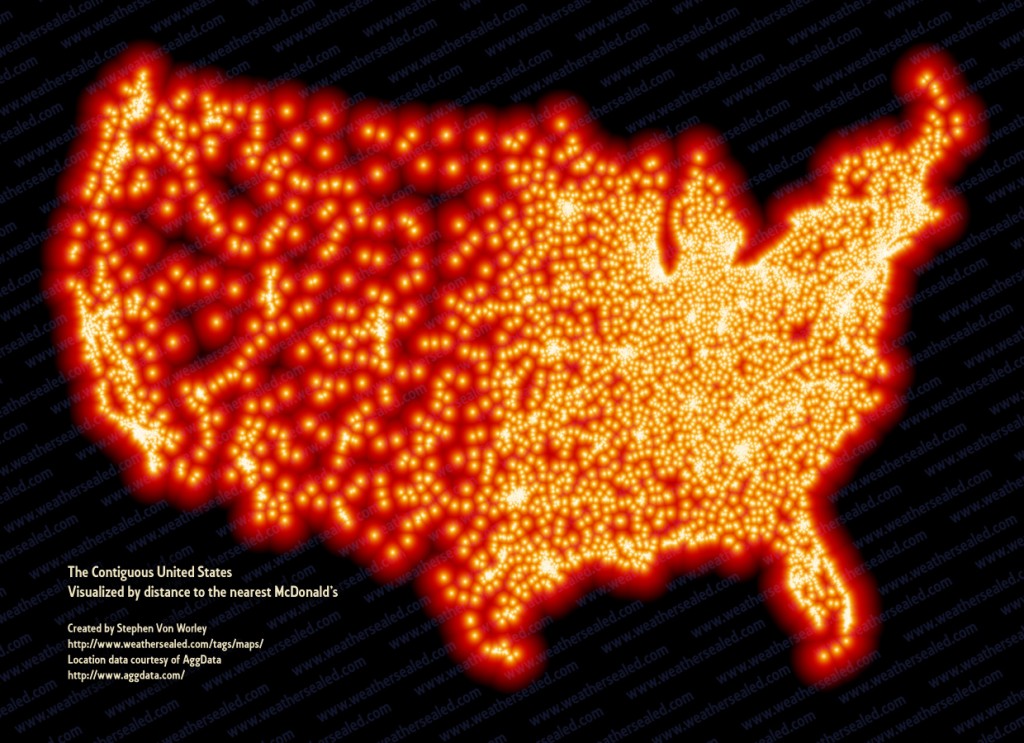
McDonald’s. Yes, They Really Are Everywhere

(By: Wired.com)

You’re looking at a map of the contiguous United States visualized by distance to the nearest McDonald’s.
I guess it’s some consolation that being on the East Coast, I don’t need to ever worry about finding one. Maybe I should worry that I can name three within ten minutes of my house.
The map was created by Steven Von Worley, who was inspired by the appearance of a McDonald’s literally in the middle of nowhere, in the Los Angelos basin. Both the map, a larger wallpaper size version, and the explanation for how it was created are here.

Won Worley warned me when I emailed him that the map isn’t perfect, however.

“In the interest of full disclosure, please note that the McFarthest Spot is
measured as the crow flies, at 107 miles.  Also ~145 miles by car, but it’s
entirely possible that there’s another location that’s closer as the crow flies,
but farther travelling on the roads.   Indeed, regarding the latter, there’s
places in the lower 48 that you can’t even drive to/from with a car – that is,
by auto, infinitely distant from MickyDee’s.”

Now if you’ll excuse me, I have a sudden craving for French fries.

I Dream of Genius: Herbal Drugs Promise Big Neural Gains

I Dream of Genius: Herbal Drugs Promise Big Neural Gains
Every pseudo-medical technician has his own brand of herbal remedies to cure your brain fuzz and make you an honor-roll star. But insta-smarts in a non-FDA-evaluated bottle? Color me skeptical.
$20  • 
#item_stats {display: none;} #item_specs {display: none;} #package_banner { display: none; }
Not that I don’t need the help: I’m taking the GRE in a few months and memorizing stacks of grad school vocab can be a little hirsute (adjective: hairy, shaggy). So I put four herbal supplements that promise enhanced brain function through several rounds of vocabulary-retention tests and GRE math drills to cull the frauds from the real deal.
Here’s how we tested: I took the allotted dose of each drug over a 48-hour period. At the same time every day, I took two GRE practice tests, one math and the other vocab-retention. The vocab test consisted of memorizing 15 new GRE words over 10 minutes, waiting a half hour, then retesting. The math consisted of 30 different problems in trigonometry, geometry and algebra. Between drugs I took a 24-hour break to (hopefully) clear out my system.
With no drugs in my system, I got these control numbers:
Vocab-Retention Score: 11/15
GRE Math Score: 22/30
A word of warning: These pills aren’t supported by FDA testing or scientific studies of their efficacy. Our testing was admittedly unscientific (N=1, a 24-year-old woman) but the results suggest that some, in fact, do work better than others. But our review’s no substitute for medical advice. So, if in doubt, consult your doctor.

Smart Nutrition Get Smart
This is a blended cocktail of every vaguely credible herbal supplement, rolled into a single pill. There’s Huperzine A (an extract from Chinese moss that prevents brain deterioration), Periwinkle extract, and Pyritinol (a drug used in Europe to aid healing in severe head trauma).
Not only did Get Smart repeatedly perform better in memory tests, I noticed the effects long after the evaluation time had ended. While testing I wrote an insightful and pithy cover letter, won a debate on the function of the Vietnam War, and finally baked a perfect chocolate soufflé. I may have even cured cancer in my sleep (unfortunately I can’t find my notes on that). In the case of Get Smart, it really was matter over mind.
Vocab-Retention Score: 15/15
GRE Math Score: 25/30
WIRED Will unleash your inner Doogie Howser. Improves focus and memory, and appears to enhance creativity.
TIRED The only thing harder to swallow than the pill’s bulky mass is its high cost — nearly a dollar per capsule. Even Steve Carrell is rolling his eyes at the name.

Natural Factors Learning Factors
Strong enough for slacker millennials, but gentle enough to feed your hyperactive tot, Learning Factors combines tuna-fish–oil extract and omega-6 fatty acids to nourish your neurons and improve concentration. Just for good measure the makers also added borage oil, an anti-inflammatory shown to decrease pain in arthritis sufferers. But for me this drug led to high performance in memory-retention tests and comprehension. Not to mention, we hear fish oil does a body good.
Vocab-Retention Score: 12.5/15
GRE Math Score: 23/30
WIRED Comes in liquid, capsules and nutrient powder. Calmed my mind and improved word retention significantly within 24 hours of use. Tuna oil is pesticide-free and dolphin-friendly.
TIRED Chewable capsules taste like peach-flavored tuna fish.

Ginkgold 60 MG
Despite conflicting scientific findings, Ginkgo biloba has been one of the most popular supplements for almost two decades and, surprise, Ginkgold is chock full of it. The claim: By improving circulation you increase the blood flow to the brain, and the ginkgo extract helps you make connections, retain information and keep focused.
Be warned: Get the dose slightly wrong and it can make you more Young Einstein than Albert Einstein. After taking the recommended dose my mind was on warp speed. But I was paranoid and loopy, too. It felt like drinking three Red Bulls and trying to meditate. I adjusted the doses, and the crazy-pill effects subdued — along with the memory help.
Vocab-Retention Score: 11/15
GRE Math Score: 22/30
WIRED You can strike Ginkgold practically anywhere (it’s widely available at natural food stores and supermarkets.)
TIRED More ups and downs than an afternoon at Magic Mountain. Increased blood flow created a series of overwhelming energy bursts, affecting quantitative test scores for the worse.

Planetary Herbals Bacopa Extract
Common to the Indian Ayurveda homeopathic medicine system, Bacopa monnieri is a flowering perennial that supposedly calms nerves and improves memory. But will it dust off your cranium? Unlikely. Bacopa extract performed the lowest in our memory tests and pretty poorly in quantitative study.
A slew of scientific evaluations show it might become more effective with long-term use, but side effects made me wary of taking it any longer than necessary. Bacopa made me groggy — and downright mopey. After a day of putzing around the house avoiding GRE books, all the studying lost was not worth any cognitive pathways gained.
Vocab-Retention Score: 7/15
GRE Math Score: 19/30
WIRED Immediate calming effects might help test-day jitters. Australian studies suggest long-term bacopa use improves short-term memory drastically. But what do Australians know? They gave the world Yahoo Serious.
TIRED Bacopa made me tired of life, tired of studying, but mostly tired of taking bacopa.


What’s your favorite study supplement? How do you use it? Submit your favorites here!